



Former U.S. national security advisor urges stronger S. Korea-U.S. economic ties to sustain alliance
Oct 16, 2026, 10:14 am


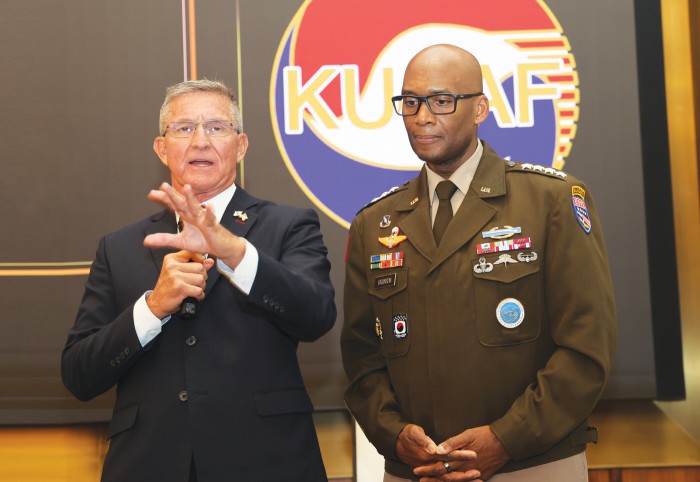 |
| Michael Flynn, former White House National Security Advisor (left), introduces Gen. Xavier Brunson, commander of United States Forces Korea, at the "Indo-Pacific Summit" co-hosted by the Gold Institute for International Strategy and the Korea-U.S. Alliance Foundation in Washington, D.C., on the 14th (local time). |
Former White House National Security Advisor Michael Flynn warned on the 14th (local time) that a U.S. president demanding the withdrawal of United States Forces Korea (USFK) will eventually emerge. Flynn, president of the Gold Institute for International Strategy, urged strengthening economic ties through expanding South Korean companies' production and investment in the United States during the "Indo-Pacific Summit" co-hosted in Washington, D.C., by the Gold Institute for International Strategy and the Korea-U.S. Alliance Foundation, stating that military cooperation alone cannot sustain the South Korea-U.S. alliance.
Flynn warned that unless the structure in which South Korea-U.S. relations rely solely on military cooperation is changed, a situation will arise where a U.S. president calls for the withdrawal of USFK, stating, "Someday a U.S. president will come in and say, 'Let's pull out all those soldiers in South Korea. Why do we need that many personnel?'" He explained that such discussions are not necessarily limited to the current Donald Trump administration, adding that debates surrounding the necessity of stationed troops have persisted in the U.S. for roughly the past 20 years.
Flynn conveyed that many Americans are asking, "South Korea is doing great. Its economy is great. So why do our troops still need to be there?" He noted that early in his military service, approximately 500,000 U.S. troops were stationed in Europe, but that number has dropped to around 65,000 today, and in South Korea, where U.S. forces once approached nearly 100,000, the presence has decreased to a "treaty level" of 25,000 to 29,000.
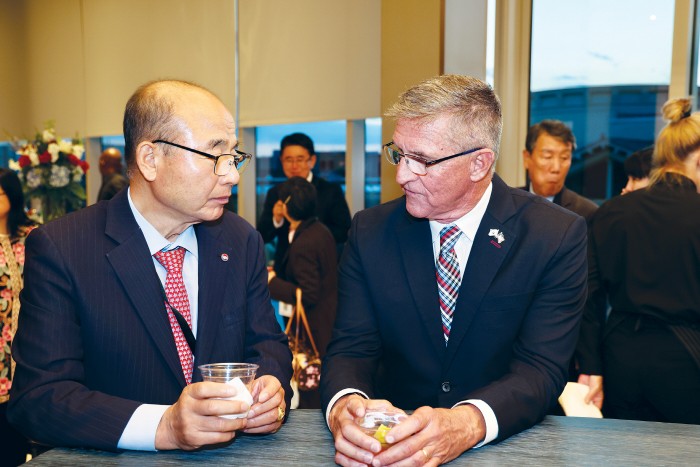 |
| Former White House National Security Advisor Michael Flynn converses with Jung Seung-jo, former Chairman of the Joint Chiefs of Staff and honorary chairman of the Korea-U.S. Alliance Foundation (left). |
Flynn says military cooperation alone is insufficient, emphasizing U.S. production by Korean firms, job links for USFK veterans
Flynn diagnosed that the "Comprehensive Strategic Alliance" mentioned by Jung Seung-jo, former Chairman of the Joint Chiefs of Staff and honorary chairman of the Korea-U.S. Alliance Foundation, currently remains largely confined to the military domain. While acknowledging that South Korea possesses a top-10 global economy and immense capabilities, and that military cooperation cannot be abandoned given North Korea's possession of nuclear weapons, he stressed that the two countries must link their relationship as closely as possible economically.
Flynn presented strong business partnerships as the best pathway to achieving peace. Emphasizing that "people do not want their factories blown up," he stressed that the bilateral relationship should be strengthened through shared economic interests.
Flynn also introduced an initiative connecting U.S. veterans who served in South Korea with employment opportunities at South Korean companies operating in the United States. He stated that he would convey the proposal—encouraging South Korean companies to prioritize hiring former U.S. service members with experience serving in Korea—to Anthony Tata, U.S. Under Secretary of Defense for Personnel and Readiness.
China security expert Thayer warns over North Korea intelligence disclosure and damaged alliance trust
Bradley Thayer, an American security expert on China and co-founder of the Committee on the Present Danger: China, pointed to the South Korean Unification Minister's disclosure of information regarding North Korean nuclear facilities as the reason behind restrictions on South Korea-U.S. intelligence sharing on North Korea.
When asked about solutions to South Korea-U.S. friction, including intelligence-sharing curbs, Thayer said it was reported that the South Korean Unification Minister disclosed information regarding an unannounced third uranium enrichment facility in North Korea. He noted that the Unification Minister maintained he was a lawmaker at the time of the remark and that the information was already public. However, Thayer explained that the U.S. and other allies take the potential disclosure of classified intelligence very seriously.
Thayer characterized the disclosure as an "extremely serious breach," arguing that in response, countries including the U.S. and Japan have restricted the sharing of certain intelligence regarding North Korea. He clarified, however, that intelligence sharing on North Korea has not been completely suspended, but is confined to specific areas.
Ha Man-joo
Most Read
-
1
Celltrion nears additional contract with major U.S..

-
2
"Aren't those foreigners on welfare?": M..

-
3
Houthis launch successive attacks on Saudi airport..

-
4
Saudi Arabia, Iran hold first diplomatic talks to..

-
5
Saudi airport in Riyadh struck again, leaving at l..

-
6
Five ASEAN countries welcome Myanmar coup leader

-
7
32 Western nations condemn Iran over terror plot t..

PEOPLE






HEADLINE NEWS

-
Address : In-Young Bldg., 34, Uisadang-daero 1-gil, Yeongdeungpo-gu, Seoul
Copyright by ASIATODAY CO., LTD. All rights resereved