



Outcry mounts as Waseda professor emeritus calls for return of Japanese assets now that S. Korea is rich
Oct 16, 2026, 09:55 am


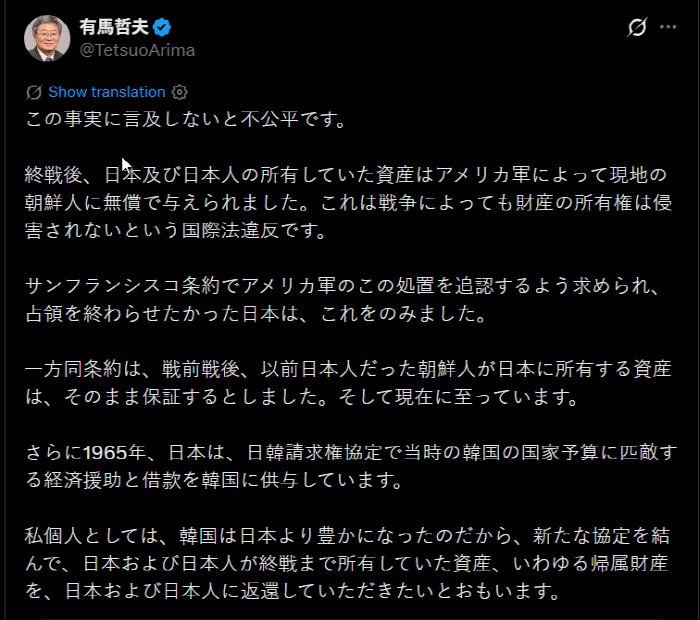 |
| / X of Tetsuo Arima, professor emeritus at Waseda University |
Criticism is mounting in South Korean online communities after Tetsuo Arima, professor emeritus at the Faculty of Social Sciences at Waseda University in Japan, posted a message demanding that South Korea return Japanese-owned assets. Netizens refuted Arima's claims by citing the damages suffered during the Japanese colonial rule and the 1965 South Korea-Japan Claims Agreement.
Recently, posts that Arima shared on his X account circulated on domestic online communities.
Mentioning the post-war handling of Japanese-owned assets and the 1965 South Korea-Japan Claims Agreement, Tetsuo Arima claimed, "Assets owned by Japan and Japanese nationals after the end of the war were given to local Koreans for free by the U.S. military."
He went on to state that this was "a violation of international law providing that ownership of property is not infringed even by war." He then explained that at the time of the Treaty of San Francisco, the U.S. demanded confirmation of the actions it had taken, and Japan accepted it in an effort to end the occupation.
Arima also claimed that the treaty guaranteed that assets owned in Japan by Koreans, who were previously Japanese nationals, would remain protected, stating, "This remains the case to this day."
Arguing that Japan provided economic aid and loans equivalent to South Korea's national budget at the time of the 1965 South Korea-Japan Claims Agreement, he expressed the view that a new agreement should be signed based on South Korea's economic growth.
Arima wrote, "Now that South Korea has become wealthier than Japan, I hope a new agreement will be signed to return the assets owned by Japan and Japanese nationals until the end of the war, so-called vested properties, to Japan and Japanese nationals."
Domestic netizens who saw the post responded that the damages Korea suffered during the Japanese colonial period should be taken into account first. One user commented, "Compensate for what was plundered from our country." Another user criticized, "It is an unimaginable claim for a colonial ruler to demand compensation from the colonized."
Others voiced that before Japan demands restitution from South Korea, human and material damages as well as forced mobilization during the Japanese colonial rule must be settled first. Netizens argued that historical issues should be addressed together, citing unpaid wages of forced labor victims and cultural heritage taken to Japan.
Criticism also followed regarding Arima taking issue with the U.S. military's disposal of assets. Some users reacted by asking whether he should demand restitution from the U.S., pointing out that the U.S. Military Government was involved in the disposal of the assets at the time. Other comments pointed out that Japan and South Korea resolved property and claims issues through the 1965 South Korea-Japan Claims Agreement.
Jeong A-reum
Most Read
-
1
Celltrion nears additional contract with major U.S..

-
2
"Aren't those foreigners on welfare?": M..

-
3
Houthis launch successive attacks on Saudi airport..

-
4
Saudi Arabia, Iran hold first diplomatic talks to..

-
5
Saudi airport in Riyadh struck again, leaving at l..

-
6
Five ASEAN countries welcome Myanmar coup leader

-
7
32 Western nations condemn Iran over terror plot t..

PEOPLE






HEADLINE NEWS

-
Address : In-Young Bldg., 34, Uisadang-daero 1-gil, Yeongdeungpo-gu, Seoul
Copyright by ASIATODAY CO., LTD. All rights resereved