



Youth employment falls for 47th consecutive month
Oct 16, 2026, 09:34 am


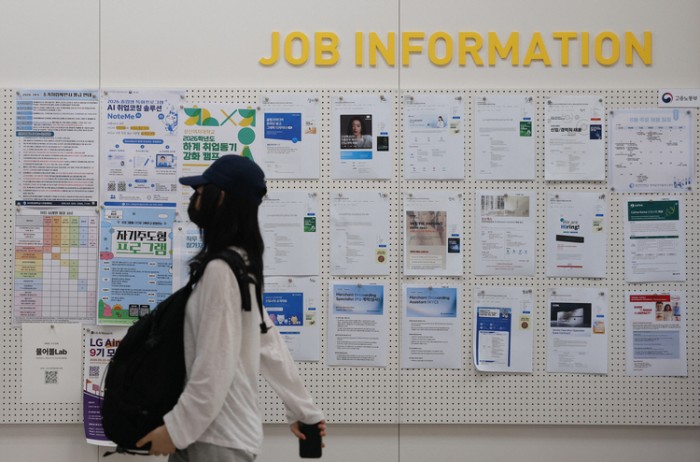 |
| A recruitment bulletin board at a university Job Plus Center in Seoul. / Yonhap |
While South Korea's number of employed people increased by more than 110,000 year-on-year last month, extending its streak of gains of over 100,000 to three consecutive months, the employment chill among young people persisted for the 47th straight month.
According to the "September 2026 Employment Trends" released by the National Data Agency on the 16th, the total number of employed persons stood at 29,266,000 last month, up 113,000 from the same month last year. Although the growth moderated compared to August when it climbed by 184,000, it marked four consecutive months of increases since June and three straight months of gains exceeding 100,000 since July. In addition, the employment rate for people aged 15 to 64 reached 70.6% last month, setting a new high for any September.
Riding this recent upward trend, the number of employed people in the third quarter reached 29,184,000, rising by 135,000 from the same period last year.
By age group, however, the employment slump among the youth demographic continued. Employment among those aged 60 and older jumped by 172,000, surpassing the total overall increase last month, while employment for people in their 30s and 50s expanded by 81,000 and 48,000, respectively. In contrast, the number of employed people aged 15 to 29 dropped by 147,000, extending its decline for the 47th consecutive month.
The employment rate for those aged 15 to 29 also fell 1.1 percentage points year-on-year to 44%, while the unemployment rate for the group rose 0.6 percentage points to 5.4%. The employment rate for those aged 15 to 34, released for the first time in this report, stood at 56.1%, down 0.4 percentage points from the same month last year.
By industry, the healthcare and social assistance sector led the overall uptrend by adding 207,000 jobs year-on-year, while the transportation and warehousing sector grew by 54,000. Over the same period, financial and insurance activities also added 32,000 jobs. Manufacturing, which had suffered from an extended downturn, saw employment climb by 16,000, breaking free from its losing streak after 27 months.
An official from the Ministry of Economy and Finance explained, "Solid export performance over recent periods has had a positive effect on manufacturing employment with a time lag."
In contrast, the employment slump across domestic demand-driven sectors persisted. Employment in the accommodation and food service sector fell by 97,000, while agriculture, forestry, and fisheries also dropped by 94,000. Educational services shed 53,000 jobs as well.
Meanwhile, the number of unemployed individuals stood at 600,000 last month, decreasing by 34,000 year-on-year, but the economically inactive population rose by 179,000 to reach 16,188,000.
Regarding the deepening employment polarization across age groups and industries, the government expressed concern that developments in international affairs, such as escalating tensions in the Middle East, could exert further negative impacts. Accordingly, authorities plan to focus on implementing three key social policy agendas in the employment sector while devising targeted measures for struggling sectors such as construction, agriculture, forestry, and fisheries through an interagency job task force.
Kwon Dae-young, First Vice Minister of Economy and Finance, who chaired the 11th Interagency Joint Job Task Force meeting on this day, stated, "To ensure that the achievements of economic growth translate into tangible benefits in the lives of our people, we will swiftly mobilize the full capabilities of all relevant ministries to prepare an implementation plan for the 'National Jobs Project.'"
Seo Byeong-ju
Most Read
-
1
Celltrion nears additional contract with major U.S..

-
2
"Aren't those foreigners on welfare?": M..

-
3
Houthis launch successive attacks on Saudi airport..

-
4
Saudi Arabia, Iran hold first diplomatic talks to..

-
5
Saudi airport in Riyadh struck again, leaving at l..

-
6
Five ASEAN countries welcome Myanmar coup leader

-
7
32 Western nations condemn Iran over terror plot t..

PEOPLE





HEADLINE NEWS

-
Address : In-Young Bldg., 34, Uisadang-daero 1-gil, Yeongdeungpo-gu, Seoul
Copyright by ASIATODAY CO., LTD. All rights resereved