



KOSPI plunges over 7% amid doubts over AI profitability
Oct 16, 2026, 09:28 am


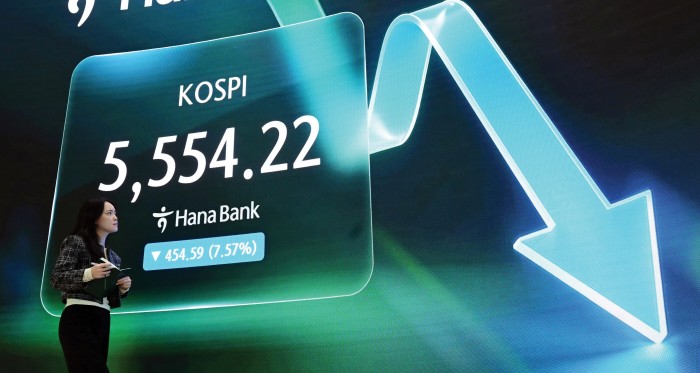 |
| An electronic display board in the dealing room of Hana Bank in Jung-gu, Seoul, on the 15th, when both the Kospi and Kosdaq tumbled, shows the Kospi at 5,554.22, down 454.59 points (7.57%) from the previous day's close, and the Kosdaq at 760.82, down 63.06 points (7.65%). / Reporter Park Sang-sun |
Fueled by concerns over the profitability of artificial intelligence (AI) investments originating from the U.S., South Korea's stock markets crashed more than 8% intraday on the 15th. This came on the heels of overnight losses on Wall Street in New York, where all three major U.S. indices closed lower amid growing inflation concerns.
On this day, the Kospi and Kosdaq finished down 7.57% and 7.65% from the previous day at 5,554.22 and 760.82, respectively. Following sell sidecars triggered on both bourses in the morning, circuit breakers were activated in the afternoon. Circuit breakers are triggered when an index drops 8% or more from the previous close; in the Kospi market, trading was halted for 20 minutes after a circuit breaker was triggered at 12:38 p.m. At the time, the Kospi stood at 5,528.05 points, down 8.0% from the previous day's closing level. This marked the 10th circuit breaker this year, occurring about two months after the one on July 29. The Kosdaq market also saw its fifth Level 1 circuit breaker activation this year.
The sell-off is analyzed to reflect mounting skepticism over the profitability and investment sustainability of the AI industry, following confirmation of the rapid growth of China's ChangXin Memory Technologies (CXMT) and slowing revenue growth at U.S. AI model developer Anthropic. In the Kospi market on this day, foreign investors sold a net 4.8196 trillion won, while retail and institutional investors net purchased 2.1451 trillion won and 2.0 trillion won, respectively. Foreign selling pressure was concentrated heavily on Samsung Electronics and SK Hynix. Samsung Electronics closed at 210,000 won, down 7.76% from the previous day, while SK Hynix ended down 10.01% at 1,262,000 won. The declines in Samsung Electronics and SK Hynix marked their steepest falls since July 28.
Amid persistent foreign selling, concerns are mounting over a widening supply-demand void as the buying capacity of institutions and retail investors remains constrained. Since the 6th, the Kospi has tumbled more than 20% across seven consecutive trading sessions of losses. Intraday, it shed more than 8%, briefly breaking below the 5,500 threshold. In light of this, experts anticipate that the 5,000 level will serve as a support line for the Kospi, advising that dip-buying strategies should also be avoided for the time being. The Samsung Securities Research Center stated, "With investor sentiment severely damaged, the phase of heightened volatility could persist in the short term," adding, "Until foreign selling subsides and external uncertainties ease, a strategy focused on risk management is more appropriate than actively expanding portfolio weightings."
Yoon Seo-young
Most Read
-
1
Celltrion nears additional contract with major U.S..

-
2
"Aren't those foreigners on welfare?": M..

-
3
Houthis launch successive attacks on Saudi airport..

-
4
Saudi Arabia, Iran hold first diplomatic talks to..

-
5
Saudi airport in Riyadh struck again, leaving at l..

-
6
Five ASEAN countries welcome Myanmar coup leader

-
7
32 Western nations condemn Iran over terror plot t..

PEOPLE






HEADLINE NEWS

-
Address : In-Young Bldg., 34, Uisadang-daero 1-gil, Yeongdeungpo-gu, Seoul
Copyright by ASIATODAY CO., LTD. All rights resereved