



Korea's export volume growth hits highest in 16 years and 8 months
Oct 16, 2026, 09:13 am


 |
| /Yonhap |
Driven by a more than 28% surge in international crude oil prices on a monthly average basis within a single month, South Korea's import prices ended a three-month decline and rebounded last month. While the won-dollar exchange rate fell by more than 3%, sharp gains in raw material prices, particularly crude oil, drove the turnaround. Meanwhile, export prices fell for a second straight month due to the drop in the exchange rate. However, with export volumes surging primarily in semiconductors, the income terms of trade posted their highest growth rate on record.
According to preliminary data on the "Export and Import Price Indices and Trade Indices for September 2026" released by the Bank of Korea on the 16th, the won-denominated import price index for last month stood at 159.37, up 1.7% from the previous month. This marks a rebound after four months, following three consecutive months of declines from June through August. Compared to the same month last year, it rose 17.6%.
The surge in global oil prices fueled the increase in import prices. The monthly average price of Dubai crude in September reached $113.71 per barrel, jumping 28.1% from $88.75 in the previous month. Over the same period, the average won-dollar exchange rate dropped 3.4% from 1,406.30 won to 1,359.00 won, but it failed to offset the impact of soaring oil prices. In terms of contract currencies, import prices also rose 4.9% month-on-month.
By usage, import prices of raw materials climbed 9.6% from the preceding month. This came as mining products rose 10.8% amid a 21.6% increase in crude oil prices. In contrast, intermediate goods fell 1.7%, as primary metal products and other items dropped despite a 1.5% gain in coal and petroleum products. Capital goods and consumer goods also declined by 2.4% and 2.3%, respectively.
Export prices fell for the second consecutive month. In September, the won-denominated export price index stood at 182.29, down 0.8% from the previous month. On a year-on-year basis, it rose 40.9%. While prices of coal and petroleum products increased due to higher global crude prices, the fall in the exchange rate dragged down prices across most items.
Among manufactured goods, coal and petroleum products rose 8.5% from the previous month, driven by gains of 8.3% in diesel and 17.9% in gasoline. Conversely, transportation equipment fell 3.2%, and computers, electronic and optical products slid 1.8%. In contract currency terms, export prices climbed 2.6% month-on-month, showing a divergence from won-based prices.
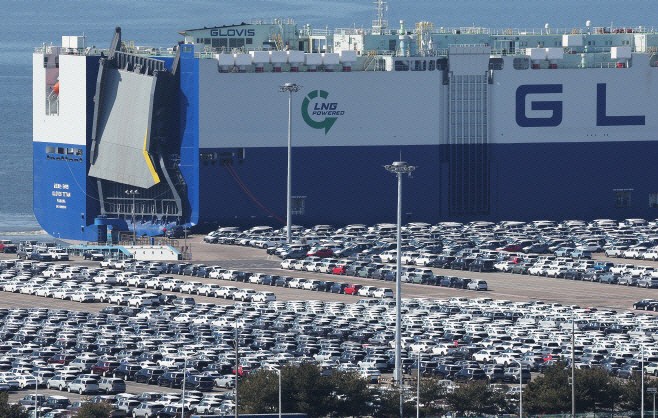
Export volume saw a substantial expansion. The export volume index for September jumped 32.1% year-on-year, marking the highest growth rate in 16 years and eight months since January 2010 (42.0%). With outbound shipments of semiconductors, computer memory devices, and mobile phones increasing, the export volume for computers, electronic and optical products surged 46.6%. Machinery and equipment also gained 11.3%. The export value index soared 89.2%.
The import volume index also rose 11.1% compared to the same month last year, propelled by a 48.4% increase in computers, electronic and optical products and a 28.7% rise in machinery and equipment. The import value index climbed 26.9% during the same period.
Terms of trade also continued to improve year-on-year. The net barter terms of trade index for September rose 25.4% from a year earlier as export prices, adjusted for time lags, gained 43.2%, outpacing the 14.2% rise in import prices. However, as the impact of higher global oil prices in August was factored in, the increase in import prices expanded, moderating the gain from the previous month's 27.1%. On a month-on-month basis, the index slipped 0.3%.
The income terms of trade index, which factors in export volume, surged 65.7% from the same month last year. Widening its pace of growth from the previous month (59.9%), the index posted the highest year-on-year increase on record. With export prices maintaining their upward momentum alongside a sharp expansion in export volume, South Korea's external purchasing power was shown to have improved.
Park Seo-a
Most Read
-
1
Celltrion nears additional contract with major U.S..

-
2
"Aren't those foreigners on welfare?": M..

-
3
Houthis launch successive attacks on Saudi airport..

-
4
Saudi Arabia, Iran hold first diplomatic talks to..

-
5
Saudi airport in Riyadh struck again, leaving at l..

-
6
Five ASEAN countries welcome Myanmar coup leader

-
7
32 Western nations condemn Iran over terror plot t..

PEOPLE






HEADLINE NEWS

-
Address : In-Young Bldg., 34, Uisadang-daero 1-gil, Yeongdeungpo-gu, Seoul
Copyright by ASIATODAY CO., LTD. All rights resereved