



Construction permit timeline takes shape for public-private SMR joined by Hyundai E&C, POSCO E&C
Oct 15, 2026, 09:51 am


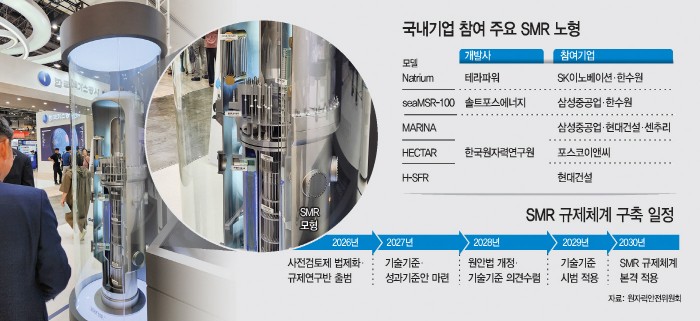 |
Next-generation small modular reactors (SMRs) involving Hyundai E&C and POSCO E&C are being developed with the goal of applying for domestic construction permits in 2031 and 2032, respectively. These reactor models had their licensing timelines left undecided until early this year.
According to the Nuclear Safety and Security Commission (NSSC) and related organizations on the 14th, the H-SFR sodium-cooled fast reactor, in which Hyundai E&C is participating, aims to apply for a construction permit in 2031, while the high-temperature gas-cooled reactor HECTAR, joined by POSCO E&C and others, is targeting 2032. In the roadmap for establishing an SMR regulatory framework unveiled by the NSSC in February, the timelines for both standard design approvals and construction permits for the two reactor types were listed as "undecided."
The H-SFR is a sodium-cooled fast reactor that uses liquid sodium as a coolant instead of water. Hyundai E&C is pursuing public-private joint development of the SFR with the Korea Atomic Energy Research Institute (KAERI) from 2025 to 2029. The goal is to complete the basic design by the end of 2029.
HECTAR is a high-temperature gas-cooled reactor aimed at supplying high-temperature heat and steam required for industrial processes. KAERI oversees the reactor design, while POSCO E&C, Daewoo E&C, SK ecoplant, and Lotte Chemical participate in its development and commercialization. Basic design is currently underway, targeting completion in 2027.
Both reactor types have also been included as targets for the NSSC's preliminary review in 2028. This is a procedure where developers review safety issues and applicable regulatory standards with the regulator before formally applying for licensing. In the February roadmap, the H-SFR had indicated 2028 as its desired target for preliminary review while its construction permit timeline remained undecided, whereas for HECTAR, both the preliminary review and licensing schedules were previously left undecided.
The H-SFR and HECTAR are non-light water reactors that employ reactor methods different from conventional large-scale nuclear plants or light-water innovative SMRs (i-SMR). They utilize sodium and helium gas as coolants, respectively. Because current nuclear technical standards are tailored around large light-water reactors, updating regulatory criteria for non-light water reactors in line with development schedules is also required.
The government's overhaul of the regulatory system is progressing along the same timeframe. The NSSC plans to draft SMR technical standards by the end of 2027 and revise related legal frameworks by 2030 to cover reactors of various types and purposes. Detailed notices, guidelines, review methodologies, and regulatory technologies for non-light water reactors will be established sequentially by 2032. Next year's budget proposal also includes funding for SMR regulatory research and preliminary reviews of non-light water reactor models. NSSC Chairman Choi Won-ho stated in this year's policy briefing that the commission will implement the roadmap for establishing a regulatory framework to "prepare for the development and construction of diverse SMRs."
However, targeting a construction permit application does not signify that actual construction projects have been finalized. NSSC materials also stipulate that licensing application timelines reflect developer plans and may change depending on future development progress. In the published schedules for both the H-SFR and HECTAR, domestic construction sites, final project operators, and permit applicants have not been specified, meaning prerequisites for demonstration and commercialization must be separately established following technology development.
Oh Keun-bae, research fellow at the Center for Nuclear Policy at Seoul National University, stated at a NEXFO workshop, "SMR export competitiveness is not determined solely by the excellence of reactor design." He added, "We must first build and demonstrate an ecosystem at home connecting nuclear fuel, regulations, the power market, demand industries, and business models before we can present a complete package to foreign client nations."
Jeong Soon-young
Most Read
-
1
AMD's Lisa Su floated as potential Nvidia successo..

-
2
Iran resumes attacks after two months, targeting U..

-
3
Alice Huang, affair partner of Jensen Huang, repor..

-
4
Xi secures fourth term as China reshuffles next-ge..

-
5
Hegseth rejects calls for impeachment over Iran wa..

-
6
Democrats flip U.S. Congress in historic midterm s..

-
7
Nvidia executive Kimberly Powell at center of Jens..

PEOPLE







-
Address : In-Young Bldg., 34, Uisadang-daero 1-gil, Yeongdeungpo-gu, Seoul
Copyright by ASIATODAY CO., LTD. All rights resereved