



KEPCO equips transmission grid management with advanced tech
Oct 15, 2026, 09:43 am


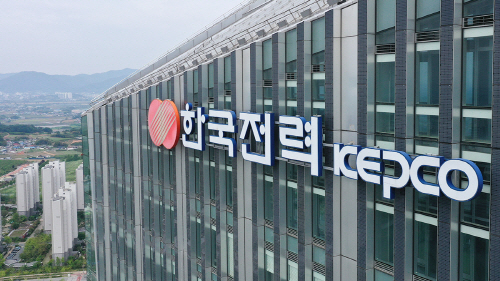 |
| A panoramic view of KEPCO headquarters. / Yonhap |
Korea Electric Power Corporation (KEPCO) has embarked on transitioning its transmission facility inspection and maintenance operations, previously centered on human labor, to advanced technology-based systems utilizing artificial intelligence (AI) and robotics. The utility plans to automate hazardous tasks that once required workers to climb transmission towers or enter underground utility conduits using robots, while also establishing a disaster monitoring system utilizing satellites.
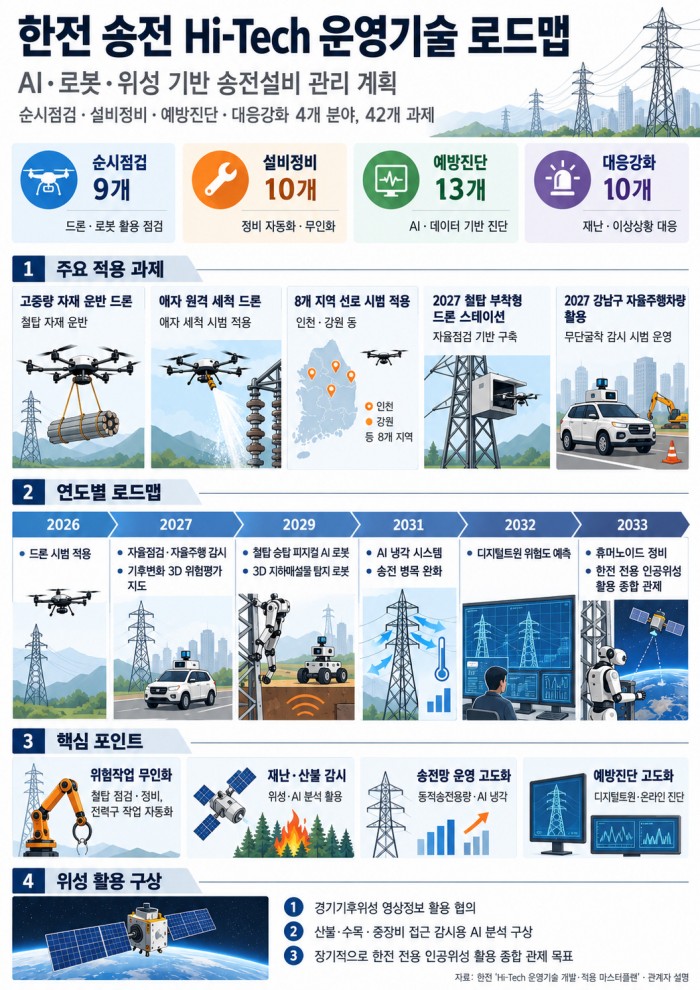
According to KEPCO on the 14th, the company recently established the "Master Plan for the Development and Application of HI-Tech Operational Technology" outlining this direction and shared its details with each business division. The master plan was formulated through open contests alongside domestic and international benchmarking as part of KEPCO's strategy to build a safer facility management system and advance transmission equipment operational technology using domestic and global advanced tech such as AI and robotics. A total of 42 development and implementation tasks across patrol inspections, facility maintenance, preventive diagnostics, and enhanced response were included in the roadmap.
Some achievements outlined in the roadmap are expected to materialize within this year. Having completed the development of drone methods to transport heavy materials to mountainous transmission towers and drone technology to remotely clean transmission line insulators, KEPCO plans to begin on-site pilot testing soon. A KEPCO official explained, "We plan to pilot the technology across transmission lines in eight regions, including Incheon and Gangwon Province, during the second half of this year, and expand implementation starting next year."
In addition, by 2027, the company will build a platform for autonomous transmission line inspections by installing stations equipped with charging and storage functions for drones on mountainous pylons. It also plans to pilot a monitoring system for unauthorized excavation around underground transmission lines using AI autonomous vehicles, beginning in Gangnam-gu, Seoul.
In the mid-to-long term, unmanned transmission facility operations utilizing physical AI robots will also be pursued. KEPCO aims to develop walking robots that directly climb steel towers to inspect equipment, as well as three-dimensional (3D) underground utility detection robots utilizing LiDAR technology, by 2029. The roadmap also outlines plans to acquire technology by 2033 to replace high-difficulty manual labor—such as power line replacement and cable laying and splicing—with humanoid robots, though KEPCO explained that humanoid robot development has not yet reached a concrete stage.
Technologies will also be secured to prevent damage to transmission facilities caused by climate change. KEPCO plans to develop a 3D risk assessment mapping system by 2027 utilizing climate forecast data from the Korea Meteorological Administration. The system will be used to screen transmission lines vulnerable to extreme weather events such as torrential downpours in advance and identify areas requiring facility reinforcement.
Furthermore, the company plans to prepare a comprehensive power facility control system utilizing KEPCO-dedicated satellites by 2033. Ahead of this, discussions are currently underway to utilize imagery data from the Gyeonggi Climate Satellites launched by Gyeonggi Province for transmission facility management. Gyeonggi Province operates two Gyeonggi Climate Satellites. A KEPCO official said, "We held working-level discussions with Gyeonggi Province in April, and once the project moves forward, we plan to develop AI analysis programs to monitor wildfires, trees near transmission lines, and heavy equipment."
 |
| An AI-generated image. |
Bae Seok-won
Most Read
-
1
AMD's Lisa Su floated as potential Nvidia successo..

-
2
Iran resumes attacks after two months, targeting U..

-
3
Alice Huang, affair partner of Jensen Huang, repor..

-
4
Xi secures fourth term as China reshuffles next-ge..

-
5
Hegseth rejects calls for impeachment over Iran wa..

-
6
Democrats flip U.S. Congress in historic midterm s..

-
7
Nvidia executive Kimberly Powell at center of Jens..

PEOPLE







-
Address : In-Young Bldg., 34, Uisadang-daero 1-gil, Yeongdeungpo-gu, Seoul
Copyright by ASIATODAY CO., LTD. All rights resereved