



S. Korea unveils blueprint for 5-year national population strategy
Oct 15, 2026, 09:19 am


 |
| Presidential Committee on Ageing Society and Population Policy |
The South Korean government has transitioned its Basic Plan on Low Fertility and Aging Society—established every five years since 2006—into the Basic Plan for National Population Strategy, unveiling its first five-year blueprint. The shift aims to redesign the nation's overall socioeconomic framework by broadening policy scope beyond childbirth support and senior welfare to encompass regional extinction, immigration, and artificial intelligence-driven technological changes.
The Presidential Committee on Population Strategy proclaimed a new demographic vision and released the key details of the 1st Basic Plan for National Population Strategy to be implemented over the next five years during a plenary meeting chaired by the President on the afternoon of the 14th. The latest plan focuses on turning demographic shifts into an opportunity for a new leap forward rather than viewing them merely as social risks, while building a sustainable future by fostering intergenerational coexistence and easing social divisions.
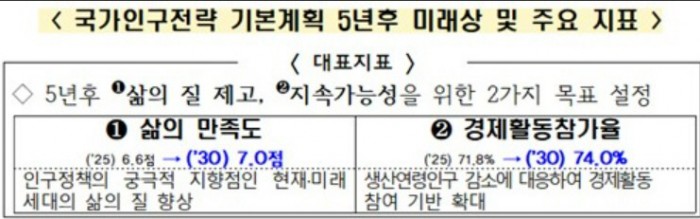
Formulated for the first time since the Framework Act on Population Strategy was wholly revised and enacted in September, the 1st Basic Plan for National Population Strategy serves as a nationwide strategy encompassing regional depopulation, technological innovation, and immigration policy beyond conventional responses to low birth rates and aging. In particular, it pivoted away from targets centered on fertility rates and total population size toward improving people's overall quality of life and ensuring social sustainability.
Notably, this master plan did not include a specific numerical target for the total fertility rate, omitting the goal of reaching a 1.0 total fertility rate by 2030 previously set by the Presidential Committee on Ageing Society and Population Policy in 2024.
This reflects the assessment that even if fertility rates rebound immediately, population decline and super-aging will likely persist over the long term due to the cumulative impact of prolonged low birth rates. Because it takes at least 20 years for newborns to enter the labor force, policymakers concluded that a socioeconomic system adapted to a shrinking population must be established separately from efforts to raise the birth rate.
Kim Jin-oh, vice chairman of the Population Strategy Committee, explained, "While boosting the total fertility rate remains a crucial policy task, we refrained from setting numerical fertility targets that could place a psychological burden on citizens contemplating marriage and childbirth. Instead, we established life satisfaction and the labor force participation rate as primary indicators to reflect perceived quality of life and economic engagement in response to population decline."
Specifically, the plan strengthens customized support so that young adults receive necessary aid at critical life transitions—such as employment, marriage, and childbirth—while helping seniors maintain economic security and social participation in their local communities. Targets set for 2030 include raising the youth employment rate to 50%, improving the senior poverty rate to 30%, lowering the female career-break rate to 10%, boosting flexible work adoption to 25.0%, and increasing the elderly employment rate to 72.0%.
Additionally, an "advance demographic impact forecast system" will be introduced to periodically release population projections and their implications across various sectors and industries. Park Jin-kyung, a standing commissioner of the Population Strategy Committee, noted, "The forecast system is designed to mandatorily share demographic realities with society and offer guidance for drafting practical policies and national strategies aligned with those changes. We will meticulously design the disclosure methods and schedule."
Meanwhile, the draft of the 1st Basic Plan for National Population Strategy announced on this day will be refined through extensive feedback from relevant agencies and finalized following review and resolution by the Vice-Ministerial Meeting and the Cabinet Council.
Vice Chairman Kim said, "This basic plan is intended not as a set of short-term targets, but to present to the public the overarching direction and core priorities of the government's population policy over the next five years. We will develop and legislate the proposed tasks through public consultation and inter-ministerial coordination."
Kim Bo-young
Most Read
-
1
Celltrion nears additional contract with major U.S..

-
2
"Aren't those foreigners on welfare?": M..

-
3
Houthis launch successive attacks on Saudi airport..

-
4
U.S. weighs dropping MOAB, world's most powerful n..

-
5
Saudi Arabia, Iran hold first diplomatic talks to..

-
6
Saudi airport in Riyadh struck again, leaving at l..

-
7
Five ASEAN countries welcome Myanmar coup leader

PEOPLE






HEADLINE NEWS

-
Address : In-Young Bldg., 34, Uisadang-daero 1-gil, Yeongdeungpo-gu, Seoul
Copyright by ASIATODAY CO., LTD. All rights resereved