



SCM on OPCON transition likely delayed beyond expected November date
Oct 14, 2026, 05:17 pm


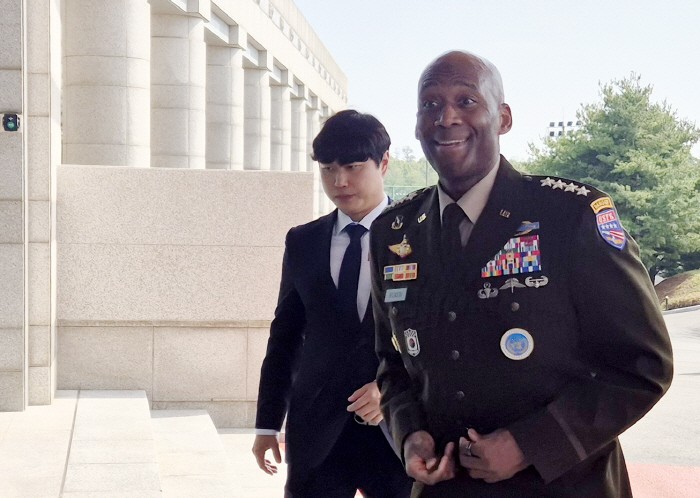 |
| Gen. Xavier Brunson, commander of the United Nations Command, Combined Forces Command, and U.S. Forces Korea, arrives at the Ministry of National Defense headquarters in Yongsan-gu, Seoul, to meet with Defense Minister Kang Shin-chul on the 23rd of last month. / Yonhap |
Prospects are emerging that the South Korea-U.S. Security Consultative Meeting (SCM), which is expected to determine the target year ("Year X") for the wartime operational control (OPCON) transition, will be delayed past the initially anticipated November timeline.
According to the Ministry of National Defense and sources within and outside the military on the 14th, Seoul and Washington are proceeding ahead of the SCM based on the principle of transferring OPCON once mutually agreed-upon conditions are met under the Conditions-based Operational Control Transition Plan (COTP). However, it is reported that the likelihood of holding the SCM next month is slim, given the U.S. midterm elections in November and South Korea's defense ministerial reshuffle.
A defense ministry official explained that consultations on mutually feasible schedules for the first face-to-face meeting between the two defense chiefs remain underway. The official added, "In accordance with last year's SCM agreement, South Korea and the U.S. have been cooperating closely this year to verify the Full Operational Capability (FOC) of the future Combined Forces Command led by the South Korean military," noting, "The joint evaluation planned for this year's capabilities has been fully completed, and remaining differences will be resolved through bilateral consultations leading up to the SCM."
FOC is the second of three stages evaluating the wartime mission capability of the South Korean military-led future Combined Forces Command. Following Initial Operational Capability (IOC) verification, the process requires passing FOC and ultimately completing Full Mission Capability (FMC) verification. The South Korean government had planned to conclude FOC verification at this year's SCM and recommend "Year X" to the commanders-in-chief of both nations.
However, the U.S. is reportedly at odds with South Korea over whether the conditions for FOC have been met, suggesting that additional coordination will be needed to narrow differences and secure U.S. cooperation.
Gen. Xavier Brunson, commander of U.S. Forces Korea, also remarked during a talk at the Center for Strategic and International Studies (CSIS) in Washington on the 13th local time, "I fully support the conditions-based OPCON transition agreement," though he added regarding the timing, "Time is a condition, but that's not for me to decide."
Lee Han-sol
Most Read
-
1
Celltrion nears additional contract with major U.S..

-
2
Kia Sportage outperforms Mazda CX-5 in German auto..

-
3
Houthis launch successive attacks on Saudi airport..

-
4
Saudi Arabia, Iran hold first diplomatic talks to..

-
5
Saudi airport in Riyadh struck again, leaving at l..

-
6
U.S. deploys carrier, 10,000 more troops to Middle..

-
7
Five ASEAN countries welcome Myanmar coup leader

PEOPLE






HEADLINE NEWS
- New White House Press Secretary links $54 billion from Seoul to Alaska LNG in first briefing
- Industrial Bank of Korea launches local subsidiary in Vietnam
- Saudi-Houthi clashes over oil facilities escalate, hitting 24 vessels in Ho..
- Bin Salman underestimates Houthi offensive, imperiling Saudi economic refor..

-
Address : In-Young Bldg., 34, Uisadang-daero 1-gil, Yeongdeungpo-gu, Seoul
Copyright by ASIATODAY CO., LTD. All rights resereved