



44 government bodies to relocate to Sejong
Oct 14, 2026, 10:19 am


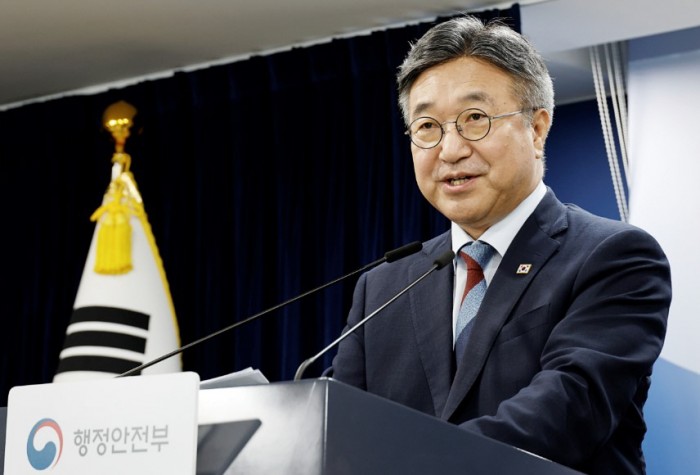 |
| Minister of the Interior and Safety Yoon Ho-jung holds a briefing on the "Phase 2 Relocation Plan for Central Administrative Agencies" at the Government Complex Seoul on the afternoon of the 13th. / Reporter Kim Bo-young |
The South Korean government will construct new office buildings for 27 central administrative agencies remaining in the greater Seoul area—including the Ministry of Justice, the Board of Audit and Inspection, the National Police Agency, the Prosecution Service, and the Major Crimes Investigation Agency—and relocate them to Sejong City next year. Priority will be given to organizations with significant scale and relocation impact, such as the Ministry of Justice and the Ministry of Gender Equality and Family, with transfers carried out sequentially to prevent any administrative disruption while taking into account agency-specific operational conditions and preparedness.
Minister of the Interior and Safety Yoon Ho-jung held a briefing on the phase 2 relocation of central administrative agencies at the Government Complex Seoul on the afternoon of the 13th, announcing that central administrative agencies based in the capital area will be transferred to Sejong in phases starting in the first half of next year to reinforce a Sejong-centered governance system.
Minister Yoon explained, "Following a review of 142 administrative agencies currently located in the capital region, we decided that all central government ministries will relocate to Sejong to enhance governance efficiency, while affiliated agencies responsible for direct public-facing services will be excluded from the relocation."
As an initial step, 27 agencies and 2,995 personnel that do not require dedicated complexes will relocate first by utilizing privately leased commercial space in the Sejong area. Meanwhile, 17 agencies and 6,934 personnel requiring standalone buildings and specialized facilities due to the nature of their operations—such as investigation, security, and monitoring and control—will move sequentially by 2031 following the construction of new premises. The relocation encompasses a total of 44 institutions, representing 9,929 authorized civil service positions.
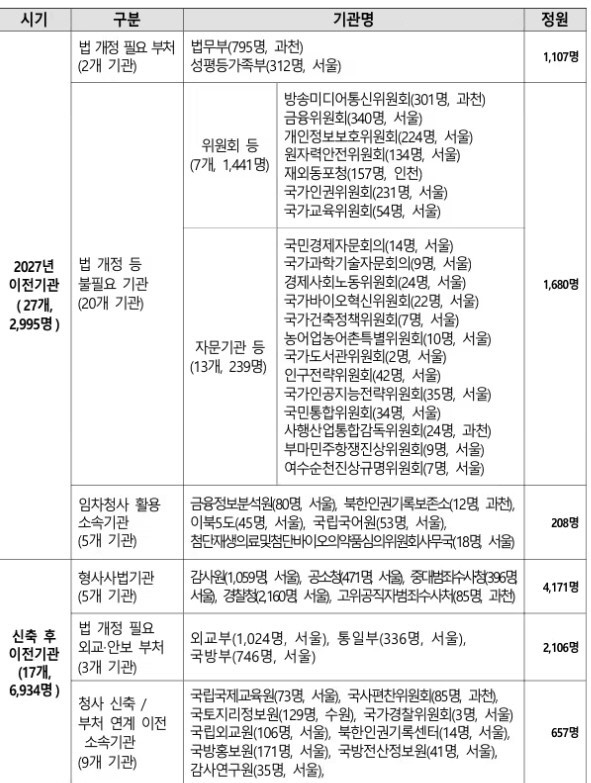 |
| Central administrative agencies subject to relocation / Ministry of the Interior and Safety |
Accordingly, the government will push to revise the Multifunctional Administrative City Act and secure budget allocations to proceed with relocating the Ministry of Foreign Affairs, the Ministry of Unification, the Ministry of National Defense, the Ministry of Justice, and the Ministry of Gender Equality and Family to Sejong. Following consultations with relevant agencies and public hearings, it will then move to revise and officially gazette the relocation plan while securing office buildings for each agency. Relocating civil servants and their families will be provided with moving expenses, initial resettlement allowances, and temporary transportation support.
In tandem, the government has also decided to review relocating presidential support bodies, including the Office of the President and the National Security Office, to Sejong in the future. The project aims to complete the presidential office in Sejong by 2029 and the Sejong branch of the National Assembly by 2033.
The plan is designed to relocate the central administrative agencies remaining in the capital region to Sejong, thereby enhancing the efficiency of inter-agency collaboration and cementing a Sejong-centered governance system.
Minister of the Interior and Safety Yoon Ho-jung stated, "The relocation of central administrative agencies to Sejong is not a mere spatial move, but a spatial strategy to overcome the unipolar concentration in the capital region and make balanced use of national territory." He added, "We will pursue the relocation while taking care of all necessary details without omission, minimizing inconvenience to the public and ensuring that the relocating agencies settle in smoothly."
Kim Bo-young
Most Read
-
1
Celltrion nears additional contract with major U.S..

-
2
"Aren't those foreigners on welfare?": M..

-
3
U.S. weighs dropping MOAB, world's most powerful n..

-
4
Houthis launch successive attacks on Saudi airport..

-
5
Saudi Arabia, Iran hold first diplomatic talks to..

-
6
Saudi airport in Riyadh struck again, leaving at l..

-
7
Five ASEAN countries welcome Myanmar coup leader

PEOPLE






HEADLINE NEWS

-
Address : In-Young Bldg., 34, Uisadang-daero 1-gil, Yeongdeungpo-gu, Seoul
Copyright by ASIATODAY CO., LTD. All rights resereved