



Wegovy seeks health insurance coverage, bringing public funding for obesity drugs to the fore
Oct 14, 2026, 10:14 am


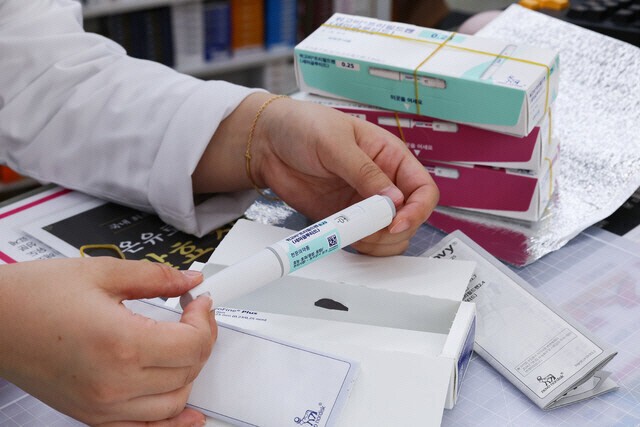 |
| A pharmacist explains the anti-obesity medication Wegovy at a pharmacy in Jongno-gu, Seoul. / Yonhap |
The anti-obesity drug Wegovy has entered the process toward health insurance coverage, expected to reignite debates over allocating public healthcare funds for severe obesity. While the South Korean government's stated policy is that support is needed for severe obesity—a primary contributor to various adult chronic illnesses—numerous hurdles remain before coverage can be granted, including defining eligibility criteria and managing fiscal impacts.
According to the Health Insurance Review and Assessment Service (HIRA) on the 13th, Novo Nordisk Korea recently filed an application for National Health Insurance (NHI) reimbursement for Wegovy. The Pharmaceutical Benefit Assessment Committee will evaluate the application within 120 days from the filing date. Following the committee's review, final approval for reimbursement will be decided after drug price negotiations with the National Health Insurance Service (NHIS) and deliberations by the Health Insurance Policy Review Committee under the Ministry of Health and Welfare (MOHW).
An official from HIRA stated, "We will assess the appropriateness of reimbursement for Wegovy by examining clinical usefulness regarding the drug's efficacy, as well as cost-effectiveness to evaluate the suitability of committing health insurance finances."
Earlier, various circles, including the National Assembly, stressed the need to cover anti-obesity medications under health insurance, citing the risks of severe obesity and precedent from overseas. Domestically, health insurance coverage for severe obesity is currently limited to bariatric and metabolic surgery.
During a plenary session of the National Assembly's Health and Welfare Committee in August, Representative Kim Tae-ho of the People Power Party pointed out, "Domestic retail prices for obesity treatments like Wegovy and Mounjaro are roughly two to five times higher than in overseas markets such as Japan and China."
In response, Minister of Health and Welfare Jung Eun-kyeong said, "Because anti-obesity drugs are not currently covered under national health insurance, there is no regulatory pricing control mechanism through the NHI system. However, given that severe obesity elevates the risk of diabetes, cardiovascular diseases, and arthritis, and can lead to increased medical expenditures overall, there is a recognized need to some extent for insurance coverage."
With the government having acknowledged that it is reviewing coverage for obesity drugs, Wegovy's reimbursement application has brought related policy discussions back to the forefront.
Key points of contention regarding reimbursement include eligibility thresholds and the long-term sustainability of NHI finances. The UK determines eligibility for Wegovy and Mounjaro through a combination of body mass index (BMI) and comorbid conditions. Japan likewise sets insurance coverage criteria by weighing BMI alongside obesity-related health disorders such as hypertension, dyslipidemia, and type 2 diabetes.
Concerns are also emerging that if health insurance coverage for Wegovy is finalized, increased prescription uptake among domestic obesity patients could exert a substantial financial strain on the national health insurance fund.
According to data submitted to Democratic Party of Korea lawmaker So Byung-hoon by the NHIS, the number of health screening examinees classified as obese with a BMI of 30 or higher stood at 1,408,609 last year, up 19.1% from 2021. Broken down by tier, individuals with a BMI between 35 and 39.9 rose by 31.2%, while those with a BMI of 40 or higher surged by 45.4%.
The broader challenge is that expanding NHI expenditures are already jeopardizing financial sustainability. As of late July, the health insurance net balance registered a deficit of 364.4 billion won, with the annual deficit projected to widen to 2.8374 trillion won by the end of this year. Granting reimbursement for obesity medications could further widen that deficit.
In documents prepared for the parliamentary audit, the MOHW stated, "While the financial requirement for insurance coverage can be projected based on the expected patient population according to eligibility guidelines and drug pricing, concrete fiscal projections remain difficult without established coverage criteria for anti-obesity drugs."
The ministry added, "In terms of expanding healthcare benefit coverage, our priority remains focused on treatments for severe, rare, and intractable diseases rather than obesity."
Seo Byeong-ju
Most Read
-
1
Celltrion nears additional contract with major U.S..

-
2
"Aren't those foreigners on welfare?": M..

-
3
U.S. weighs dropping MOAB, world's most powerful n..

-
4
Houthis launch successive attacks on Saudi airport..

-
5
Saudi Arabia, Iran hold first diplomatic talks to..

-
6
Saudi airport in Riyadh struck again, leaving at l..

-
7
Five ASEAN countries welcome Myanmar coup leader

PEOPLE






HEADLINE NEWS

-
Address : In-Young Bldg., 34, Uisadang-daero 1-gil, Yeongdeungpo-gu, Seoul
Copyright by ASIATODAY CO., LTD. All rights resereved