



S. Korea-U.S. alliance put to test as warning bells chime in Washington
Oct 13, 2026, 10:08 am


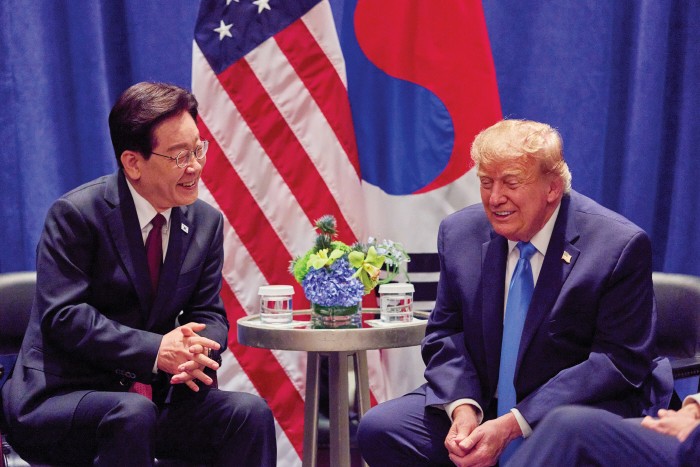 |
| President Lee Jae-myung holds a summit with U.S. President Donald Trump at a hotel in New York on September 22 (local time) while visiting the city to attend the United Nations General Assembly. / Yonhap |
As differences between South Korea and the U.S. consecutively surface across intelligence and counterintelligence, wartime operational control (OPCON) transfer, investment, and trade issues, concerns are mounting in the United States that the trust and resilience of the bilateral alliance are being put to the test. Analysts diagnose that rather than the alliance itself being destabilized, the key challenge now lies in whether both sides can reconcile divergent perspectives while preserving mutual trust as security and economic hurdles converge all at once.
"There is a lot of concern in Washington about the trajectory of the alliance," said Jenny Town, a senior fellow and Korean Peninsula expert, during a panel hosted by the Korea Defense Veterans Association (KDVA) in Washington, D.C., on the 10th (local time). While noting that the South Korea-U.S. alliance remains strong and resilient, she assessed that tensions in investment, trade, and tariffs colliding with security priorities mean "how strong that resilience is is now being tested."
The U.S. side’s misgivings have manifested most tangibly in intelligence and counterintelligence cooperation. In a written response to South Korean media inquiries regarding the state of bilateral intelligence coordination the previous day, a senior official from the Donald Trump administration specifically cited intelligence and counterintelligence matters, expressing expectations that Seoul uphold standards that have anchored the alliance for decades.
Washington reportedly curtailed South Korea's access to intelligence regarding North Korean nuclear facilities after Unification Minister Chung Dong-young referred in the National Assembly last March to Kusong, North Pyongan Province, as the site of a uranium enrichment facility. In June, the National Intelligence Service was sidelined from a South Korea-U.S.-Japan working-group meeting on North Korean cyber threats at Washington's request. While the specific grounds and scope of the restricted intelligence sharing have not been officially confirmed, Washington’s direct mention of cooperation standards in intelligence and counterintelligence—the very bedrock of the alliance—is seen as notable.
Perceptual gaps also emerged regarding the OPCON transfer. Robert Abrams, chairman and president of the KDVA and former commander of U.S. Forces Korea, pointed out during a Defense and Diplomacy Dialogue panel on the same day that the term "accelerate" regarding OPCON transfer serves as "a clear case of a real language barrier." He explained that while South Korea might interpret it as expediting the timeline even if certain transition conditions remain partially unmet, the "American perspective" entails meeting 100% of the preconditions while merely moving the target schedule forward.
The former commander disclosed that following a recent closed-door briefing in South Korea, shortfalls still remain in the transition conditions and no progress has been made on several critical benchmarks. While affirming respect for South Korea's sovereign choices, he cautioned that straying from proven bilateral processes and command-governance frameworks could elevate military risks.
Marc Knapper, former Chargé d'Affaires at the U.S. Embassy in Seoul, also stressed that differences between South Korea and the U.S. must not signal to North Korea, China, or Russia that fissures exist within the alliance.
Ha Man-ju
Most Read
-
1
Celltrion nears additional contract with major U.S..

-
2
"Aren't those foreigners on welfare?": M..

-
3
U.S. weighs dropping MOAB, world's most powerful n..

-
4
Houthis launch successive attacks on Saudi airport..

-
5
Saudi Arabia, Iran hold first diplomatic talks to..

-
6
Saudi airport in Riyadh struck again, leaving at l..

-
7
Five ASEAN countries welcome Myanmar coup leader

PEOPLE






HEADLINE NEWS

-
Address : In-Young Bldg., 34, Uisadang-daero 1-gil, Yeongdeungpo-gu, Seoul
Copyright by ASIATODAY CO., LTD. All rights resereved