



Hanwha Ocean moves beyond submarines, leaps toward global naval shipbuilding hub
Oct 02, 2026, 10:33 am


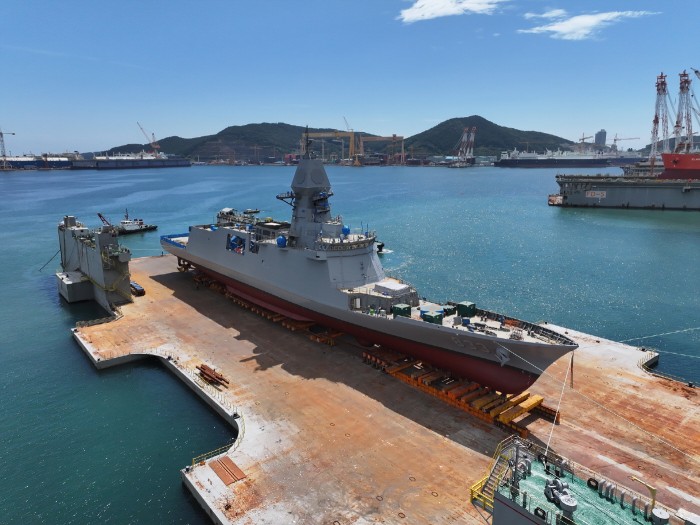 |
| The ROK Navy's Ulsan-class Batch-III frigate No. 5, ROKS Pyeongtaek (FFG-833), photographed near the floating dock at Hanwha Ocean's Geoje shipyard. The superstructure is equipped with a four-sided, fixed, 100% digital integrated sensor mast combining a multi-function phased array radar (MFR) and an infrared search and track (IRST) system, delivering superior anti-air and anti-surface detection capabilities. It demonstrates shipbuilding expertise that shortens construction periods by applying large-block assembly methods to reduce the number of modules installed and streamline the building process. / Photo courtesy of Hanwha Ocean |
Hanwha Ocean is tightening its grip on targeting the overseas naval vessel market. Beyond its established reputation built on submarines, the move is a bold bid to leap forward as an integrated naval ship exporter encompassing surface combatants. In Southeast Asia, it is vying for the Philippine submarine program, while in South America, it has jumped into bidding wars for submarines and frigates in Chile. The Philadelphia Shipyard (Philly Shipyard) in the U.S. serves as its springboard for entering North America.
On July 31, Hanwha Ocean signed a main contract with the Defense Acquisition Program Administration (DAPA) for the detailed design and construction of the lead ship of the Korea Next-Generation Destroyer (KDDX) program. Valued at a total of 7.8 trillion won, the project aims to deploy six 7,000-ton class destroyers by 2036. This effectively represents official validation of its design and shipbuilding capabilities for large surface combatants.
This foundation extends abroad. On September 8, Hanwha Ocean was notified of its selection as the preferred bidder for the Royal Thai Navy's next-generation frigate acquisition program. Valued at approximately 683.3 billion won, the project involves one OCEAN-40F vessel. However, this remains at the preferred negotiation stage rather than a signed contract, and the subsequent three vessels have not yet been finalized.
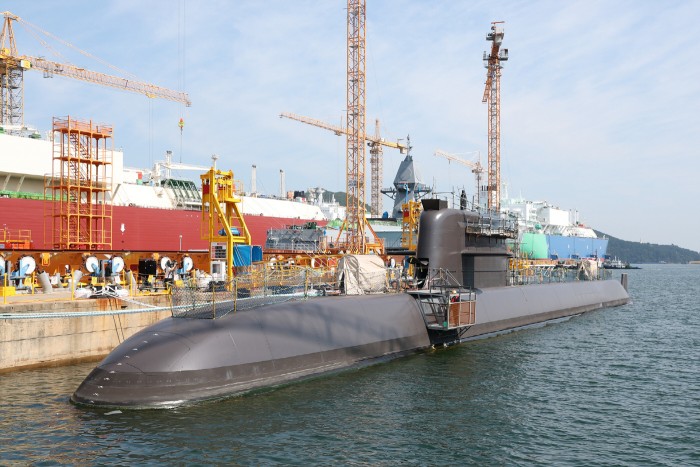 |
| ROKS Seo Hui (SS-088), the ROK Navy's second 3,600-ton class latest Dosan Ahn Changho-class Batch-II submarine, undergoing construction and final outfitting at Hanwha Ocean's Geoje shipyard / Photo courtesy of Hanwha Ocean |
The Philippines is pursuing the acquisition of submarines for the first time since the establishment of its navy. Rival HD Hyundai Heavy Industries holds an advantage in its track record for surface vessels, having won contracts for 12 ships in the Philippines since 2016.
The card Hanwha Ocean is playing is the KSS-III Batch II submarine, "ROKS Seo Hui." Displacing approximately 3,600 tons, it is equipped with 10 vertical launch system (VLS) cells. Hanwha Ocean explains that its propulsion system, which combines an indigenously developed Air-Independent Propulsion (AIP) system with lithium-ion batteries, is a world first and provides the longest underwater endurance among conventional diesel submarines. However, this is the company's description and has not been independently verified.
After clearing the company's stringent defense security clearance, the interior of the Seo Hui, boarded by this reporter, was undergoing various final checks ahead of its launch, with delivery to the navy scheduled for late next year following test evaluations. The KSS-III PN (Philippines) model proposed by Hanwha Ocean to the Philippines directly inherits the cutting-edge specifications of the 3,600-ton Seo Hui, featuring a displacement of 2,800 to 3,000 tons and combining lithium-ion batteries with AIP.
Chile is jointly pursuing new submarines and multi-purpose frigates to replace two German HDW Type 209 submarines commissioned in 1984. Hanwha Ocean unveiled its tailored submarine, "Ocean 2000," and frigate, "Ocean 4500," while top executives including President Jeong In-seop accompanied President Lee Jae-myung on his state visit to Chile. With both programs emphasizing maintenance, technology transfer, and construction at local state-run shipyards, the level of localization serves as a critical variable. Program scale and details remain under negotiation.
Hanwha finalized its acquisition of Philly Shipyard in December 2024. In March of this year, it secured its first U.S. Navy project by participating in the U.S. Navy's Next-Generation Logistics Ship (NGLS) program as a subcontractor to a design firm. The two maintenance, repair, and overhaul (MRO) contracts for U.S. Navy vessels won by Hanwha Ocean in 2024 stand as separate achievements. However, because the shipyard possesses only two docks, Hanwha is considering facility expansion and additional acquisitions.
As seen in the Canadian Patrol Submarine Project (CPSP), entering bidding wars armed with top-tier weapon systems and on-time delivery capabilities does not automatically translate into signed contracts. The direction can shift depending on the budgets and political timelines of procuring nations, including Thailand, the Philippines, and Chile. Naval vessel exports represent a comprehensive national effort that spans government-to-government negotiations, financing packages, and follow-on logistics support. The final contract scorecard will determine whether Hanwha Ocean's bid establishes itself as a growth engine for K-defense in the maritime sector.
Ku Pil-hyun
Most Read
-
1
Alteogen secures European patent for Keytruda SC,..

-
2
Trump shares map on social media labeling Strait o..

-
3
Celltrion seeks rheumatoid arthritis indication ex..

-
4
Kia Sportage outperforms Mazda CX-5 in German auto..

-
5
Chinese e-commerce giants AliExpress, Temu and She..

-
6
China expels No. 2 military official Zhang Youxia..

-
7
Houthi rebels release video claiming downing of Sa..

PEOPLE







-
Address : In-Young Bldg., 34, Uisadang-daero 1-gil, Yeongdeungpo-gu, Seoul
Copyright by ASIATODAY CO., LTD. All rights resereved