



September consumer prices rise 2.9%, returning to 2% range despite high oil prices
Oct 02, 2026, 09:43 am


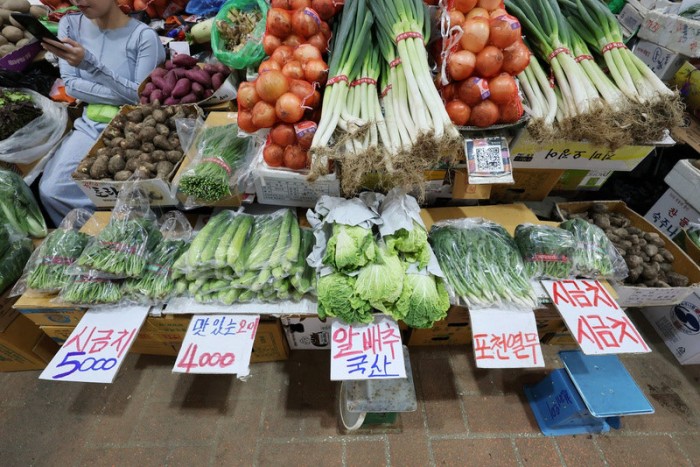 |
| A vegetable stall at a traditional market in Seoul. / Yonhap |
Despite high oil prices, falling agricultural product prices brought South Korea's consumer price growth back down to the 2% range after just one month. While upward price pressures such as oil market volatility persist, the government plans to stabilize prices through measures including price ceilings on petroleum products and fuel tax cuts.
According to the "September Consumer Price Trends" released by the Ministry of Data and Statistics on the 2nd, the consumer price index stood at 120.43 (2020=100) last month, up 2.9% from the same month last year. After posting a 3.1% gain in August, inflation returned to the 2% range.
By item category, industrial products including petroleum products climbed 4.2% year-on-year, driving price gains last month. In particular, petroleum products rose 14.8%, posting gains of over 14% for two consecutive months, with diesel surging 20.0% and gasoline advancing 11.8%.
Processed food and information technology (IT) products climbed in tandem. Processed food rose 2.1% due to factory-gate price hikes, while electronic product price gains also widened, with computer prices surging 27.4% on the back of rising semiconductor prices.
During the same period, agricultural, livestock, and fisheries products fell 0.3%, continuing a downward trend for two straight months and acting as a downward drag on overall inflation. Among them, agricultural products dropped 4.0%, with key staples apple and napa cabbage decreasing 9.2% and 15.2%, respectively.
Lee Doo-won, director general for economic trends statistics at the ministry, explained, "Shipments of apples, pears, and other items increased ahead of the holiday, widening the decline in fruit prices. A combination of government discount support and supply conditions drove down agricultural prices."
The cost of living index, composed of frequently purchased items that account for a large share of household spending, climbed 2.5% year-on-year, escaping the 3% range after one month.
The government analyzed that measures such as price caps on petroleum products, implemented after the outbreak of the Middle East war, contributed to price stabilization. According to the Ministry of Economy and Finance, inflation last month would have reached an estimated 3.5% in the absence of the price ceiling policy.
As state-level price policies—such as the price cap mechanism and Chuseok livelihood stabilization measures—have a tangible impact on actual inflation rates, the government intends to devote all efforts toward stabilizing the public livelihood economy going forward.
Lee Joo-seop, director general for public livelihood economy at the ministry, presided over the "Price-Related Ministries Meeting and Pan-Government Joint Task Force on Infringements on People's Livelihood" on the same day, stating, "As upward price pressures persist due to the prolonged Middle East war, the government must make every effort to manage prices stably."
He added, "We must strengthen supply and price management across agricultural, livestock, and fisheries product categories, continue efforts to improve distribution structures, stabilize petroleum prices through price caps and fuel tax cuts, and ensure thorough support for vulnerable groups through oil price-linked subsidies."
Seo Byung-ju
Most Read
-
1
Alteogen secures European patent for Keytruda SC,..

-
2
Trump shares map on social media labeling Strait o..

-
3
Celltrion seeks rheumatoid arthritis indication ex..

-
4
Kia Sportage outperforms Mazda CX-5 in German auto..

-
5
Chinese e-commerce giants AliExpress, Temu and She..

-
6
China expels No. 2 military official Zhang Youxia..

-
7
Houthi rebels release video claiming downing of Sa..

PEOPLE







-
Address : In-Young Bldg., 34, Uisadang-daero 1-gil, Yeongdeungpo-gu, Seoul
Copyright by ASIATODAY CO., LTD. All rights resereved