



Spike in 30-year U.S. Treasury yields rattles Asia
Oct 01, 2026, 09:40 am


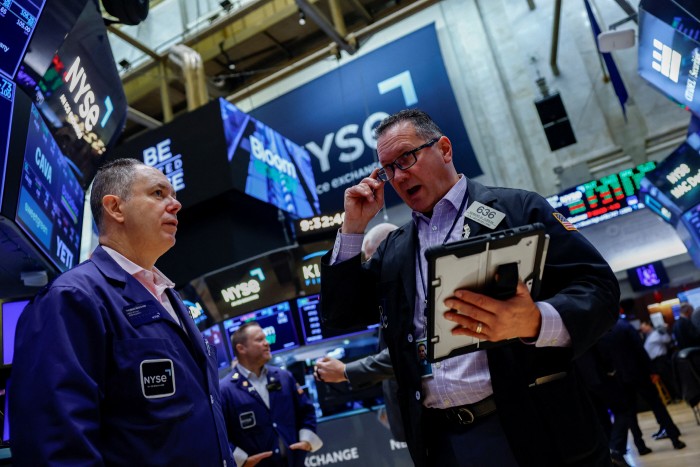 |
| Traders work on the floor of the New York Stock Exchange (NYSE) on the 29th (local time). Wall Street's three major indexes closed lower across the board on the day as the 30-year U.S. Treasury yield touched an intraday high unseen since 2002. / Reuters, Yonhap |
Yields on 30-year U.S. Treasury bonds rose for a sixth consecutive trading session on the 29th (local time), touching an intraday high of 5.613% to record their highest level since 2002. The surge in long-term U.S. interest rates is amplifying the risk of capital flight from Asia and compounding upward pressure on borrowing costs. Bloomberg reported that South Korean government bonds are the most sensitive in emerging Asia to shifts in the U.S. yield curve.
30-year U.S. Treasury yields reach intraday high of 5.613%, highest since 2002, while 2-year yields dip following comments from New York Fed president
CNBC reported that the yield stood at 5.600% at 2:50 p.m. (3:50 a.m. on the 30th KST), up 3.8 basis points from the previous session. Bloomberg noted that after Federal Reserve Bank of New York President John Williams remarked that one additional rate hike toward year-end could be appropriate while stressing there was no need to rush into further action, market expectations for near-term tightening receded somewhat, sending two-year yields down by as much as 5 basis points before trading around 4.89%.
International oil prices fell that day on news of Saudi Arabia resuming crude exports. Brent crude futures settled down 2.56% at 102.59 dollars per barrel (139,286 won), while West Texas Intermediate (WTI) dropped 3.48% to finish at 89.38 dollars (121,351 won). Long-term bond supply pressures persisted, however, as Paramount Skydance pursued issuing around 32 billion dollars (43.45 trillion won) in investment-grade corporate bonds to fund its acquisition of Warner Bros. Discovery.
Foreign net outflows from Asian equities reach 192 billion dollars, yield spreads with U.S. Treasuries near extreme levels
The rise in U.S. Treasury yields is spreading across Asian financial markets. Bloomberg analyzed that interest rate gaps between U.S. Treasuries and emerging Asian sovereign bonds are nearing record levels, escalating the risk of regional capital outflows. The discount on Malaysian 10-year bonds relative to U.S. Treasuries widened to 125 basis points, its largest since 2007, while the discount on Thai 10-year bonds spread to 290 basis points, approaching an all-time peak.
Foreign capital flight was pronounced in Asian stock markets as well. Manish Raychaudhuri, chief executive of Ammer Capital Partners, wrote in a Reuters column that monthly net foreign selling of Asian equities was estimated at 192 billion dollars (260.68 trillion won) through the 25th, far exceeding the 2025 peak of 45 billion dollars. The mechanism is one where climbing U.S. interest rates prompt global capital to rotate into dollar assets, thereby putting pressure on capital outflows from emerging markets.
Rising yields also took a toll on equity valuations. While average 10-year yields in Asia rose from 3.4% at the end of last October to 4.2% late this month, the 12-month forward price-to-earnings (P/E) ratio for the FactSet Asia Market Index dropped from 16.7 times to 12.5 times. Raychaudhuri pointed out that the contraction in P/E ratios was sharpest in the South Korean and Taiwanese markets—which carry heavy weightings in tech equities such as Samsung Electronics, SK Hynix, and TSMC—during this phase of rising U.S. yields.
Bloomberg notes South Korean sovereign debt is most sensitive to U.S. yield curve steepening, with foreign ownership at 12%
South Korea's bond market was also identified as possessing a structure vulnerable to shifts in long-term U.S. interest rates. According to a Bloomberg analysis in February covering four phases where the U.S. Treasury yield curve steepened over the preceding 12 months, every 20-basis-point steepening in the U.S. curve widened the spread between South Korea's 3-year and 10-year yields by an average of 8 basis points. In effect, for every 1 basis point the U.S. Treasury yield curve steepened, South Korea's government bond yield curve steepened by 0.41 basis points.
Stephen Chiu, chief Asia FX and rates strategist at Bloomberg Intelligence, assessed that South Korean sovereign bonds are the most vulnerable in emerging Asia to a steepening U.S. Treasury yield curve. Lower South Korean yields provide insufficient buffer against rising U.S. Treasury yields, while a high proportion of foreign ownership was also cited as a factor compounding sensitivity.
The burden of climbing U.S. interest rates surfaced in the domestic equity market as well. The Kospi slipped 18.93 points (0.27%) on the 29th from the previous session to close at 6,870.81, marking a two-day slide as foreign investors sold a net 2.99 trillion won. Downward pressure from rising U.S. rates and quarter-end rebalancing by global pension funds were pointed to as underlying drivers. In response, the South Korean government decided to scale back its issuance of Treasury bonds to counter rising domestic bond yields. The Ministry of Economy and Finance stated that Deputy Prime Minister and Minister of Economy and Finance Lee Hyung-il convened an expanded macroeconomic and financial meeting on the 30th, deciding to reduce Treasury bond issuance volumes by utilizing increased tax revenues generated by the semiconductor boom.
Ha Man-ju
Most Read
-
1
Alteogen secures European patent for Keytruda SC,..

-
2
Trump shares map on social media labeling Strait o..

-
3
Celltrion seeks rheumatoid arthritis indication ex..

-
4
Chinese e-commerce giants AliExpress, Temu and She..

-
5
China expels No. 2 military official Zhang Youxia..

-
6
Houthi rebels release video claiming downing of Sa..

-
7
Trump rejects Iran's offer to open Strait of Hormu..

PEOPLE







-
Address : In-Young Bldg., 34, Uisadang-daero 1-gil, Yeongdeungpo-gu, Seoul
Copyright by ASIATODAY CO., LTD. All rights resereved