



U.S. House China committee chair warns Seoul's close ties with China pose risk to U.S.
Oct 01, 2026, 09:49 am


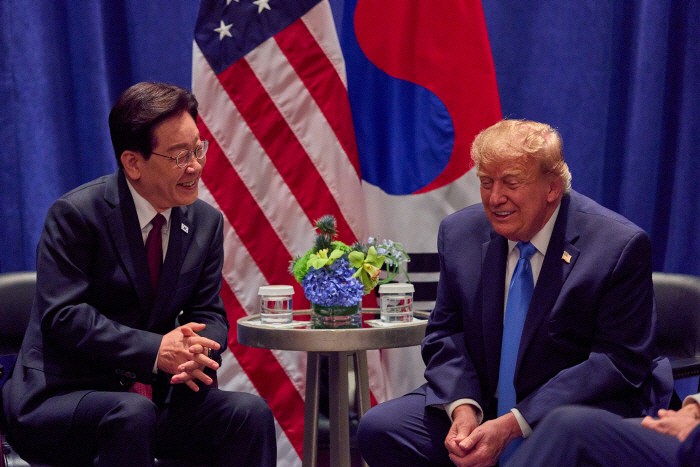 |
| President Lee Jae-myung, visiting the U.S. to attend the United Nations General Assembly, holds a summit meeting with U.S. President Donald Trump at a hotel in New York on the 22nd (local time). / Joint Press Pool |
John Moolenaar, chairman of the U.S. House Select Committee on the Strategic Competition Between the United States and the Chinese Communist Party, sent a letter to Secretary of State Marco Rubio calling for heightened vigilance, arguing that South Korea's economic, technological, and diplomatic moves toward China pose "significant risks" to the U.S., the committee disclosed on the 30th (local time).
Citing high-level summit exchanges between South Korea and China, South Korean firms' semiconductor investments in China, and discriminatory regulations against U.S. businesses, Chairman Moolenaar raised the possibility that friction between Seoul and Washington could evolve into a "structural shift" in South Korea's foreign alignment. He requested the State Department provide a briefing by October 31 on developments in South Korea-China relations and the administration's response.
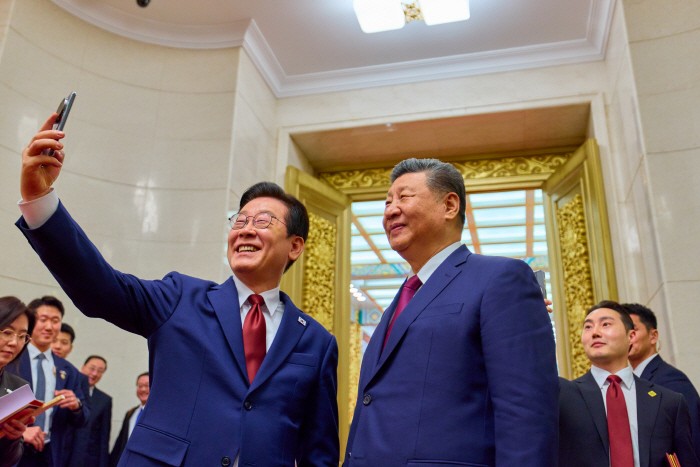 |
| President Lee Jae-myung and Chinese President Xi Jinping take a commemorative photo with a Xiaomi smartphone following a state dinner at the Great Hall of the People in Beijing, China, on January 5. The Xiaomi smartphone was presented by President Xi as a gift to President Lee during the Gyeongju summit in November 2025. / Joint Press Pool |
U.S. House China committee chair warns of structural alignment shift amid Seoul-Beijing rapprochement, urges heightened vigilance in letter to Secretary of State Rubio
At the outset of the letter dated September 28 and dispatched on the 29th, Chairman Moolenaar recalled Secretary Rubio's testimony before the House Foreign Affairs Committee in June, in which Rubio remarked that "elected leaders in South Korea are taking positions contrary to U.S. national interests." Moolenaar noted that his letter details concerns corroborating that assessment and expressed readiness to cooperate with the State Department to respond appropriately to the shifting dynamics in South Korea-China relations.
While noting that "the U.S.-ROK alliance remains indispensable," he argued that precisely for this reason, the possibility that frictions could develop into a structural shift in South Korea's foreign alignment warrants close monitoring and, if necessary, coordinated action.
Chairman Moolenaar stressed that nine months of intensive summit-level exchanges between Seoul and Beijing, deepening South Korean semiconductor investments in China, and discriminatory treatment faced by U.S. firms in South Korea compared to their Chinese-linked competitors demonstrate the need for "heightened vigilance," emphasizing that "alliances are sustained by candor, and divergences between allies over vital national interests are not matters to be taken lightly."
The letter was also copied to Secretary of Defense (War) Pete Hegseth, Secretary of Commerce Howard Lutnick, and U.S. Trade Representative Jamieson Greer.
Reuters reported that while Chairman Moolenaar characterized South Korea as a "major U.S. ally," he warned that Seoul's efforts to improve ties with China pose substantial risks to the U.S.
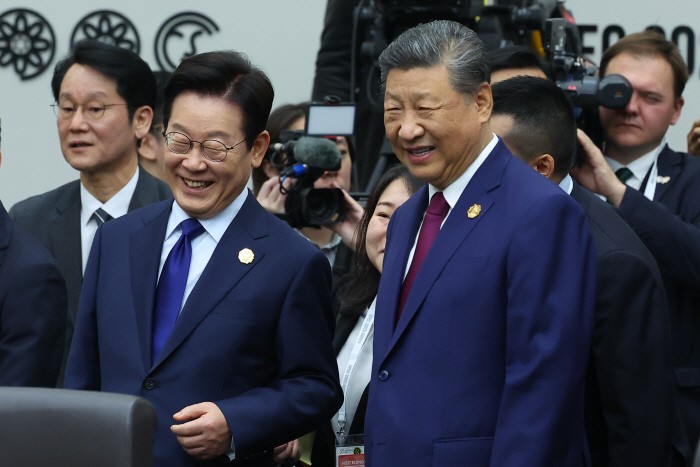 |
| President Lee Jae-myung converses with Chinese President Xi Jinping during the first session of the 2025 Asia-Pacific Economic Cooperation (APEC) summit held at the Gyeongju Hwabaek International Convention Center (HICO) on October 31, 2025. / Yonhap |
Chinese President Xi visits South Korea for first time in 11 years; President Lee makes four-day state visit to China, leading to signing of 14 bilateral MOUs
The letter explained that Chinese President Xi Jinping visited South Korea in 2025 for the first time in 11 years, and two months later in January this year, President Lee Jae-myung made a four-day state visit to China—the first by a South Korean president since 2019—meeting with President Xi, Premier Li Qiang, and Zhao Leji, chairman of the Standing Committee of the National People's Congress.
Chairman Moolenaar noted that President Lee publicly designated 2026 as the year of complete restoration for South Korea-China relations, describing the trajectory of bilateral cooperation as an irreversible trend. The letter stated that 14 memorandums of understanding (MOUs) were signed across trade, science and technology, digital sectors, intellectual property, and quarantine standards.
Chairman Moolenaar asked the U.S. administration to take note of two features of the South Korea-China exchanges at the time. He characterized President Xi's unusually explicit reference to the joint sacrifices made by China and Korea against Japanese militarism 80 years ago as an attempt to drive a wedge between two U.S. treaty allies. Chairman Moolenaar also pointed out that such remarks came at a time when relations between China and Japan were deteriorating over the Taiwan issue. Reuters reported that Chairman Moolenaar evaluated the pace of summit-level exchanges between Seoul and Beijing as unprecedented.
In a post on X (formerly Twitter) this week, President Lee addressed the expansion of South Korea's trade with China, stating, "While the South Korea-U.S. alliance is paramount in diplomacy, managing relations with China is also important." President Lee held talks with President Trump in New York on the 22nd on the sidelines of the UN General Assembly. That meeting took place two days prior to talks between President Trump and President Xi.
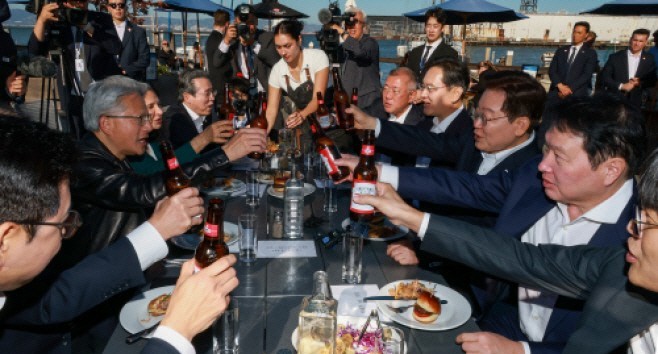 |
| President Lee Jae-myung toasts with attendees during a global artificial intelligence (AI) leaders dinner held at The Ramp restaurant in San Francisco, U.S., on July 24 (local time). From right: Naver Board Chairman Lee Hae-jin, SK Group Chairman Chey Tae-won, President Lee Jae-myung, Samsung Electronics Executive Chairman Lee Jae-yong, Hyundai Motor Group Executive Chair Euisun Chung, Senior Presidential Secretary for Policy Kim Yong-beom, Microsoft Corporate Vice President of Azure Hardware Rani Borkar, Nvidia Chief Executive Officer Jensen Huang, and Deputy Prime Minister and Minister of Science and ICT Bae Kyung-hoon. / Yonhap |
Chinese facilities of Samsung and SK Hynix, export control channels highlighted amid supply chain pressure concerns
The letter pointed out that alongside these exchanges, China has pursued expanding bilateral communication mechanisms regarding export controls and supply chains. Chairman Moolenaar argued that regardless of their stated purpose, such channels create a separate structure running parallel to allied export control coordination, within which China gains visibility into policy deliberations among U.S. allies. He repeatedly criticized China's critical mineral export controls as amounting to an economic declaration of war against the U.S.
Chairman Moolenaar assessed that Samsung Electronics' NAND flash memory plant in Xi'an and SK Hynix's DRAM facility in Wuxi and NAND production facility in Dalian serve as serious leverage points through which the Chinese Communist Party can exert influence over allied global supply chains. He evaluated the administration's decision to terminate the Validated End-User (VEU) status for these facilities on December 31, 2025, and transition to an annual, facility-by-facility licensing regime as the correct policy. However, he expressed concern that this measure creates an annually recurring pressure point, leading South Korea to seek compromises with China due to commercial incentives and providing Chinese authorities with predictable opportunities to exercise leverage.
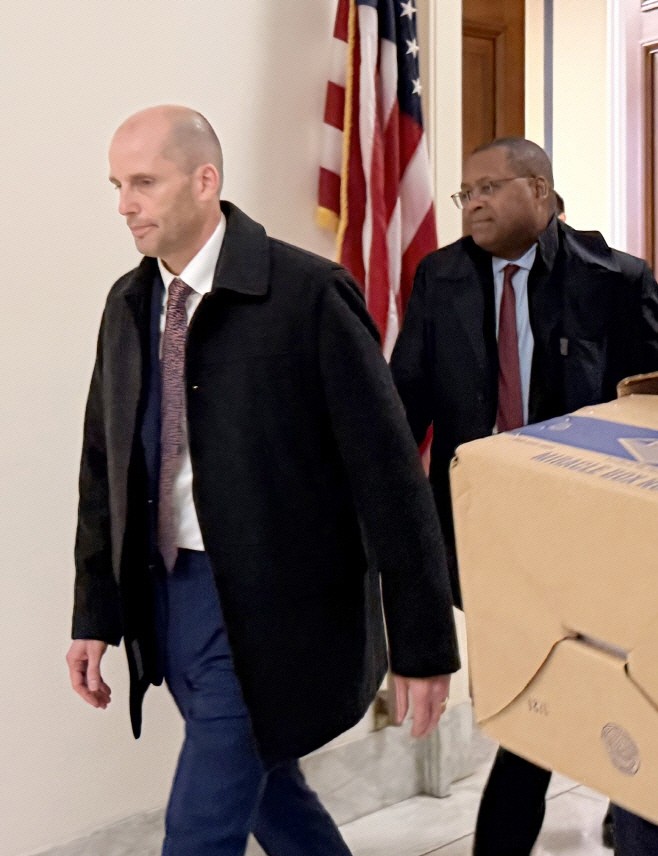 |
| Harold Rogers, interim chief executive officer of Coupang's South Korean entity (left), exits after testifying at a closed-door hearing before the House Judiciary Committee at the U.S. Capitol in Washington, D.C., on February 23 (local time). / Yonhap |
No fines imposed for AliExpress fund theft, while Coupang faces over 400 on-site inspections by 11 agencies and 409 million dollars in penalties
The letter argued that South Korea's law enforcement appears biased against U.S. firms in a manner favorable to Chinese competitors. Chairman Moolenaar noted that AliExpress, owned by Alibaba which the U.S. Department of Defense designated as a Chinese military company, and Temu, investigated over forced labor risks, together secured approximately 16.5 million monthly active users (MAU) in South Korea during the first quarter of 2026, closing in on market leaders.
He pointed out that South Korean authorities were slow to respond even after identifying structural issues, including the unauthorized transfer of consumer personal data to overseas merchants and dozens of unfair terms routing disputes to foreign courts. The letter stated that while the Fair Trade Commission's revised Enforcement Decree of the Electronic Commerce Act took effect on July 21, 2026, the mandate requiring foreign platforms to appoint a domestic representative will only enter into force after 12 months.
Chairman Moolenaar emphasized that this regulatory disparity becomes starker when comparing how South Korean authorities handle severe security incidents involving Chinese-linked companies versus minor matters involving U.S. firms. According to the letter, when hackers exploited a one-time password (OTP) security vulnerability at AliExpress in October 2025 to siphon off roughly 6 million dollars (8.13 billion won) in settlement payouts meant for South Korean small merchants, South Korean regulators conducted no on-site searches and imposed no fines, even though the platform concealed the breach for four months.
The letter also criticized that while toxic levels of lead, cadmium, and endocrine-disrupting chemicals hundreds of times above statutory safety limits were repeatedly detected in children's toys, apparel, and accessories sold on AliExpress and Temu, South Korean authorities granted voluntary compliance agreements for hazardous goods rather than instituting binding legal oversight.
In contrast, Chairman Moolenaar claimed that 11 South Korean regulatory bodies launched an all-out offensive against U.S. firm Coupang following a low-sensitivity data incident in which neither financial data nor passwords were breached, nor was data exfiltrated abroad by Chinese nationals. He noted that authorities imposed penalties totaling 409 million dollars (554.48 billion won) across more than 400 on-site inspections and over 4,400 requests for document submissions.
Chairman Moolenaar expressed concern that the practical effect of South Korea's platform policies is to allow Chinese platforms to expand their market share and capture South Korean consumer data while imposing burdens on U.S. companies. Companies mentioned in the letter did not immediately respond to requests for comment, while Coupang declined to comment, Reuters reported.
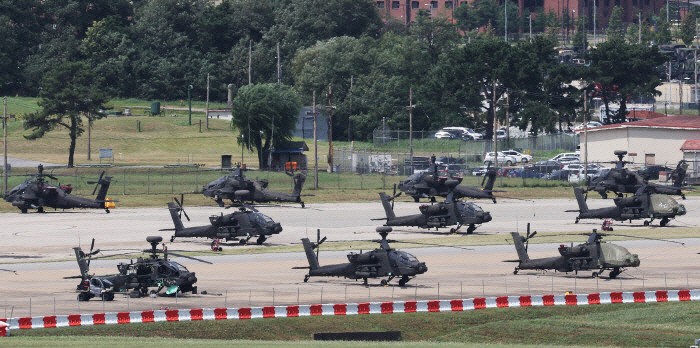 |
| U.S. Forces Korea Apache helicopters remain on standby at Camp Humphreys in Pyeongtaek, Gyeonggi Province, on the 10th. / Yonhap |
Support for Taiwan contingencies and USFK operations questioned, North Korea intelligence-sharing controversy also raised
The letter noted that the widening divide between Seoul and Washington is especially troubling given that the 2026 National Defense Strategy assesses South Korea as capable of assuming primary responsibility for deterring North Korea and seeks to transition the role of U.S. Forces Korea (USFK) toward responding to broader regional contingencies. While acknowledging that South Korea made strides in burden-sharing metrics—including a substantial hike in its 2026 defense budget and progress on the transfer of wartime operational control (OPCON)—Chairman Moolenaar argued that Seoul has publicly framed these moves as reducing reliance on the U.S. rather than expanding contributions to the alliance.
He stressed that Seoul's posture regarding regional contingencies is even more alarming. Chairman Moolenaar pointed out that a February 2026 incident in the West Sea Air Defense Identification Zone led to public friction over notification and coordination, prompting commentaries in South Korea that criticized USFK operations rather than China's actions.
The letter asserted that South Korea has virtually ruled out supporting regional responses to a Taiwan contingency provoked by Chinese aggression, citing President Lee's remark, "Whatever happens across the Taiwan Strait, what does that have to do with us?" Reuters reported that this statement was made during President Lee's 2024 election campaign.
Chairman Moolenaar noted that reports of Unification Minister Chung Dong-young unauthorizedly disclosing classified U.S. intelligence in March 2026 compelled U.S. intelligence agencies to implement new security measures, including restrictions on certain intelligence-sharing regarding North Korea. He pointed out that while President Lee sought the Trump administration's cooperation on initiatives reliant on high trust and strict information security—such as nuclear-powered submarine programs and the OPCON transfer—he publicly criticized these safeguards. According to an April Reuters report cited in the letter, President Lee dismissed claims that Minister Chung leaked U.S.-provided intelligence as "absurd."
Reuters notes letter arrives during period of U.S.-ROK tensions, coincides with prospects of 54 billion dollar Alaska LNG investment
Reuters observed that the letter landed after a period of strained bilateral ties marked by sharp criticism of South Korea from President Trump. While the two nations have maintained an alliance since the 1950–53 Korean War—in which China backed North Korea—divergences over trade, China policy, and security have surfaced even as President Trump pursues improved relations with Beijing, Reuters analyzed.
At the same time, Reuters drew attention to the fact that the letter was sent just as South Korea pledged hundreds of billions of dollars in investments to the U.S. People familiar with the discussions told Reuters that President Trump could announce plans as early as the 30th to deploy South Korea's strategic investment fund toward major U.S. projects, including roughly 54 billion dollars (73.21 trillion won) for Alaska liquefied natural gas (LNG) infrastructure. Reuters previously reported that SK Hynix has been reviewing options ranging from leasing part of Intel's semiconductor facility in Ohio to breaking ground on new production lines for its subsidiary Solidigm.
The South Korean Ministry of Foreign Affairs stated that while it could not comment on the specific details of the letter, the U.S.-ROK alliance forms the cornerstone of South Korea's foreign policy and both countries continue to advance alliance ties across multiple areas. The ministry stressed that South Korean regulatory authorities treat all companies operating domestically on a fair and equal basis.
Ha Man-ju
Most Read
-
1
Alteogen secures European patent for Keytruda SC,..

-
2
Trump shares map on social media labeling Strait o..

-
3
Celltrion seeks rheumatoid arthritis indication ex..

-
4
Chinese e-commerce giants AliExpress, Temu and She..

-
5
China expels No. 2 military official Zhang Youxia..

-
6
Houthi rebels release video claiming downing of Sa..

-
7
Trump rejects Iran's offer to open Strait of Hormu..

PEOPLE






-
Address : In-Young Bldg., 34, Uisadang-daero 1-gil, Yeongdeungpo-gu, Seoul
Copyright by ASIATODAY CO., LTD. All rights resereved