



Retirement at 65 raises questions over jobs and wage structure, not just age limits
Oct 02, 2026, 09:22 am


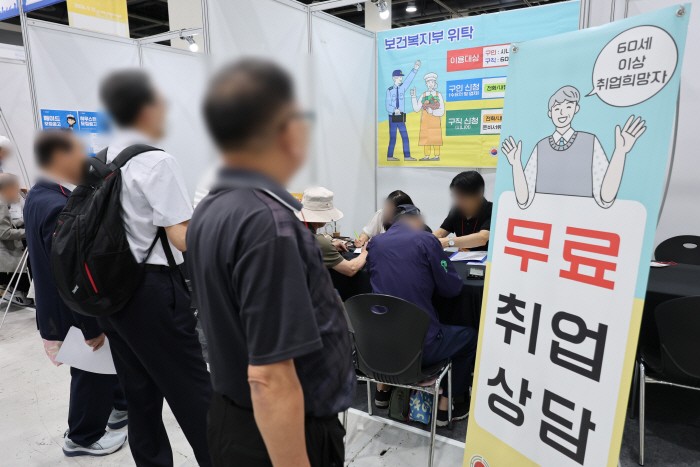 |
| Visitors browse booths at the "Seoul Senior Job Fair 2026," held at the aT Center in Yangjae-dong, Seoul, on September 17. / Yonhap News |
Labor circles are ramping up pressure once again to pass legislation extending the legal retirement age. Raising the retirement age is seen as essential to enable older adults to work longer and reduce the income gap before national pension payouts begin. However, experts point out that merely pushing back the exit age while leaving existing seniority-based pay systems and workforce operations intact risks squeezing new hires and slowing promotions, highlighting the urgent need to overhaul both wage and employment structures in tandem.
According to labor representatives on the 1st, the Federation of Korean Trade Unions (FKTU) sent an official request to the ruling Democratic Party urging the resumption of the special committee on retirement age extension and the convening of a high-level policy consultation, setting a goal to reach a conclusion within the year. Although labor leaders secured commitments to resume talks during a meeting with the party leader last month and reached common ground on wrapping up discussions this year during a presidential briefing, the labor umbrella took formal action after follow-up schedules stalled. The FKTU had walked out of the special committee in January after the legislative timeline was pushed from last year into the second half of this year.
Even if legislative talks resume, coordination will be needed between raising the statutory retirement age outright and combining it with post-retirement rehiring schemes. Extending existing employment contracts versus signing entirely new agreements after retirement can create marked differences in job security, wages, and assigned duties. If rehiring is adopted, rules must also be established governing contract duration and working conditions.
Wage structures represent another critical variable. Under systems where pay automatically increases with years of service, extending employment periods sharply drives up corporate labor expenses. At workplaces with capped headcounts and payroll budgets, such financial strain could lead to cutbacks in junior hiring or delays in promotions. Conversely, if companies can retain skilled workers while adjusting job scopes and working hours, leeway opens up to maintain older workforces alongside new entries.
Kim Deok-ho, a professor at Sungkyunkwan University and former standing member of the Economic, Social and Labor Council, observed, "Increasing older employment does not necessarily crowd out youth jobs. However, simply extending the retirement age within a framework combining seniority-based pay and low labor mobility risks burdening new hiring, making it essential to reform wage structures and job designs simultaneously."
Japan chose not to raise retirement numbers uniformly, requiring companies instead to secure employment through multiple pathways. Employers setting retirement below 65 must implement one of three measures: raising the retirement age to 65, establishing a continuous employment system up to 65, or abolishing mandatory retirement altogether.
This framework is accompanied by structural support. Japan's Ministry of Health, Labour and Welfare emphasizes that extending retirement and continuous employment requires reviewing personnel management systems—including seniority wages and severance allowances—while investing in vocational skills training, identifying roles suitable for older workers, and improving workplace environments. The government also provides expert counseling and institutional guidance to businesses.
Germany operates a "partial retirement scheme for older workers" (Altersteilzeit) that bridges the transition into retirement by simultaneously adjusting working hours and income. When eligible employees agree with their employers to halve their working hours, employers supplement part-time wages and cover additional pension contributions. While not an automatic entitlement for every worker, it offers a proven model for sustaining earnings and pension coverage through flexible hour adjustments.
The Organisation for Economic Co-operation and Development (OECD) similarly recommended that to prolong working lives in South Korea, retirement age extensions must be paired with reducing the influence of job tenure on wages and tackling labor market dualism. The OECD also highlighted the urgency of closing the gap between mandatory retirement and pension eligibility ages.
Another unresolved issue is who actually reaps the benefits of an extended retirement age. While workers enjoying stable tenure until retirement stand to gain directly from extended careers, those already displaced from primary jobs or stuck in precarious employment cannot bridge income gaps through a higher statutory retirement age alone. For these groups, re-employment assistance, vocational training, and income security nets are required in parallel.
Professor Kim stressed, "Discussions on extending retirement must not be confined to simply deciding what age to work until. Multiple avenues must be established together, including post-retirement rehire, job redeployment, phased retirement, and working-hour adjustments. Wage frameworks must also shift from tenure-based to job- and role-based structures to support older worker retention while fostering youth entry into the labor market."
Kim Nam-hyung
Most Read
-
1
Alteogen secures European patent for Keytruda SC,..

-
2
Trump shares map on social media labeling Strait o..

-
3
Celltrion seeks rheumatoid arthritis indication ex..

-
4
Kia Sportage outperforms Mazda CX-5 in German auto..

-
5
Chinese e-commerce giants AliExpress, Temu and She..

-
6
China expels No. 2 military official Zhang Youxia..

-
7
Houthi rebels release video claiming downing of Sa..

PEOPLE







-
Address : In-Young Bldg., 34, Uisadang-daero 1-gil, Yeongdeungpo-gu, Seoul
Copyright by ASIATODAY CO., LTD. All rights resereved