



PPP lawmakers stage mourning-garb protest at Serious Crime Investigation Agency
Oct 02, 2026, 09:12 am


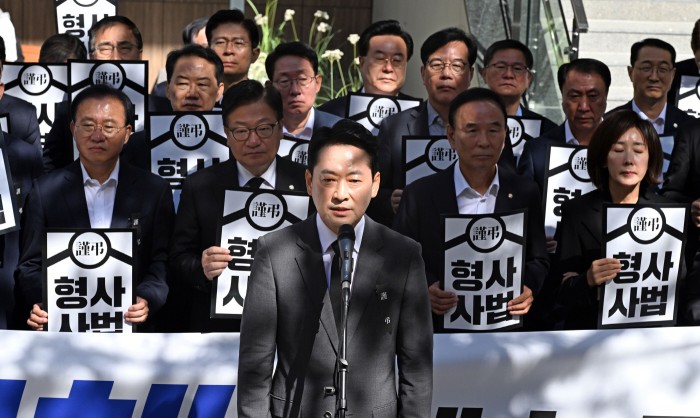 |
| People Power Party leader Jang Dong-hyeok (front) speaks during an on-site general meeting of party lawmakers held outside the Serious Crime Investigation Agency in Jung-gu, Seoul, on the 1st, condemning the dismantling of the criminal justice system on the eve of the Prosecution Service's abolition and the establishment of the Public Prosecution Office and the Serious Crime Investigation Agency. / Reporter Song Ui-ju |
On October 2, South Korea's criminal justice system undergoes a watershed transformation for the first time in 72 years. The Prosecution Service is abolished, with investigative authority transferred to the Serious Crime Investigation Agency and indictment powers handed to the Public Prosecution Office. Both top posts tasked with steering the new framework—the head of the Serious Crime Investigation Agency and the head of the Public Prosecution Office—remain vacant. Holding an on-site general meeting outside the Serious Crime Investigation Agency on the eve of the rollout, the main opposition People Power Party (PPP) zeroed in on leadership vacuums and poor readiness, slamming the transition: "With an empty-shell investigation agency and an empty-shell prosecution office, the gates of hell for public safety have been thrown wide open."
The PPP convened an on-site meeting of party lawmakers outside the agency on the 1st under the banner of "Condemning the Dismantling of the Criminal Justice System." Around 70 lawmakers, including party leader Jang Dong-hyeok and floor leader Jeong Jeom-sig, dressed in black suits and bowed their heads while holding funeral-style placards reading "Condolences: Criminal Justice."
"There is no agency head, no holding cells, no computer network, and staffing is nowhere near complete," Representative Jang warned. "Shuffling cases in circles and burying investigations will become the daily norm." Turning his remarks toward President Lee Jae-myung, Jang added, "The Prosecution Service was abolished for his own sake—to drop existing charges against him. Yet, because he knows all too well the public safety nightmare this will unleash, President Lee himself must be dreading the arrival of October 2 the most. Resuming the trials against President Lee is the only way to save the Republic of Korea."
Floor leader Jeong likewise criticized the move: "Every available mechanism to expose police cover-ups and buried cases has vanished. Starting tomorrow, the gates of hell will open to a collapse of public safety where rape cannot be uncovered as rape, nor murder as murder."
Calling into question the state of the agency's building, Jeong pointed out, "A government organ of a sovereign state has leased space in a commercial office building, and interior renovations are still underway. The offices are desolate, strewn with steel beams and exposed metal piping. This is the stark reality of South Korea's public safety apparatus."
Regarding the leadership vacuum, he remarked, "What is even more alarming is that the top post itself remains unfilled. The Lee Jae-myung administration tore down the prosecution and left the fallout completely unmanaged. Anxious over internal party backlash, they have not even submitted the confirmation hearing request to the National Assembly for Kim Ji-yong, the nominee to head the Serious Crime Investigation Agency."
Representative Park Hyung-soo, the opposition ranking member on the parliamentary Legislation and Judiciary Committee, raised concerns over the independence of investigative bodies. "Until now, prosecutors were able to investigate figures in power thanks to robust status guarantees, but police personnel assigned to the Serious Crime Investigation Agency enjoy no such statutory protections whatsoever. How could they possibly investigate live power?" Park asked. He further charged, "This reorganization of investigative bodies is an act of private retribution for past investigations and indictments against the president. This restructuring of the criminal justice system will face the stern judgment of the public and history."
The PPP plans to ramp up its offensive against the ruling camp by pairing public outreach rallies with the upcoming parliamentary audit. The party aims to hold a large-scale outdoor demonstration on the 3rd to highlight the missteps of the Lee Jae-myung administration, followed by an aggressive focus on the judicial revamp and everyday livelihood issues during the parliamentary audit kicking off on the 6th, seeking to seize the political initiative both inside and outside the National Assembly.
Kim Chae-yeon
Most Read
-
1
Alteogen secures European patent for Keytruda SC,..

-
2
Trump shares map on social media labeling Strait o..

-
3
Celltrion seeks rheumatoid arthritis indication ex..

-
4
Kia Sportage outperforms Mazda CX-5 in German auto..

-
5
Chinese e-commerce giants AliExpress, Temu and She..

-
6
China expels No. 2 military official Zhang Youxia..

-
7
U.S. deploys carrier, 10,000 more troops to Middle..

PEOPLE






-
Address : In-Young Bldg., 34, Uisadang-daero 1-gil, Yeongdeungpo-gu, Seoul
Copyright by ASIATODAY CO., LTD. All rights resereved