



U.S. and S. Korea release fact sheet on 200 billion dollar investment in U.S.
Oct 01, 2026, 10:05 am


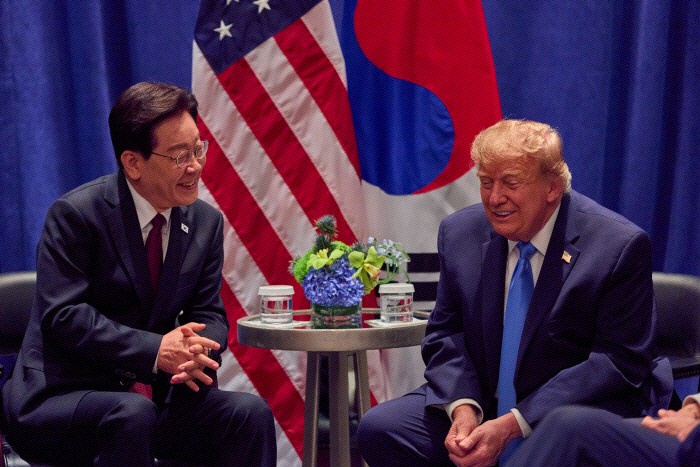 |
| South Korean President Lee Jae-myung, visiting the U.S. to attend the United Nations General Assembly, holds a summit meeting with U.S. President Donald Trump at a New York hotel on the 22nd of last month (local time). / Yonhap |
The governments of South Korea and the U.S. jointly announced specific implementation plans for three strategic investment projects—Texas gas-fired power generation, nuclear power plants, and Alaska LNG—as follow-up measures to the memorandum of understanding (MOU) on strategic investment in the U.S. signed last year. The two governments emphasized, "The plans announced today further strengthen the strategic partnership between our two nations and demonstrate the shared commitment of both governments to implementing the trade agreement."
The South Korean and U.S. governments released a Joint Fact Sheet on the 1st outlining specific implementation plans for strategic investment projects in the U.S.
In a joint press release, both nations stated, "These efforts aim to establish stable and resilient supply chains by enhancing cooperation between South Korea and the U.S. in strategic industrial sectors, including energy."
This Joint Fact Sheet follows the South Korea-U.S. trade agreement announced on July 30 of last year and the intergovernmental memorandum of understanding (MOU) on strategic investment signed on November 14 of the same year.
The two governments added, "Through this announcement, we aim to enhance stability and balance in bilateral trade and investment relations while expanding cooperation across entire supply chains," noting, "We will continue to cooperate in accordance with the principle of good faith to implement the trade agreement."
The first initiative, Project Star, entails investing 22.3 billion dollars to build a 6,472-megawatt natural gas power generation facility in Encinal, Texas.
Power produced will be directly supplied to an adjacent data center, with plans to begin phase-one commercial operations in 2029 and progressively bring all facilities online by 2032.
The venture will be led by U.S. developer Related Companies and utility NextEra Energy, while Texas natural gas producer Lewis Energy Group will provide the site along with associated infrastructure such as gas and water supplies.
Both governments noted, "The two countries plan to collaborate to expand the participation of South Korean firms across the entire project lifecycle, including equipment, engineering, procurement, and construction (EPC), as well as long-term operations and maintenance (O&M)."
Furthermore, the U.S. expressed its willingness, in accordance with the principle of good faith, to offer opportunities for South Korean companies to supply South Korean-made equipment, including turbines, to similar projects within the U.S.
The second initiative, Project Power, is a comprehensive cooperation framework to construct eight large-scale nuclear power reactors in the U.S. It encompasses building two South Korean-designed APR1400 units and six Westinghouse AP1000 units.
The two sides plan to expand U.S. power generation capacity and bolster energy security while contributing to the U.S. objective of breaking ground on 10 large-scale nuclear reactors by 2030. The blueprint aims to expand cooperation in the global nuclear power market going forward by combining U.S. nuclear technology with South Korean construction and supply chain capabilities.
Signatories to Project Power include the South Korean and U.S. governments, Westinghouse, Korea Electric Power Corporation (KEPCO), and Korea Hydro & Nuclear Power (KHNP).
Out of the total 200 billion dollar strategic investment ceiling, 120 billion dollars will be allocated to Project Power. Of this amount, 100 billion dollars is earmarked for nuclear reactor construction costs, and 20 billion dollars serves as contingency reserves against construction cost escalation.
The two nations agreed to cooperate in remitting an advance payment of 10 billion dollars by the end of the year, contingent upon fulfilling requirements under domestic laws. The advance payment will primarily be used to secure long-lead items required for nuclear reactor construction early on.
In addition, South Korean companies will pursue a minority equity stake investment in Westinghouse Electric Company (WEC). This framework is designed to allow South Korea and the U.S. to share commercial profits generated from large-scale nuclear reactor projects, with specific investment terms to be finalized through future consultations between the parties involved.
The third initiative, Project North, centers on the Alaska LNG venture. Seoul and Washington agreed to commence project review, premised on commercial reasonableness as stipulated in the strategic investment MOU and compliance with each country's domestic legal requirements.
The U.S. agreed to support the participation of South Korean vendors and suppliers throughout project implementation.
In addition, plans call for ensuring, to the extent feasible, that long-term offtake agreements can be signed at economically viable prices for Alaska LNG produced through the project, while granting South Korea priority access to the produced LNG.
Kim Jeong-gyu
Most Read
-
1
Alteogen secures European patent for Keytruda SC,..

-
2
Trump shares map on social media labeling Strait o..

-
3
Celltrion seeks rheumatoid arthritis indication ex..

-
4
Chinese e-commerce giants AliExpress, Temu and She..

-
5
China expels No. 2 military official Zhang Youxia..

-
6
Houthi rebels release video claiming downing of Sa..

-
7
Trump rejects Iran's offer to open Strait of Hormu..

PEOPLE







-
Address : In-Young Bldg., 34, Uisadang-daero 1-gil, Yeongdeungpo-gu, Seoul
Copyright by ASIATODAY CO., LTD. All rights resereved