



South Korea's exports surpass 800 billion dollars for first time
Oct 01, 2026, 10:02 am


 |
| / Yonhap |
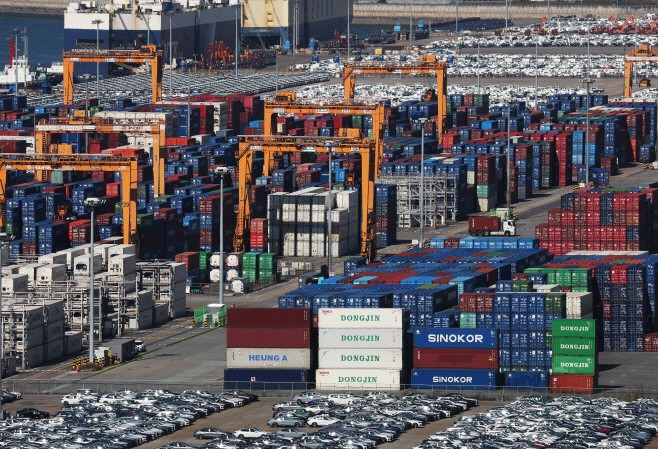
South Korea's outbound shipments surpassed 120 billion dollars last month for the first time in history. Cumulative exports through September have already overtaken last year's annual record of 709.3 billion dollars, bringing the 1 trillion dollar milestone within sight.
According to September import and export trends released by the Ministry of Industry and Trade on October 1, exports last month jumped 83.5% year-on-year to reach 120.94 billion dollars. This marks the first time monthly exports have cleared the 120 billion dollar threshold.
Cumulative exports through last month totaled 814.5 billion dollars, surpassing the previous full-year record high of 709.3 billion dollars set last year.
Average daily exports adjusted for working days also surged 105% compared to the same month last year to hit 5.63 billion dollars. This is also the first time daily exports have exceeded 5 billion dollars.
Semiconductors stood at the center of the export surge. Semiconductor exports last month rocketed 262.8% year-on-year to 60.3 billion dollars. As strong demand for memory persisted alongside simultaneous gains in export volumes and contract prices, monthly semiconductor exports crossed 60 billion dollars for the first time.
Memory contract prices also maintained their upward trajectory. The price of 16Gb DDR5 climbed from 37.5 dollars in May to 48 dollars in September, while 128Gb NAND prices advanced from 26.5 dollars to 30.6 dollars over the same period.
Computer shipments saw a sharp increase driven by expanding investments in AI infrastructure. Computer exports in September surged 435.3% to 7 billion dollars, sustaining upward momentum amid the spread of agentic AI and continued demand for AI infrastructure such as data centers.
Wireless communication device exports rose 23.4% to 2.14 billion dollars, marking an 11th consecutive month of growth. Strong sales of premium smartphones including the Galaxy Z8 series and S26 Ultra, coupled with higher shipments of components bound for iPhones, contributed to the gains.
In mobility, performances were mixed. Automobile exports dropped 5.5% to 6.05 billion dollars. A base effect from fewer working days emerged because the Chuseok holiday fell in September this year unlike last year when it was in October, and sluggish used-car exports also weighed on results. Daily average automobile exports, however, gained 5.5%.
Ship exports increased 29.9% to 3.76 billion dollars, boosted by higher delivery volumes of LNG carriers and very large gas carriers (VLGCs).
Petroleum product exports reached 7.22 billion dollars, rising 72.0% on the back of higher global crude oil prices. Petrochemical exports also climbed 5.1% to 3.95 billion dollars. These gains, however, were heavily driven by price increases, as export volumes in September fell 6.9% for petroleum products and 19.1% for petrochemicals.
Secondary battery exports rose 14.0% to 720 million dollars, marking five straight months of expansion. The increase reflected volume growth driven by the expanding energy storage system (ESS) market along with unit price improvements fueled by rising mineral prices.
Imports rose 26.0% year-on-year to 71.09 billion dollars. Energy imports advanced 38.0% to 12.96 billion dollars, while non-energy imports grew 23.6% to 58.13 billion dollars.
Crude oil imports rose 38.4% to 8 billion dollars as import volumes climbed 2.0% and unit prices increased 35.7%. In the non-energy segment, imports of semiconductor manufacturing equipment rose 50.8% to 3.44 billion dollars, while wireless communication device imports rose 27.3% to 2.01 billion dollars.
The trade balance posted a surplus of 49.85 billion dollars. This is an increase of 40.37 billion dollars compared to the same month last year, marking the first time a monthly trade surplus has crossed 40 billion dollars. The cumulative trade surplus from January through September reached 252.5 billion dollars, up 202.7 billion dollars from the same period last year.
The government views the likelihood of hitting 1 trillion dollars in annual exports this year as having increased. However, external factors such as intensifying global protectionism and instability in the Middle East are cited as variables that could constrain export growth momentum.
Minister Kim Jung-kwan stated, "While expectations are rising that we will achieve 1 trillion dollars in annual exports, strengthening global protectionism and regional tensions in the Middle East remain major variables for our exports." He added, "The government will keep high-level channels with trade authorities of major nations operational at all times and closely monitor export restriction trends, while taking proactive measures to prevent unexpected external variables from adversely impacting our shipments so that we can sustain export upward momentum through the remaining fourth quarter."
Kim Jeong-gyu
Most Read
-
1
Alteogen secures European patent for Keytruda SC,..

-
2
Trump shares map on social media labeling Strait o..

-
3
Celltrion seeks rheumatoid arthritis indication ex..

-
4
Kia Sportage outperforms Mazda CX-5 in German auto..

-
5
Chinese e-commerce giants AliExpress, Temu and She..

-
6
China expels No. 2 military official Zhang Youxia..

-
7
Houthi rebels release video claiming downing of Sa..

PEOPLE







-
Address : In-Young Bldg., 34, Uisadang-daero 1-gil, Yeongdeungpo-gu, Seoul
Copyright by ASIATODAY CO., LTD. All rights resereved