



Air strikes, terror attacks, and cross-border clashes: why Pakistan cannot break the cycle of violence
Sep 29, 2026, 10:14 am


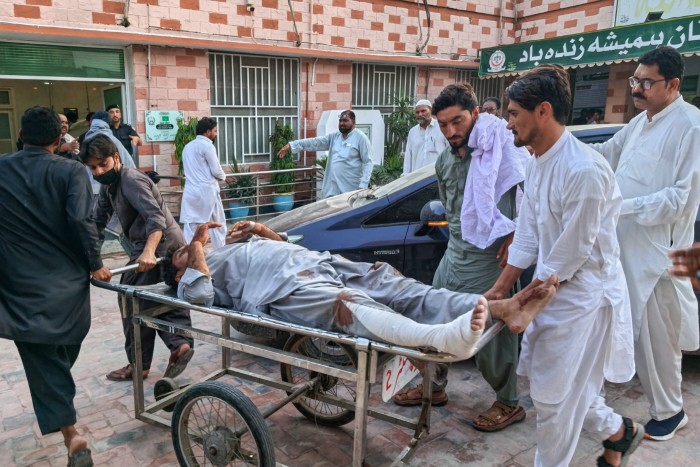 |
| Injured victims of a suicide bombing are transported to a hospital in Dera Ismail Khan, northwestern Pakistan, on the 26th local time. A suicide bombing targeting a roadside police checkpoint occurred that day, leaving a trail of casualties. / AP, Yonhap News |
Tensions are escalating along the border between Pakistan and Afghanistan amid a series of cross-border clashes, bombings, and retaliatory airstrikes. As both nations trade military strikes and blame, critics point out that a counterterrorism strategy relying solely on military retaliation has hit its limits.
According to Reuters on the 27th local time, the Afghan Ministry of Defense announced that it killed 28 militants and wounded 32 others who infiltrated the Kamdesh district in the eastern province of Nuristan the previous day. The ministry claimed the group included Islamic State (IS) members and consisted mostly of former Afghan government security personnel. According to the ministry's explanation, Pakistani intelligence agencies brought them into Pakistan under the pretext of assistance, trained them, and sent them to Nuristan, while Pakistani militias coordinated with them before pulling back once the fighting started.
The Pakistani government issued an immediate refutation. Pakistan's Ministry of Information and Broadcasting stated on X (formerly Twitter) that the Afghan side's claims are "frivolous, baseless, and devoid of any truth". It maintained that Pakistani security forces and intelligence agencies never took part in the Nuristan clashes, nor did they train former Afghan personnel or support IS, adding that video presented as evidence was fabricated.
On the same day, a terrorist attack struck within Pakistan as well. Local emergency response service Rescue 1122 said an explosion occurred in the Darazinda area of Dera Ismail Khan in northwestern Khyber Pakhtunkhwa province, leaving 11 dead and 30 injured. The Tehrik-i-Taliban Pakistan (TTP) claimed responsibility for the assault. In this region near the Afghan border, attacks targeting police and security forces had continued into this month.
A 10-day frenzy of terror attacks, airstrikes, and drone strikes
Military clashes between the two countries escalated in earnest on the 18th. At the time, an attack on a mosque inside a police compound in Kohat, Khyber Pakhtunkhwa, left at least 31 dead and around 100 injured. On the 21st, Pakistan deployed fighter jets to strike TTP camps in Afghanistan's Paktika and Kunar provinces, and the information ministry announced that it killed 28 militants, including suicide bombing trainees.
The Taliban government immediately protested. Denying the existence of terror camps within the country, spokesman Zabihullah Mujahid claimed three civilians were killed in the airstrikes and vowed retaliation. The UN Assistance Mission in Afghanistan (UNAMA) also confirmed the deaths of three civilians.
Subsequently, on the 24th, eight rudimentary drones flew into Pakistani airspace from the Afghan side and were all brought down. Spokesman Mujahid denied involvement in launching the drones, but Pakistani Information Minister Attaullah Tarar said that early that morning, Pakistani forces conducted precision strikes against 10 locations inside Afghanistan identified as drone launch and storage sites. Pakistani authorities view the drone strikes as evidence that the Afghan Taliban is actively aiding the TTP rather than simply tolerating them.
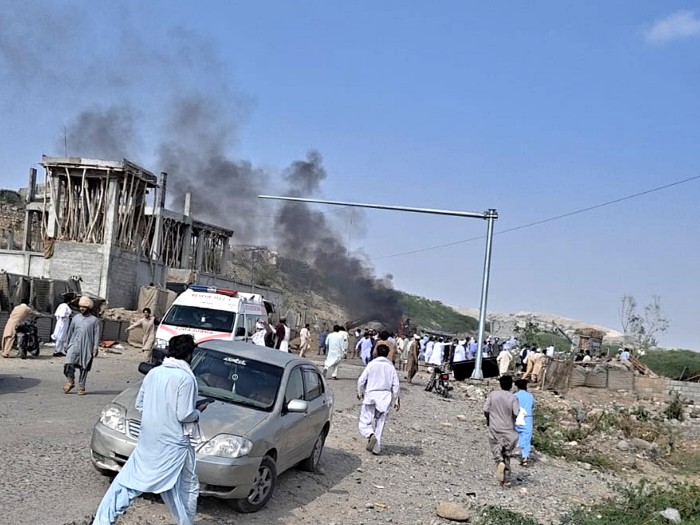 |
| Plumes of thick smoke rise from the site of an explosion near a police checkpoint in Dera Ismail Khan, northwestern Pakistan's Khyber Pakhtunkhwa province, on the 26th local time. A bomb attack targeting a police checkpoint near the site where a peace rally was being held that afternoon left at least 11 people dead. / Xinhua, Yonhap News |
Two decades of strikes and retaliation: military operations hit structural limits
The Pakistani military touts its battlefield results, claiming to eliminate hundreds of militants each month. Yet in Khyber Pakhtunkhwa and southwestern Balochistan provinces, dozens of soldiers, police officers, and civilians continue to lose their lives every month. According to the South China Morning Post (SCMP), experts assess that these tactical victories have failed to translate into the strategic success Islamabad has long sought. The counterterrorism approach, which relies on retaliating only after coming under attack, simply does not work.
Riccardo Valle, a researcher tracking armed groups in South and Central Asia, characterized this strategy as "incomplete and limited." He pointed out that grievances among local residents and an absence of governance are undermining the effectiveness of counterterrorism operations, while provincial police also lack the equipment and capacity to confront armed insurgents. He cited the fact that intelligence operations remain reactive rather than preventive as another shortcoming. Valle noted that "tactical gains are not compensating for larger strategic flaws, fueling a cycle of instability," analyzing that the insurgency has become entrenched as a "multigenerational problem" that continuously absorbs younger generations.
Diplomatic mediation efforts have also stalled. Pakistani officials believe the Taliban government is responding unenthusiastically to mediation offers from China, Turkiye, and Qatar. According to local security analyst Iftikhar Firdous, compromise options such as establishing a joint border surveillance mechanism were discussed during talks in Belarus last summer, but broke down after the Afghan side rejected Pakistan's demands to halt TTP attacks or isolate the group from the border. High-ranking officials from Qatar and Turkiye visited Kabul on the 17th to mediate, but their presence failed to prevent the Kohat attack the following day.
Signs are also emerging that the battle lines are widening, with indications of operational ties between the Islamist TTP and Baloch separatist militants. In July, the TTP and the Balochistan Liberation Army (BLA) carried out back-to-back attacks hours apart in Pishin and Ziarat in Balochistan province. Muhammad Faisal, a researcher at the University of Technology Sydney, observed growing tactical cooperation, including joint training and logistical coordination, though he noted it remains uncertain whether this will evolve into a lasting strategic alliance given their divergent objectives: overthrowing the Pakistani state versus secession.
Farwa Aamer, director of South Asia initiatives at the Asia Society Policy Institute in the U.S., pointed out that "force alone cannot deter long-term security threats, and violence only begets more violence," adding that "in the absence of a political solution and an effective counterinsurgency strategy, prolonged instability could dampen foreign investment, including in critical minerals."
Jeong Ri-na
Most Read
-
1
Trump shares map on social media labeling Strait o..

-
2
Trump demands rates fall below 1% as Fed hikes for..

-
3
Celltrion seeks rheumatoid arthritis indication ex..

-
4
Chinese e-commerce giants AliExpress, Temu and She..

-
5
Trump warns countries not helping U.S. must pay re..

-
6
China expels No. 2 military official Zhang Youxia..

-
7
Houthi rebels release video claiming downing of Sa..

PEOPLE






HEADLINE NEWS
- N. Korea declares nuclear status irreversible and condemns S. Korea, U.S., Japan at UN
- Japan tracks Ukraine fiber-optic drones, bolsters SDF electronic warfare
- Wave of undocumented Chinese caught in Argentina after Brazil's visa-free m..
- France's far-right National Rally forms first-ever parliamentary group in S..

-
Address : In-Young Bldg., 34, Uisadang-daero 1-gil, Yeongdeungpo-gu, Seoul
Copyright by ASIATODAY CO., LTD. All rights resereved