



S. Korea moves to institutionalize telemedicine, but policy details remain undecided
Sep 28, 2026, 09:38 am


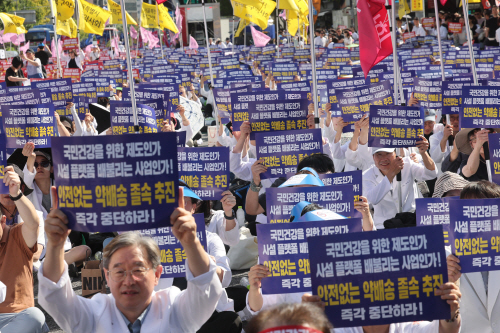 |
| Participants hold placards outlining their demands during a nationwide rally of pharmacists in front of Dongwha Duty Free in Jongno-gu, Seoul, on the 20th. / Yonhap |
Ahead of the formal institutionalization of telemedicine, the South Korean government has amended the Enforcement Decree of the Medical Service Act, moving to refine regulatory frameworks for the stable rollout of remote care. While the government established legal grounds for easing telemedicine restrictions and operating system infrastructure, the amendment left out guidelines on prescription duration limits and the expansion of medication delivery—issues where sharp disagreements persist with medical and pharmaceutical circles—suggesting that debate surrounding these matters will continue.
According to the Ministry of Health and Welfare on the 27th, the proposed partial amendment to the Enforcement Decree of the Medical Service Act will be open for public comment through November 2. With the revised Medical Service Act institutionalizing telemedicine scheduled to take effect on December 24, this enforcement decree outlines detailed operational provisions necessary to implement the system.
First, the Health Insurance Review and Assessment Service will be entrusted with receiving, investigating, analyzing, and generating statistics on non-reimbursed telemedicine records, as well as building and operating related information systems. In addition, the decree specifies criteria for relaxing telemedicine regulations during emergencies—such as disasters, infectious disease outbreaks, wartime or national emergencies, and collective closures or strikes by healthcare professionals that severely hinder in-person care—providing legal grounds to expand telemedicine services during crises.
Provisions for establishing and running the technical infrastructure are also included. Under the proposed decree, the National Health Insurance Service will be entrusted with building and operating the telemedicine support system and electronic prescription delivery system, reporting its operational performance to the Minister of Health and Welfare semiannually.
The ministry plans to collect and review feedback on the decree before promulgating and enforcing it alongside the implementation of the revised Medical Service Act on December 24. A ministry official said, "We aim to strengthen patient safety and data privacy through the stable management and operation of the telemedicine system."
Although prepared to overhaul regulations with telemedicine institutionalization just three months away, the amendment makes no mention of issues closely watched by the medical community, such as prescription limits and comprehensive medication delivery. Medical and pharmaceutical groups, including the Korean Medical Association and the Korean Pharmaceutical Association, argue that initial telemedicine consultations should be capped at a maximum seven-day prescription supply, citing potential risks to patient health. They maintain that clear standards capping prescription lengths for first-time telemedicine patients must be codified in subordinate statutes of the Medical Service Act to prevent prolonged prescriptions issued without direct in-person examinations.
Furthermore, strong pushback continues from pharmaceutical circles following government plans to expand drug delivery to all telemedicine patients. On the 20th of last month, the government announced plans to establish a pan-governmental public-private consultative council comprising relevant ministries—including the health ministry, the Ministry of SMEs and Startups, and the Office for Government Policy Coordination—alongside pharmacist groups and telemedicine platform operators to discuss measures for expanding medication delivery under telemedicine.
At a nationwide rally on the 20th, Korean Pharmaceutical Association President Kwon Young-hee said, "We firmly reject a private platform-driven telemedicine system that undermines public healthcare, triggers doctor-shopping and drug misuse, and threatens public safety."
Seo Byung-ju
Most Read
-
1
Celltrion nears additional contract with major U.S..

-
2
Putin proposes trilateral U.S.-China-Russia summit..

-
3
U.S. weighs dropping MOAB, world's most powerful n..

-
4
"Aren't those foreigners on welfare?": M..

-
5
Houthis launch successive attacks on Saudi airport..

-
6
Saudi Arabia, Iran hold first diplomatic talks to..

-
7
Saudi airport in Riyadh struck again, leaving at l..

PEOPLE






HEADLINE NEWS

-
Address : In-Young Bldg., 34, Uisadang-daero 1-gil, Yeongdeungpo-gu, Seoul
Copyright by ASIATODAY CO., LTD. All rights resereved