



Lee faces time for domestic politics as avalanche of major issues looms
Sep 28, 2026, 09:18 am


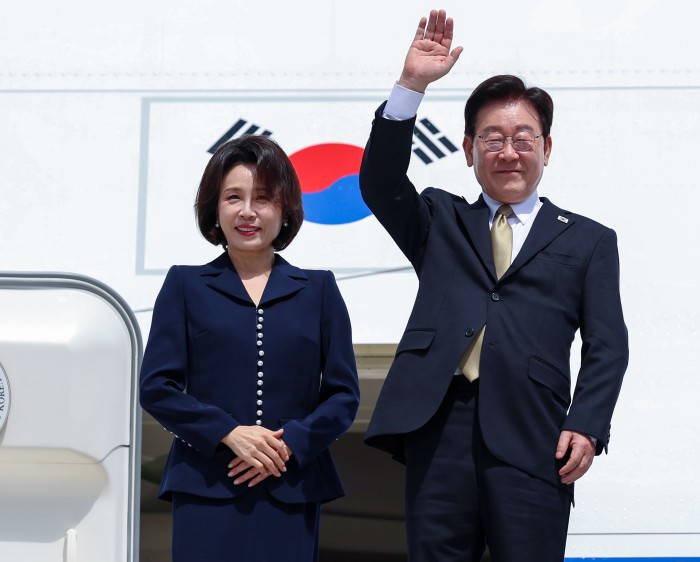 |
| President Lee Jae-myung and First Lady Kim Hea-kyung wave to well-wishers from Air Force One at Felipe Ángeles International Airport in Mexico City on the 26th local time after concluding a state visit to Mexico. / Yonhap |
President Lee Jae-myung faces another round of domestic politics after wrapping up trips to the U.S. and Mexico that coincided with the Chuseok holiday. A series of major domestic issues awaits, ranging from key appointments in the presidential office following the offered resignation of Chief of Staff Kang Hoon-sik and the vacancy of the chief policy secretary, to a clash with Chief Justice Cho Hee-dae over re-nominating a Supreme Court justice candidate, to a suspected landmine explosion in the Demilitarized Zone (DMZ).
According to the presidential office and other sources on the 27th, the immediate priority for President Lee is realigning his core staff. Kang tendered his resignation on the 21st, the day of the departure for the overseas trip, saying he would take general responsibility for state affairs. Former Chief of Staff for Policy Kim Yong-beom stepped down on the first of the month, leaving the post overseeing economic policies vacant.
President Lee is expected to handle Kang's resignation first, having stated prior to departure that he had not made a decision yet on whether to accept it. Once the issue surrounding Kang is settled, plans for realigning key presidential aides, including naming a successor for the chief policy secretary, are projected to take more concrete shape.
Key criteria for the new chief of staff are viewed as political and organizational reform capabilities following recent controversies over appointments, while the capacity to coordinate real estate, public livelihood, and economic issues is considered crucial for the policy secretary position. Another point of attention is whether the reshuffle will expand into the personnel and civil affairs teams with these two senior vacancies.
Addressing the friction with the judiciary over the re-nomination of a Supreme Court justice candidate is another task. On the 22nd, during President Lee's overseas trip, Chief Justice Cho formalized his refusal to comply with the presidential office's request to recommend an alternative nominee to replace candidate Son Bong-gi. The presidential office strongly pushed back, reiterating its demand for a new nomination.
The standoff has already escalated into an all-out confrontation across political circles, drawing in both ruling and opposition parties. With conflicting constitutional interpretations emerging over the chief justice's recommendation authority versus the president's appointment power, the dispute risks dragging on prolonged. How President Lee cuts through this knot is expected to be a major variable in the political landscape.
The suspected landmine blast in the western DMZ also stands as an urgent security concern. On the 21st, two explosions occurred during a route clearance operation near the Military Demarcation Line in Paju, Gyeonggi Province, injuring three service members. The military and the United Nations Command have launched a joint on-site investigation to determine the cause.
The People Power Party is calling the government's security response into question, pointing to delays in the on-site investigation. The Ministry of National Defense contends that advance preparations were necessary given the risks of the area adjacent to the demarcation line and troops' safety. Depending on the findings regarding the type of explosive and how it was planted, the incident could expand into an inter-Korean issue.
With recent approval ratings hovering in the 30% range, the weight of President Lee's initial domestic response after returning carries even greater significance. How steadily the president settles these personnel, judicial, and security issues upon his return from diplomatic duties is widely seen as the first litmus test for state affairs after the Chuseok holiday.
A ruling camp official noted, "The priority after Chuseok is clearing the backlog of domestic issues while demonstrating stability in state governance. We must also carefully monitor how responses to each issue shape public sentiment and the political climate after the holiday."
Park Young-hoon
Most Read
-
1
Celltrion nears additional contract with major U.S..

-
2
U.S. weighs dropping MOAB, world's most powerful n..

-
3
"Aren't those foreigners on welfare?": M..

-
4
Putin proposes trilateral U.S.-China-Russia summit..

-
5
Houthis launch successive attacks on Saudi airport..

-
6
Saudi Arabia, Iran hold first diplomatic talks to..

-
7
Saudi airport in Riyadh struck again, leaving at l..

PEOPLE





HEADLINE NEWS

-
Address : In-Young Bldg., 34, Uisadang-daero 1-gil, Yeongdeungpo-gu, Seoul
Copyright by ASIATODAY CO., LTD. All rights resereved