



Lee warns of major impact from Hormuz blockade, proposes energy supply chain alliance
Sep 23, 2026, 09:04 am


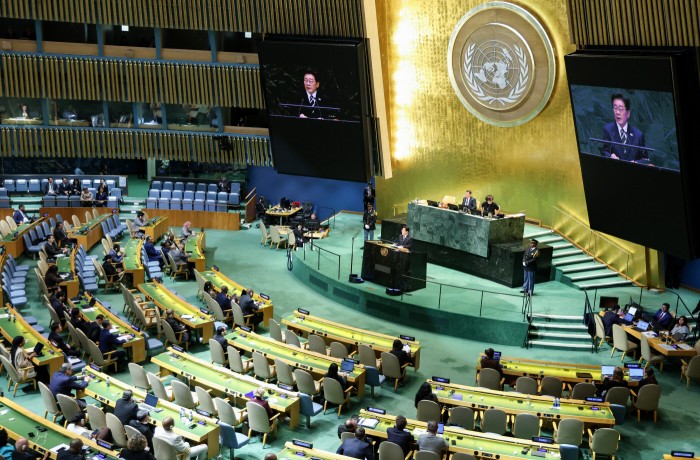 |
| President Lee Jae-myung delivers a keynote address at the United Nations General Assembly hall in New York on the 22nd local time. / Yonhap News |
Delivering a keynote address at the United Nations General Assembly on the 22nd local time during his visit to New York, President Lee Jae-myung addressed the energy crisis triggered by maritime blockades in the Strait of Hormuz and proposed a "Global Energy Supply Chain Solidarity" to overcome it.
The initiative envisions countries with both the capacity and willingness to supply global public goods strengthening energy supply chain cooperation by leveraging existing frameworks, such as the International Energy Agency (IEA)—a framework President Lee characterized as a "Solidarity of Constructive Contributors".
In his address during the high-level general debate of the UN General Assembly, President Lee proposed the partnership, remarking, "The recurring maritime blockades in the Strait of Hormuz and the Red Sea have shown just how severely the daily lives of people around the world are disrupted when critical arteries of energy and logistics are weaponized. Countries equipped with the capacity and will to provide global public goods must expand their space for cooperation."
The "Solidarity of Constructive Contributors" for energy supply chain cooperation represents one of three pillars of the "K-Initiative" vision he outlined during the speech.
President Lee criticized the disruptions, stating, "Free and safe navigation through international straits is a right guaranteed by international law and a pillar underpinning the global economy. Attacking commercial vessels and endangering the lives and safety of seafarers cannot be justified under any circumstances."
He continued, "The Republic of Korea will actively utilize existing cooperative frameworks, including the International Energy Agency (IEA), while reinforcing energy supply chain cooperation even more thoroughly. This is not a challenge South Korea can resolve on its own. Yet, we cannot simply sit idly by until every nation reaches consensus on a single solution."
He then stressed, "Expanding the breadth of cooperation through a 'Solidarity of Constructive Contributors' is crucial."
President Lee clarified, "This is not an effort to create a new institution or an exclusive bloc. Rather, it is about expanding scope in a flexible and open manner while respecting the international order and the functions of the United Nations. When the fruits of such cooperation achieved 'separately yet together' accumulate, we will be able to restore faith in multilateralism beyond geopolitical rivalry, stalemate, and fragmentation."
President Lee also put forward a "Global AI Basic Society" and a "Green Great Transformation" as the other core pillars of the "K-Initiative".
He explained, "Starting with 'AI Basic Healthcare,' South Korea is pursuing an AI transformation designed to firmly guarantee fundamental rights across diverse facets of life, including social security, labor, housing, and culture."
He went on to say, "The Republic of Korea envisions a 'Global AI Basic Society' where no nation and no individual is left behind from the foundational benefits of AI advancements, and we will take the lead in ensuring that artificial intelligence serves as a tool to solve shared challenges confronting humanity, such as the climate crisis, public health, food security, and refugee issues."
Turning to the "Green Great Transformation," President Lee noted, "The climate crisis is often described as 'a group project shared by eight billion people.' South Korea has set its 2035 Nationally Determined Contribution (NDC) and is actively participating in climate action centered around the Paris Agreement and the United Nations."
President Lee also urged that "the United Nations must also evolve to keep pace with changing times," proposing organizational reforms such as reducing institutional redundancies and duplicate projects, and adopting swift decision-making mechanisms.
He stated, "We also support reforms of the Security Council that make it operate in a more effective, democratic, and accountable manner."
He added, "South Korea will fulfill its responsibilities and roles to deliver tangible outcomes that citizens of the world can feel across the UN's three core pillars: peace, development, and human rights. Through the Busan Global Partnership Forum, we will support inclusive growth, share historical experiences such as the Saemaul Undong, and continue sustainable and innovative investments."
Citing Dag Hammarskjöld, the second UN Secretary-General, who famously observed that "the United Nations was not created in order to bring us to heaven, but in order to save us from hell," President Lee asked, "Is the United Nations saving humanity from war, poverty, and disaster today?"
He concluded, "The deeper the crisis, the more we must return to the founding spirit of the United Nations. A year ago in this very hall, I proudly declared that the Republic of Korea, a beacon for global citizens, had returned to the international stage. Today, standing upon the international community's solidarity, South Korea declares its bold commitment to taking the lead in restoring the UN spirit."
Hong Sun-mi
Most Read
-
1
Celltrion nears additional contract with major U.S..

-
2
"Aren't those foreigners on welfare?": M..

-
3
Houthis launch successive attacks on Saudi airport..

-
4
Saudi Arabia, Iran hold first diplomatic talks to..

-
5
Saudi airport in Riyadh struck again, leaving at l..

-
6
Five ASEAN countries welcome Myanmar coup leader

-
7
32 Western nations condemn Iran over terror plot t..

PEOPLE





HEADLINE NEWS

-
Address : In-Young Bldg., 34, Uisadang-daero 1-gil, Yeongdeungpo-gu, Seoul
Copyright by ASIATODAY CO., LTD. All rights resereved