



Naju rice cake shop beats summer slump after joining Temu
Sep 21, 2026, 05:45 pm


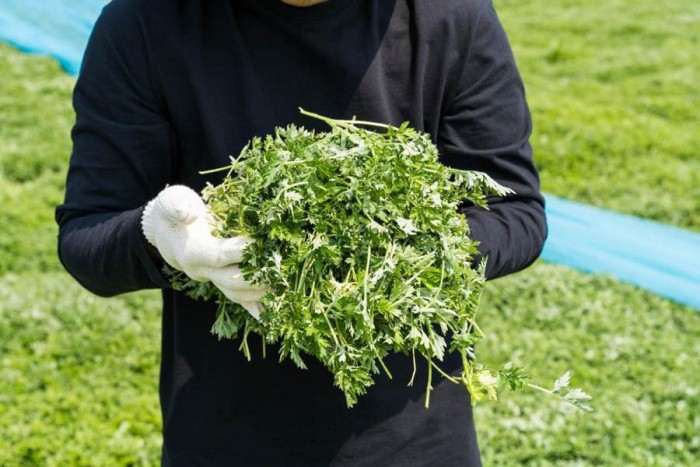 |
| Myeongga Samdae Rice Cake House sources mugwort from farms in Jindo to make its signature mugwort seolgi rice cakes. / Courtesy of Myeongga Samdae Rice Cake House |
A local rice cake maker that used to see sales plunge every summer has managed to reverse the seasonal slump. Myeongga Samdae Rice Cake House, based in Naju, South Jeolla Province, saw summer sales rise by more than 30% from a year earlier after ramping up sales on online platform Temu this year.
According to Temu on Sept. 21, Myeongga Samdae Rice Cake House joined Temu’s Local Seller Program early this year and currently sells four rice cake products, including mugwort seolgi, mugwort injeolmi and soybean seolgi.
As new orders through Temu continued, the company’s total summer sales increased by more than 30% from the same period last year. That compares with last summer, when seasonal weakness cut order volume by half.
The company attributes the increase largely to the addition of Temu to its existing distribution channels, which helped it reach new groups of consumers.
“Securing a new sales channel allowed us to receive steady orders even during the summer off-season,” a company official said. “As product sales increase, we expect not only our production facilities but also transactions with local farms supplying raw materials to expand.”
Sales patterns on Temu also differed from those on other platforms.
When Myeongga Samdae Rice Cake House ran a discount promotion for soybean seolgi across several sales channels at the same time, the increase in sales lasted only one or two days on other platforms. On Temu, however, elevated order volume continued for about two weeks. Purchases also continued after the promotion ended and prices returned to normal, according to the company.
Customers also bought in different quantities. While 1-kilogram packages were the main sellers on other online channels, Temu recorded a relatively higher share of sales for 2-kilogram family packs.
The company also believes Temu’s product exposure system played a role. Temu recommends products based not only on customer search terms but also on factors such as sales volume and user ratings.
Myeongga Samdae Rice Cake House products currently have an average customer rating of around 4.8 out of 5 on Temu.
The increase in online orders has also affected production.
During last summer’s off-season, the company’s Naju manufacturing facility cut output to around 70% of maximum capacity and reduced operations from six days a week to five.
This summer, however, the production line has been running at full capacity while maintaining a six-day production schedule. Output of mugwort seolgi, which has been particularly popular on Temu, has increased by about 15%.
The volume of raw materials sourced from local farms is also expected to rise.
Myeongga Samdae Rice Cake House contracts with farms in Jindo, South Jeolla Province, for the mugwort used in its mugwort seolgi. The mugwort is harvested once in spring and stored for use throughout the year, but stronger sales this year have depleted inventories faster than expected.
The company is therefore considering increasing the amount of mugwort it purchases from Jindo farms next spring.
It also plans to source ingredients for chestnut rice cakes and sweet potato rice cakes, which are scheduled to be launched on Temu this fall, from local farms.
Temu launched its service in South Korea in July 2023 and has operated its Local Seller Program since last year, allowing Korean sellers to list products directly and ship them to domestic consumers.
Thousands of Korean businesses currently sell products through the program.
In a survey conducted by Temu this year of around 100 Korean sellers, about 80% of respondents said they viewed Temu as a sales channel that either complements existing channels or helps drive growth. Around 60% said their sales volume and revenue increased after joining Temu.
The following is a Q&A with a Myeongga Samdae Rice Cake House representative.
Please briefly introduce Myeongga Samdae Rice Cake House.
“We launched the Myeongga Samdae Rice Cake House brand in Naju, South Jeolla Province, in 2024. We make rice cakes using carefully selected high-quality ingredients sourced from across the country. We believe in the simple principle that good ingredients produce the best taste, and we make rice cakes that the whole family can enjoy. Our products include mugwort seolgi, mugwort injeolmi, soybean seolgi and super sweet corn injeolmi.”
What prompted you to join Temu?
“In Korea, rice cake sales tend to slow as the weather gets hotter because consumers generally prefer lighter foods. Last summer, our order volume fell by about 50%. To overcome this seasonal factor, we needed a new sales channel in addition to our existing ones. We learned about Temu’s Local Seller Program, which allows domestic sellers to join the platform, and signed up in early 2026.”
What has changed since joining Temu?
“New demand generated through Temu helped increase our total sales this summer by more than 30% year on year. Even though it was the off-season, sales rose sharply compared with last year. Additional orders also brought greater activity to the local supply chain.
“Mugwort seolgi was especially popular. That allowed our dedicated manufacturing facility in Naju to operate at full capacity and created a basis for pursuing larger purchase contracts with farms in Jindo, South Jeolla Province, that supply our raw materials.”
What are the positive aspects of the Temu platform?
“Temu’s product discovery model exposes products naturally while customers shop. Rather than relying on searches for a specific brand name or large advertising expenditures, product visibility is determined by factors such as value, sales volume and positive reviews.
“One advantage is that we can reach a broad group of new customers in a short period of time. Customers on Temu also tend to order larger-volume products much more often than those on other platforms.”
What changes has this brought to the local community?
“This summer, higher order volume allowed us to run our production line at 100% capacity and maintain a six-day workweek, increasing the income of local workers compared with last year.
“The scale of our contracts with local farms supplying various raw materials is also gradually increasing. We plan to place larger orders next spring.”
Choi Jeong-a
Most Read
-
1
Celltrion’s Omlyclo gains ground in major European..

-
2
Trump demands rates fall below 1% as Fed hikes for..

-
3
Trump makes $1 trillion bet ahead of midterm elect..

-
4
Iran resumes ballistic missile production, assembl..

-
5
Samsung Electronics, Mistral AI to jointly develop..

-
6
Trump warns countries not helping U.S. must pay re..

-
7
Seoul faces triple squeeze over troop deployment t..

PEOPLE







-
Address : In-Young Bldg., 34, Uisadang-daero 1-gil, Yeongdeungpo-gu, Seoul
Copyright by ASIATODAY CO., LTD. All rights resereved