



Hyundai E&C vows to complete Pohang AI data center in 16 months
Sep 21, 2026, 09:56 am


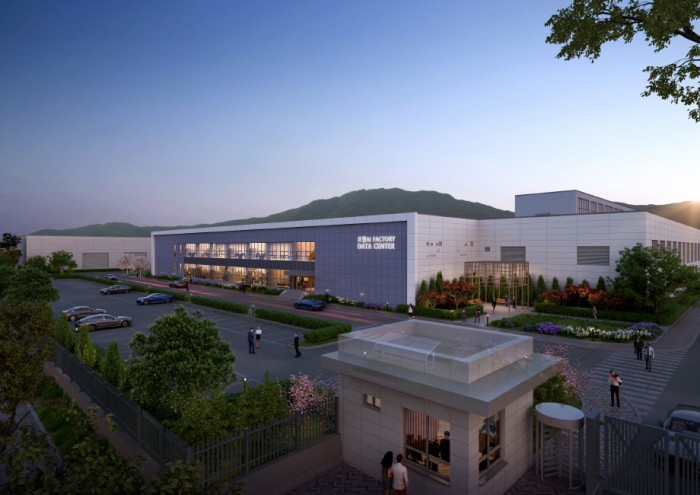 |
| Rendering of the Pohang artificial intelligence data center. |
Hyundai E&C said on Sept. 21 that it recently signed the main contract for construction of the Pohang artificial intelligence data center, commissioned by AI Factory Pohang PFV, and has begun installing precast concrete structures.
The project involves building a dedicated AI data center with a power intake capacity of 30 megawatts at the Gwangmyeong General Industrial Complex in Ocheon-eup, Nam-gu, Pohang, North Gyeongsang Province. Construction began in June, with operations targeted for the second half of next year. The total construction period is 16.5 months.
To meet the tight schedule, Hyundai E&C is applying precast concrete, or PC, construction throughout the project. While beams and columns have previously been built using PC methods at commercial data centers in South Korea, this is the first domestic project in which all concrete structural components, including slabs, walls and staircases, are prefabricated.
The approach has shortened structural construction to just two months, compared with about a year using conventional on-site concrete casting methods.
Hyundai E&C also reduced the overall schedule by using pre-construction services to review the optimal project structure and construction methods before breaking ground, alongside a fast-track approach that allows design, permitting and construction preparation to proceed simultaneously.
Power intake capacity refers to the maximum amount of electricity that can be supplied from the external power grid. The Pohang AI data center’s 40 MW capacity is equivalent to the amount of electricity simultaneously used by more than 130,000 households in Nam-gu, Pohang, based on average monthly household consumption of 214.78 kilowatt-hours.
Project developer Neo AI Cloud plans to build the Pohang AI data center as a scalable infrastructure capable of reliably supporting next-generation graphics processing units. It also plans to link GPU-as-a-service offerings with AI platform services to support domestic and overseas companies in developing AI models and operating related services.
The Pohang AI data center incorporates Hyundai E&C’s advanced construction technologies. To support GPU servers based on Nvidia’s latest AI chip, Vera Rubin, the facility will feature an ultra-high-density environment with power density about 10 times that of conventional cloud data centers.
The facility is designed with a power usage effectiveness, or PUE, of 1.25, a key measure of data center energy efficiency, minimizing energy losses and achieving a level considered among the best in South Korea. The figure is close to the U.S. Department of Energy’s benchmark of 1.2 for top-tier efficiency.
“As generative AI and large-scale AI models rapidly expand, competition in the data center market is shifting beyond sheer scale toward how quickly services can be launched,” a Hyundai E&C official said.
“We will successfully complete this data center within the scheduled construction period and demonstrate differentiated competitiveness by securing business viability, speed and quality alongside our construction capabilities.”
Lee Soo-il
Most Read
-
1
Celltrion’s Omlyclo gains ground in major European..

-
2
Trump demands rates fall below 1% as Fed hikes for..

-
3
Trump makes $1 trillion bet ahead of midterm elect..

-
4
Iran resumes ballistic missile production, assembl..

-
5
Samsung Electronics, Mistral AI to jointly develop..

-
6
Trump warns countries not helping U.S. must pay re..

-
7
Seoul faces triple squeeze over troop deployment t..

PEOPLE







-
Address : In-Young Bldg., 34, Uisadang-daero 1-gil, Yeongdeungpo-gu, Seoul
Copyright by ASIATODAY CO., LTD. All rights resereved