



Hanwha Qcells, POSCO partner on agrivoltaic solar projects
Sep 21, 2026, 09:51 am


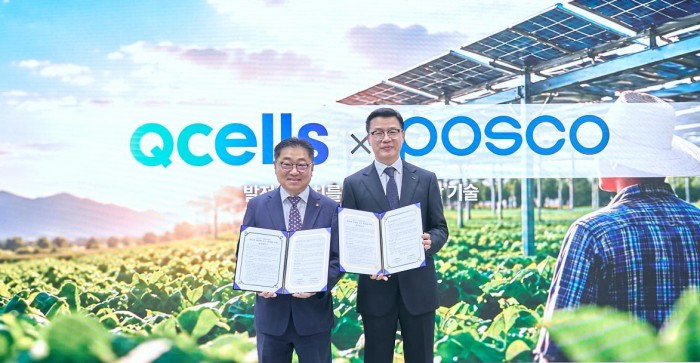 |
| Hanwha Qcells Korea Business Division Head Yoo Jae-yeol, left, and POSCO Cold-Rolled and Coated Steel Marketing Office Head Hong Sam-soo pose for a photo. / Hanwha Qcells |
Hanwha Qcells and POSCO are teaming up to develop an integrated agrivoltaic solution based on domestically produced equipment as they prepare for growth in the market. The companies plan to jointly develop solar modules and mounting structures and later build a cooperative network with other Korean companies to create a business model spanning financing, construction and electricity sales.
Hanwha Solutions’ Qcells division and POSCO said on Sept. 21 that they signed a memorandum of understanding on Sept. 17 to promote agrivoltaic solar power in South Korea and foster the related industrial ecosystem.
Agrivoltaics combines crop cultivation with solar power generation. By adjusting the placement and angle of solar modules, the system secures enough sunlight for crops while using the remaining solar energy to generate electricity. It is seen as a way to supplement farm income while expanding renewable energy deployment.
Until now, agrivoltaic projects in South Korea have largely been limited to pilot programs. Solar facilities can typically be used for more than 30 years, but the previous Farmland Act limited their use to eight years, making it difficult to secure sufficient commercial viability.
However, under the Act on the Promotion and Support of Agrivoltaic Power Generation Projects, enacted and promulgated in June, the maximum permit period was extended from eight years to 23 years, creating a basis for ordinary farmers and agricultural cooperatives to pursue long-term projects.
Under the agreement, the two companies plan to form a domestic industry alliance centered on Korean companies. Through the partnership, they aim to build an integrated solution linking financing, equipment procurement, construction and electricity sales for agrivoltaic projects.
Hanwha Qcells will produce and supply high-efficiency modules dedicated to agrivoltaic projects at its Jincheon plant in North Chungcheong Province. Drawing on its solar business experience, it will also provide construction and maintenance services. After power plants are completed, the company plans to offer electricity sales solutions, including brokering power purchase agreements with companies seeking renewable electricity and supporting entry into real-time bidding markets.
POSCO will supply mounting structure materials designed to resist ground corrosion and suit domestic farming conditions. It plans to develop structures that protect crops and farmland without interfering with agricultural activities, while also working toward standardizing agrivoltaic structures in South Korea. The two companies will jointly develop a dedicated package combining solar modules and mounting structures.
“Agrivoltaics is a solution that can simultaneously expand renewable energy and improve the sustainability of rural communities,” said Yoo Jae-yeol, head of Hanwha Qcells’ Korea Business Division. “We will work with POSCO to help build a sound agrivoltaic market.”
Hong Sam-soo, head of POSCO’s Cold-Rolled and Coated Steel Marketing Office, said, “We will cooperate with Hanwha Qcells to develop structural solutions suited to South Korea’s agricultural environment and contribute to building the related industrial ecosystem.”
Son Kang-hoon
Most Read
-
1
Celltrion’s Omlyclo gains ground in major European..

-
2
Trump demands rates fall below 1% as Fed hikes for..

-
3
Trump makes $1 trillion bet ahead of midterm elect..

-
4
Iran resumes ballistic missile production, assembl..

-
5
Samsung Electronics, Mistral AI to jointly develop..

-
6
Trump warns countries not helping U.S. must pay re..

-
7
Seoul faces triple squeeze over troop deployment t..

PEOPLE







-
Address : In-Young Bldg., 34, Uisadang-daero 1-gil, Yeongdeungpo-gu, Seoul
Copyright by ASIATODAY CO., LTD. All rights resereved