



Religious groups oppose government plan to introduce abortion pills
Sep 21, 2026, 09:36 am


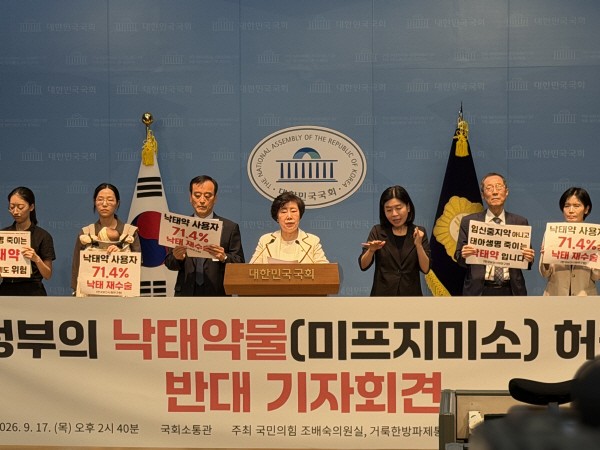 |
| Protestant groups oppose the government’s plan to introduce abortion pills at the National Assembly. / Courtesy of Esther Prayer Movement |
Religious groups, led by Protestant and Catholic organizations, have voiced opposition to the government’s phased introduction of abortion medication, including Mifegyne. They warned that bringing in the drugs before establishing a comprehensive legal and institutional framework covering the scope of permitted abortions, safety management and protection for pregnant women in crisis could undermine respect for human life.
According to religious groups on Sept. 18, the Catholic Bishops’ Conference of Korea issued a statement after the government formally announced the introduction of abortion medication on Sept. 16.
“It merely institutionalizes abortion in an ‘orderly’ manner without changing its fundamental nature in any way,” the bishops’ conference said. “We express deep concern that it will instead further entrench a disregard for life in our society.”
“The sophistication of the procedure does not change the essence of taking a life,” it said. “Whether at nine weeks of pregnancy or in a hospital or pharmacy, this medication ends a human life in the womb.”
It added that “phased introduction” should not be seen as a restriction, but rather as “a roadmap for expansion and entrenchment.”
“Securing social acceptance at the initial stage through the controlled framework of hospitals and then later loosening that framework to expand access would be the first step toward establishing and normalizing abortion pills in our society,” the bishops’ conference said.
It concluded, “A society that truly respects human beings is not one that eases women’s difficulties by eliminating the weakest lives, but one that shares responsibility so women do not have to give up those lives.”
The United Christian Churches of Korea, or UCCK, the country’s largest Protestant umbrella group, also issued a statement on Sept. 17 calling for the policy to be halted, describing it as “a policy that disregards the legal framework for protecting life.”
“All life is a dignified existence that deserves protection,” the group said, arguing that abortion medication should not be treated merely as an issue of medical access and convenience.
The UCCK particularly pointed to gaps in the current legal framework.
On Aug. 19, the Ministry of Government Legislation issued an interpretation in response to an inquiry from the Ministry of Food and Drug Safety, stating that abortion medication should be approved for import if it meets the requirements for safety and efficacy under the Pharmaceutical Affairs Act.
The government subsequently announced a phased plan to introduce abortion medication at a national policy coordination meeting on Sept. 16.
The UCCK called on the National Assembly to first establish legal standards covering the gestational limits, grounds and procedures for abortion, as well as counseling and reflection periods, protections for minors and vulnerable women, medical safety management and emergency response, and rules for prescription, administration and follow-up care.
Protestant groups Love Life Movement and Esther Prayer Movement held a press conference in front of the National Assembly’s main gate on Sept. 18 condemning the government’s push to legalize the sale of abortion medication.
“While spending astronomical sums to overcome the world’s lowest birth rate, pushing to introduce abortion pills that could expose adolescents and future generations indiscriminately is an obvious policy contradiction,” the groups said.
They also called on the government to stop using what they described as the misleading term “pregnancy termination,” arguing that it obscures the original meaning of “abortion” or “termination of pregnancy,” and urged the use of what they called more direct language.
“No one has the right to harm another life in the name of pursuing a woman’s right to happiness,” they said. “The government’s role should not be to authorize drugs that end life, but to build a society that protects unborn children.”
Hwang Ui-joong
Most Read
-
1
Celltrion’s Omlyclo gains ground in major European..

-
2
Trump demands rates fall below 1% as Fed hikes for..

-
3
Trump makes $1 trillion bet ahead of midterm elect..

-
4
Iran resumes ballistic missile production, assembl..

-
5
Samsung Electronics, Mistral AI to jointly develop..

-
6
Trump warns countries not helping U.S. must pay re..

-
7
Seoul faces triple squeeze over troop deployment t..

PEOPLE







-
Address : In-Young Bldg., 34, Uisadang-daero 1-gil, Yeongdeungpo-gu, Seoul
Copyright by ASIATODAY CO., LTD. All rights resereved