



DAPA to integrate cutting-edge SME technologies into K-defense weapon systems
Sep 18, 2026, 09:46 am


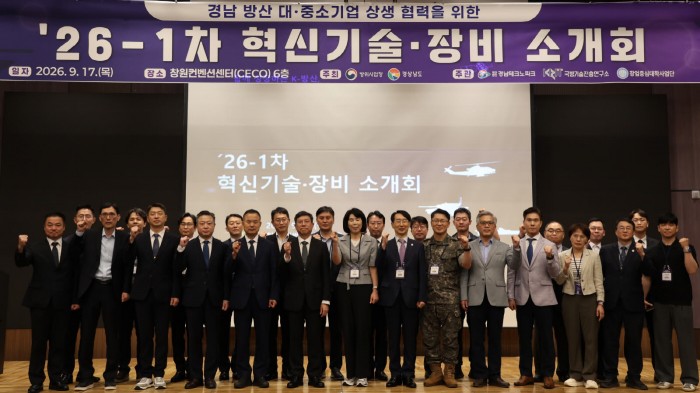 |
| Key attendees, including Jung Jae-joon, head of the Defense Acquisition Program Administration's (DAPA) Conventional Power Program Project Headquarters (sixth from left in the front row), pose for a commemorative photo at the 2026-1st Innovative Technologies and Equipment Presentation held at the Changwon Convention Center on the 17th. / DAPA |
The Defense Acquisition Program Administration (DAPA) has stepped up on-site communication to integrate the innovative technologies of small and medium-sized enterprises (SMEs) and venture firms into operational weapon systems.
DAPA hosted the 2026-1st Innovative Technologies and Equipment Presentation at the Changwon Convention Center on the 17th to support outstanding SMEs entering the defense sector and strengthen win-win cooperation with prime system integrators.
Around 300 stakeholders from industry, academia, research institutes, the military, and government attended the event, including project teams from DAPA and the armed forces alongside prime integrators responsible for developing and mass-producing weapon systems. The gathering carried significant weight as it went beyond a simple technology showcase, serving as a joint review to assess whether individual SME technologies can be directly applied to land, sea, and air weapon systems.
A total of 16 SMEs unveiled their core technologies and equipment at the presentation.
In the AI and unmanned systems sectors, notable presentations included flight control computers for defense drones, command and tactical communication networks for Manned-Unmanned Teaming (MUM-T), and collision avoidance systems for unmanned naval platforms.
The aerospace sector also showcased advanced products and capabilities demanding high-level engineering, such as aircraft composite materials and surface treatment technologies, as well as secondary batteries for artificial satellites.
What stands out is DAPA's clear commitment not to let the event remain a mere technology showcase.
The agency detailed its SME support programs, such as Defense Innovation Enterprise 100, K-Defense Startups, and military field demonstration support projects, while laying out follow-up procedures to link outstanding technologies with actual defense procurement projects.
Identified technologies will undergo review through the tentatively named SME Technology Review (STR) meeting, an upcoming initiative planned by DAPA. Working groups comprising project teams, end-user armed services, and system integrators will directly verify the feasibility of integrating these technologies into weapon systems.
This move is seen as an effort to narrow the long-standing gap between technology development and weapon system application that SMEs have faced when trying to enter defense acquisition programs despite possessing competitive capabilities.
While South Korea's defense ecosystem has largely grown around large prime integrators behind flagship platforms like the K9 self-propelled howitzer, the K2 main battle tank, and the FA-50 light combat aircraft, there is growing recognition that sustained export competitiveness requires strong technological backing from SMEs and startups in critical components, materials, software, and unmanned systems.
"We will spare no support to ensure K-defense achieves sustainable growth by combining the innovative technology of SMEs with the mass-production capabilities of prime system integrators," said Jung Jae-joon, head of DAPA's Conventional Power Program Project Headquarters.
Ultimately, the crux lies not in how many promising technologies are discovered, but in how quickly those identified can be deployed into actual weapon systems.
Attention is now focused on whether the presentation in Changwon will establish itself as a tangible pipeline connecting SME innovations with military requirements, defense acquisition programs, and prime contractor mass production.
Ku Pil-hyun
Most Read
-
1
Celltrion’s Omlyclo gains ground in major European..

-
2
Trump demands rates fall below 1% as Fed hikes for..

-
3
Hyundai Motor Group breaks ground on integrated st..

-
4
U.S. strikes 3 Iranian oil tankers, Iran vows reta..

-
5
Trump makes $1 trillion bet ahead of midterm elect..

-
6
Iran resumes ballistic missile production, assembl..

-
7
Samsung Electronics, Mistral AI to jointly develop..

PEOPLE







-
Address : In-Young Bldg., 34, Uisadang-daero 1-gil, Yeongdeungpo-gu, Seoul
Copyright by ASIATODAY CO., LTD. All rights resereved