



S. Korea still undecided on troop deployment a day ahead of S. Korea-U.S. foreign ministers' meeting
Sep 18, 2026, 09:44 am


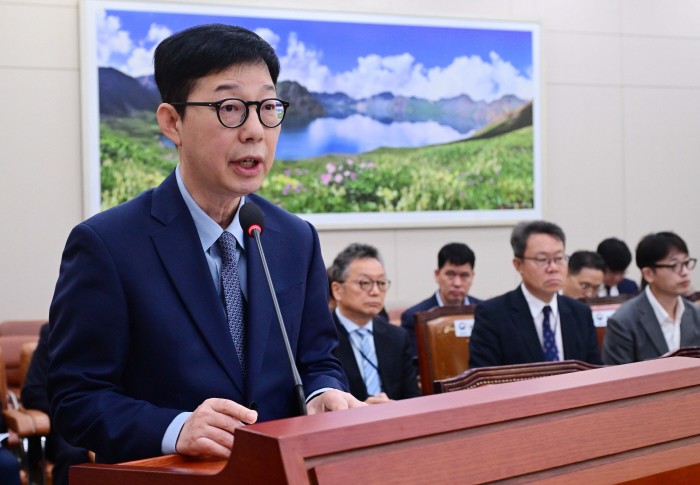 |
| First Vice Minister of Foreign Affairs Park Yoon-joo delivers a report on current issues, including the massive flooding in Nepal, the potential troop deployment to the Strait of Hormuz, and investment in the U.S., during a plenary session of the Foreign Affairs and Unification Committee at the National Assembly on the 17th. / By Reporter Lee Byung-hwa |
Just a day before a meeting between South Korean Foreign Minister Cho Hyun and U.S. Secretary of State Marco Rubio, the South Korean government maintains that no concrete plans have been finalized regarding its contribution to stabilizing the Strait of Hormuz. With the government yet to clarify its position ahead of the South Korea-U.S. foreign ministers' meeting on the 18th, concerns are mounting over whether negotiations with Washington can proceed effectively.
Attending a plenary session of the National Assembly's Foreign Affairs and Unification Committee on the 17th, First Vice Minister of Foreign Affairs Park Yoon-joo repeatedly answered lawmakers' questions regarding troop deployment to Hormuz by stating that "internal deliberations on contribution options are underway, and no specifics have been decided." At the same time, he indicated that the South Korea-U.S. alliance is not the sole factor being weighed in the review.
Addressing criticism that preparations for consultations with the U.S. regarding the Hormuz deployment remain inadequate, Vice Minister Park remarked, "(The upcoming consultation with the U.S. side) will likely be an information-sharing stage regarding our current progress," adding that "(Minister Cho) will find it difficult to make definitive remarks as no specific plan has been determined."
Regarding the government dispatch of an on-site fact-finding mission to the United Arab Emirates (UAE) and Bahrain, Park clarified that the mission was intended to assess general security conditions rather than serve as a prerequisite for troop deployment.
Vice Minister Park reiterated the government's principled stance that the Strait of Hormuz deployment has been closely discussed with the international community, including potential participation in a multinational mission led by Britain and France as well as the U.S., emphasizing that the matter will be evaluated from the perspective of national interests such as maritime stability, the safety of Korean citizens, and supply chain security.
However, he suggested that even if forces are deployed to the Strait of Hormuz, it will be the result of balancing national interests rather than bowing to U.S. pressure. "Fundamentally, whatever concrete plan is reached regarding the Hormuz issue, it will stem from our independent decision," Park said. "We must also comprehensively consider relations with littoral states of the strait, including Iran."
In fact, the government has been reviewing ways to contribute to stabilizing the Strait of Hormuz since around April, engaging in discussions through the British- and French-led multinational mission framework. Amid this backdrop, public pressure from U.S. President Donald Trump for troop contributions escalated last month, while opposition spread among the general public and the ruling bloc, prompting the government to undertake repeated and cautious deliberations.
The postponement of a National Security Council (NSC) meeting, which had been anticipated to convene on Thursday, is viewed as an extension of these ongoing deliberations. Some observers project that the government's definitive position on the Hormuz deployment will take final shape only after the South Korea-U.S. foreign ministers' meeting.
Mok Yong-jae
Most Read
-
1
Celltrion’s Omlyclo gains ground in major European..

-
2
Trump demands rates fall below 1% as Fed hikes for..

-
3
Hyundai Motor Group breaks ground on integrated st..

-
4
U.S. strikes 3 Iranian oil tankers, Iran vows reta..

-
5
Trump makes $1 trillion bet ahead of midterm elect..

-
6
Iran resumes ballistic missile production, assembl..

-
7
Samsung Electronics, Mistral AI to jointly develop..

PEOPLE







-
Address : In-Young Bldg., 34, Uisadang-daero 1-gil, Yeongdeungpo-gu, Seoul
Copyright by ASIATODAY CO., LTD. All rights resereved