



Final decision on first U.S. investment project delayed
Sep 18, 2026, 09:41 am


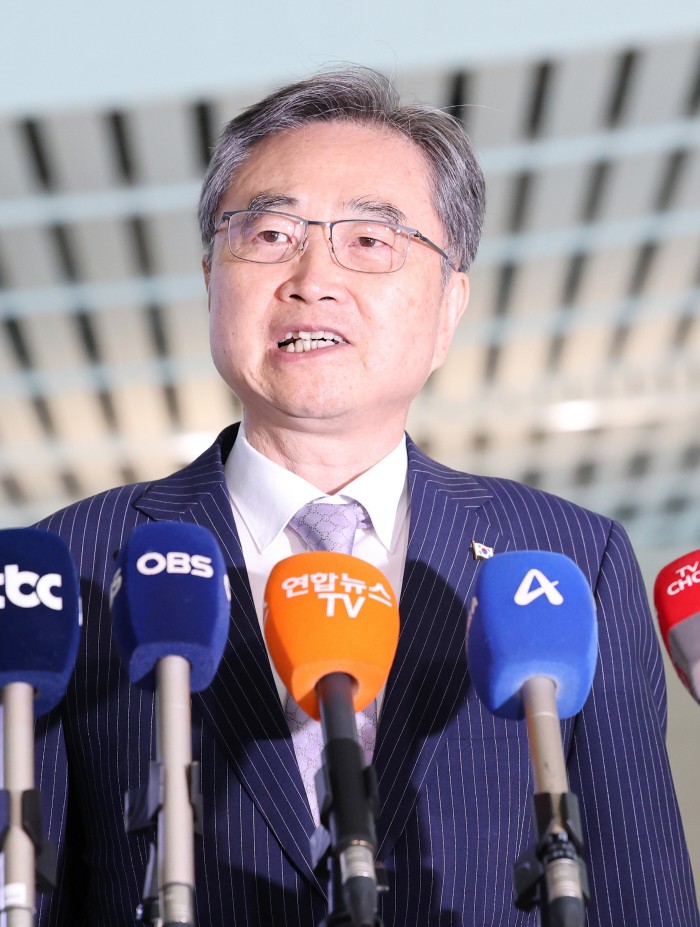 |
| Foreign Minister Cho Hyun answers reporters' questions as he departs for a South Korea-U.S. foreign ministers' meeting at Terminal 2 of Incheon International Airport in Yeongjongdo, Incheon, on the 17th. / Yonhap |
President Lee Jae-myung's strategic investment initiative in the U.S. is facing growing pains from the very first phase of finalizing its initial projects. As Seoul and Washington struggle to bridge differences over detailed conditions for core sectors—including nuclear energy, gas-fired power generation, and liquefied natural gas (LNG)—a closed-door briefing to the National Assembly originally scheduled for the 17th was postponed. The signing of a memorandum of understanding (MOU) and the announcement of the first flagship project, previously discussed for the 18th, have been delayed again and are now widely expected to slip into next week.
According to government and political sources on the 17th, the Ministry of Trade, Industry and Energy requested the postponement of scheduled closed-door briefings before the parliamentary Trade, Industry, Energy, SMEs and Startups Committee and the Economy and Finance Committee regarding U.S. investments. The ministry stated that while it is "consulting closely with the U.S., finding common ground is taking time," reiterating its commitment to continue negotiations with the national interest as the top priority.
One of the sharpest points of contention in the talks is nuclear power. South Korea and the U.S. have reportedly discussed applying South Korea's homegrown APR1400 reactor model to some of the large-scale nuclear power plants slated for construction in the United States. However, the U.S. government and Westinghouse have shown reluctance regarding the domestic construction of the APR1400 in the U.S., leaving last-minute disagreements unresolved.
Equity participation in Westinghouse and securing managerial decision-making leverage are also on the negotiating table. To bolster competitiveness for future overseas nuclear project bids, South Korea is seeking substantive influence, such as securing a certain equity stake and board representation, rather than remaining a passive capital investor.
Investment in pyroprocessing—a method for recycling spent nuclear fuel—presents another key variable. Because it is intertwined with nuclear fuel cycle issues as well as broader nuclear industry cooperation, meticulous coordination between the two nations is required.
Discussions also remain underway regarding project terms for the Encinal combined-cycle gas turbine project in Texas, which has emerged as a leading candidate for the first U.S. investment venture. As securing stable electricity off-takers, long-term power purchase agreements (PPAs), and the participation of South Korean companies directly dictate capital recovery, the government is scrutinizing project profitability.
For the Alaska LNG project, the scope of investment and profit-sharing models remain major sticking points. South Korea and the U.S. are reportedly conducting final-stage coordination over how revenues generated through strategic investments in the U.S. will be structured and divided.
The overall $350 billion U.S. investment package consists of $200 billion in strategic investments and $150 billion in shipbuilding cooperation investments. Because the strategic investments must clear domestic review procedures and parliamentary briefings to be finalized, an agreement on detailed terms between South Korea and the U.S. must come first before the initial project can be officially confirmed.
The core benchmark emphasized by the South Korean government throughout the talks is "commercial viability." Rather than focusing solely on the sheer scale of investment, officials insist on selecting projects based on capital recoverability, substantive participation by South Korean firms, and enhancements to national industrial competitiveness.
Sources in and around the government suggest that after further consultations over the weekend, authorities will likely seek to reschedule the National Assembly briefing and the MOU signing next week.
Park Young-hoon
Most Read
-
1
Celltrion’s Omlyclo gains ground in major European..

-
2
Trump demands rates fall below 1% as Fed hikes for..

-
3
Hyundai Motor Group breaks ground on integrated st..

-
4
U.S. strikes 3 Iranian oil tankers, Iran vows reta..

-
5
Trump makes $1 trillion bet ahead of midterm elect..

-
6
Iran resumes ballistic missile production, assembl..

-
7
Samsung Electronics, Mistral AI to jointly develop..

PEOPLE







-
Address : In-Young Bldg., 34, Uisadang-daero 1-gil, Yeongdeungpo-gu, Seoul
Copyright by ASIATODAY CO., LTD. All rights resereved