



Korean shipbuilders turn attention to marine infrastructure
Sep 16, 2026, 09:47 am


 |
| This image was generated by AI. |
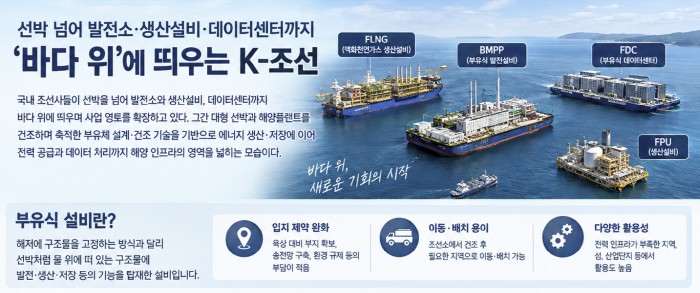
The shipbuilding industry's business domain is expanding beyond traditional vessels into offshore industrial complexes. Leveraging hull design and construction technologies honed through vessels and offshore plants, South Korean shipbuilders are placing power plants, production facilities, and even data centers at sea. As a result, they are broadening their footprint in marine infrastructure to span energy production and storage, power supply, and data processing.
According to the shipbuilding industry on the 15th, domestic shipbuilders have recently accelerated moves to mount various infrastructures, previously built on land, onto floating offshore structures. Unlike conventional offshore facilities anchored directly to the seabed, floating facilities mount power generation, production, and storage functions onto vessel-like floating bodies.
The primary driver behind shipbuilders' push into floating infrastructure is fewer site constraints compared to land-based developments. Building large-scale power plants or data centers onshore requires substantial time and capital, ranging from land acquisition and grid expansion to environmental permitting and licensing. By contrast, floating facilities can be constructed at shipyards and towed directly to demand centers, making them viable alternatives for power-deficient regions, islands, and industrial complexes.
Domestic shipbuilders, including HD Hyundai, Hanwha Ocean, and Samsung Heavy Industries, have earmarked floating marine infrastructure as a future growth engine, stepping up technology development and commercialization. Building on their accumulated expertise in offshore plants such as floating liquefied natural gas (FLNG) facilities and floating production units (FPUs), shipbuilders are expanding their portfolios into barge-mounted power plants (BMPPs) and floating data centers (FDCs).
HD Hyundai is expanding into the offshore power infrastructure market with BMPPs, often dubbed power plants on the sea. HD Korea Shipbuilding & Offshore Engineering recently received Approval in Principle (AiP) from the American Bureau of Shipping (ABS) for its proprietary 100MW-class BMPP. The facility mounts medium-sized HiMSEN engines and power generation systems onto a barge-type hull to produce and deliver up to 100MW of electricity. It is expected to find application in areas where building massive onshore power grids is difficult, as well as in power-intensive hubs such as data centers and industrial parks.
Hanwha Ocean took the concept further by moving the data center itself onto the water. The shipbuilder unveiled a 60MW-class FDC model, formally entering the offshore data infrastructure market. The FDC generates its own electricity offshore and uses seawater for cooling, lowering both electricity and cooling costs essential for data center operations. Designed with a modular architecture, the facility allows flexible configurations for power generation, supply modes, server types, and data center capacities based on local environmental conditions and client requirements.
Samsung Heavy Industries, leveraging its edge in offshore engineering, secured AiP from both the ABS and the U.K.'s Lloyd's Register (LR) for a conceptual design applying its proprietary natural gas liquefaction system, SENSE, to FLNG topsides. The company also received Basic Design Review (BDR) approval from the ABS. Natural gas liquefaction systems are core facilities that cool natural gas to cryogenic temperatures to enable storage and transportation. Samsung Heavy Industries is securing core technological competitiveness in FLNGs through in-house development and verification.
An industry official stated, "With surging global interest in energy and power infrastructure, business opportunities utilizing floating facilities are multiplying," adding, "Shipbuilders are also turning their attention to this market, drawing upon the technical capabilities accumulated through conventional vessels and offshore plants."
Kim So-young
Most Read
-
1
U.S. Treasury Secretary Bessent publicly warns ove..

-
2
Celltrion’s Omlyclo gains ground in major European..

-
3
Hyundai Motor Group breaks ground on integrated st..

-
4
Russia faces warning signs over prolonged war econ..

-
5
U.S. strikes 3 Iranian oil tankers, Iran vows reta..

-
6
S. Korea seeks redemption from World Cup setback w..

-
7
Trump makes $1 trillion bet ahead of midterm elect..

PEOPLE







-
Address : In-Young Bldg., 34, Uisadang-daero 1-gil, Yeongdeungpo-gu, Seoul
Copyright by ASIATODAY CO., LTD. All rights resereved