



S. Korea, U.S. hold security talks with Hormuz troop deployment on table
Sep 15, 2026, 09:09 am


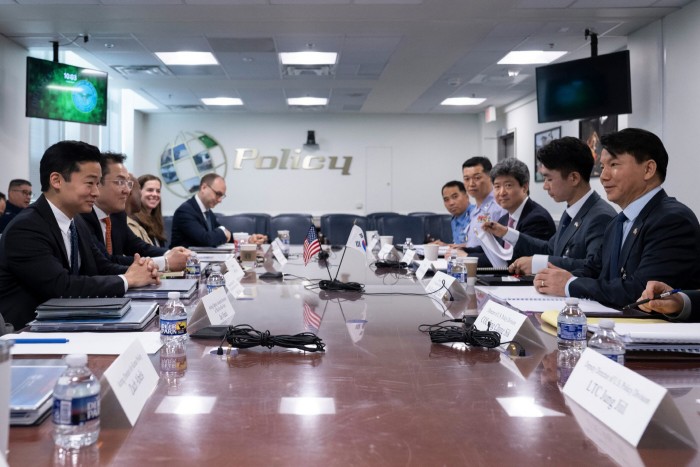 |
| The 28th Korea-U.S. Integrated Defense Dialogue (KIDD) is underway in Washington, D.C., on May 13 local time. / Courtesy of Ministry of National Defense |
Key security issues, including the potential deployment of South Korean troops to the Strait of Hormuz and the transition of wartime operational control (OPCON), are expected to reach a critical juncture this week as South Korea and the U.S. hold consecutive sessions of the Korea-U.S. Integrated Defense Dialogue (KIDD) and the National Security Council (NSC).
With Washington continuing to press for troop contributions and Seoul having wrapped up an on-site fact-finding mission, close attention is centering on whether the Hormuz issue will officially reach the bilateral negotiating table.
According to the Ministry of National Defense on the 14th, South Korea's Ministry of National Defense and the U.S. Department of War will convene the 29th KIDD in Busan from the 16th to the 18th. The meeting will bring together key defense and diplomatic officials from both sides, led by Deputy Minister for National Defense Policy Kim Hong-cheol and U.S. Deputy Assistant Secretary of War for East Asia George Lemur as chief delegates.
A defense ministry official noted that during the talks, South Korea and the U.S. plan to address the full spectrum of alliance security matters, including the OPCON transfer, combined defense posture, and shipbuilding cooperation.
The foremost focal point is the troop dispatch to Hormuz. Since the outbreak of the war involving Iran, the U.S. has consistently called on South Korea to contribute militarily to securing the Strait of Hormuz. Ahead of the KIDD talks, the South Korean government dispatched a survey team to the United Arab Emirates (UAE) last week to assess local conditions for a potential deployment.
While the Trump administration is understood to favor deployment prior to the upcoming November midterms, the defense ministry maintains that sending a survey team does not presuppose an actual deployment and that no decision has been finalized.
The NSC, anticipated to convene on the 17th, may also review whether to deploy forces and evaluate potential modes of contribution based on findings from the field mission. Discussions regarding the OPCON transfer are also expected to pick up momentum ahead of the Security Consultative Meeting (SCM) slated for November.
At the SCM, the two allies plan to review the results of the Full Operational Capability (FOC) validation required for the OPCON handover, after which they seek to recommend a target transition year, dubbed Year X, to their respective presidents by year's end.
Consequently, observers suggest that this round of KIDD will serve as a stepping stone not only for the Hormuz question but also for fleshing out the OPCON transfer roadmap.
Launched in 2011, KIDD is a high-level consultative body established to facilitate timely and effective bilateral security dialogue.
It has convened once or twice annually on an alternating basis, with the Busan session taking place four months after the 28th meeting in Washington, D.C., this past May. This marks the first time the dialogue is being hosted outside Seoul or Washington.
The bilateral shipbuilding initiative known as Project MASGA could also be tabled. As U.S. officials reportedly toured domestic shipyards during their visit to South Korea, concrete avenues of cooperation—such as naval vessel construction and maintenance—may well be explored.
Nevertheless, mounting domestic public opposition against sending troops to Hormuz is deepening the government's dilemma.
Representative Jin Sung-joon of the Democratic Party of Korea, who chairs the National Assembly's National Defense Committee, commented on MBC Radio that day that public sentiment leaning against deployment is higher and must be carefully factored in, adding that sizable skepticism and opposition toward deployment persist within the Democratic Party as well.
Lee Han-sol
Most Read
-
1
Celltrion’s Omlyclo gains ground in major European..

-
2
Trump demands rates fall below 1% as Fed hikes for..

-
3
Hyundai Motor Group breaks ground on integrated st..

-
4
U.S. strikes 3 Iranian oil tankers, Iran vows reta..

-
5
Trump makes $1 trillion bet ahead of midterm elect..

-
6
Iran resumes ballistic missile production, assembl..

-
7
Samsung Electronics, Mistral AI to jointly develop..

PEOPLE







-
Address : In-Young Bldg., 34, Uisadang-daero 1-gil, Yeongdeungpo-gu, Seoul
Copyright by ASIATODAY CO., LTD. All rights resereved