



Lee pursues summit diplomacy with five Central Asian nations
Sep 14, 2026, 09:14 am


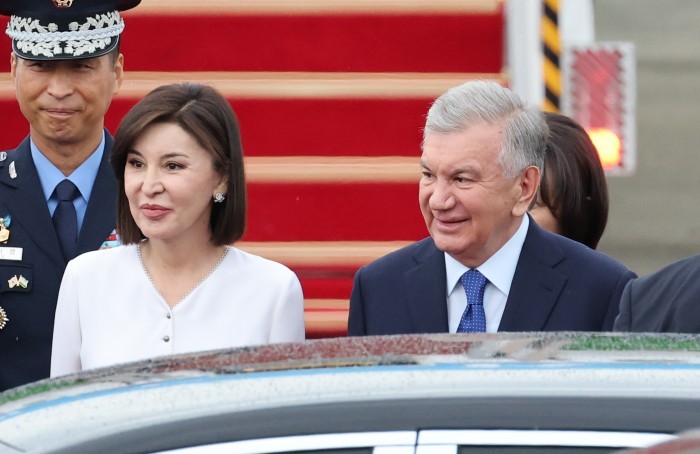 |
| Uzbek President Shavkat Mirziyoyev and First Lady Ziroat Mirziyoyeva walk after arriving at Seoul Airport in Seongnam on the 13th. / Yonhap |
President Lee Jae-myung is embarking on a series of summit diplomacy meetings with five Central Asian nations amid overlapping security and trade issues and external uncertainties. The initiative aims to broaden diplomatic horizons to Central Asia, diversify supply chains, and build a new axis of economic cooperation at a time of growing uncertainty in the international order, including U.S.-China competition and Middle East instability.
According to Cheong Wa Dae on the 13th, President Lee will hold bilateral summits in Seoul starting with Uzbekistan on the 14th, followed by Turkmenistan and Kazakhstan on the 15th, and Tajikistan and Kyrgyzstan on the 16th. On the final day, he will preside over the First Korea-Central Asia Summit.
President Lee views this round of summit diplomacy as an extension of diplomatic diversification. During a meeting with senior secretaries and aides on the 11th, President Lee emphasized that "the world order is rapidly becoming multipolar," adding that "we must join hands with more nations and expand our diplomatic scope." The vision is to build a new axis of economic and cultural cooperation extending toward Europe and the Middle East through collaboration with Central Asia.
The heightened strategic value of Central Asia also adds weight to this vision. As a geopolitical hub on the Eurasian continent endowed with rich energy and critical minerals, Central Asia presents an increasing need for cooperation to secure resources and diversify markets amid the restructuring of global supply chains.
Central Asia has emerged as an increasingly vital region for South Korea's economic security, especially as major powers reorganize critical mineral and energy supply chains around themselves.
Accordingly, the government plans to diversify supply chains by connecting Central Asia's critical mineral and energy resources with South Korea's exploration and processing technologies. The scope of cooperation will also expand to include artificial intelligence (AI), digital technologies, science and technology, infrastructure and plant engineering, as well as customs, regulations, and intellectual property rights. The vision looks beyond simple resource procurement toward building a long-term cooperation model that couples technology with industry.
Directions for mid- to long-term cooperation will be outlined in the Seoul Declaration to be adopted at the summit. The government intends to institutionalize bilateral cooperation by elevating the cooperative framework—which had been maintained at the ministerial level since the launch of the Korea-Central Asia Cooperation Forum in 2007—to the summit level.
Following the summit, a business summit attended by around 500 government and corporate representatives will convene to explore customized cooperation for each nation, along with market entry and contract opportunities for South Korean businesses. Corporate cooperation is expected to broaden across digital transformation and high-tech sectors, in addition to infrastructure, plant engineering, and energy.
The horizon of cooperation extends beyond the economy. The government plans to secure Central Asian nations' backing on Korean Peninsula affairs while reinforcing joint efforts against transnational crimes such as terrorism, narcotics, and cybercrime. The cooperation scope will also widen to include climate change response, water resource management, and disaster response, alongside expanded Korean language and cultural education, as well as youth and talent exchanges on the occasion of the 90th anniversary of ethnic Koreans settling in Central Asia next year.
President Lee stated, "Through this summit, relations between South Korea and Central Asia will be solidified into a summit-level multilateral cooperation framework, and the New Northern Policy will gain greater momentum."
Park Young-hoon
Most Read
-
1
Celltrion’s Omlyclo gains ground in major European..

-
2
Trump demands rates fall below 1% as Fed hikes for..

-
3
Hyundai Motor Group breaks ground on integrated st..

-
4
U.S. strikes 3 Iranian oil tankers, Iran vows reta..

-
5
Trump makes $1 trillion bet ahead of midterm elect..

-
6
Iran resumes ballistic missile production, assembl..

-
7
Samsung Electronics, Mistral AI to jointly develop..

PEOPLE






-
Address : In-Young Bldg., 34, Uisadang-daero 1-gil, Yeongdeungpo-gu, Seoul
Copyright by ASIATODAY CO., LTD. All rights resereved