



S. Korea to freeze health insurance premium rate at 7.19% next year
Sep 09, 2026, 09:33 am


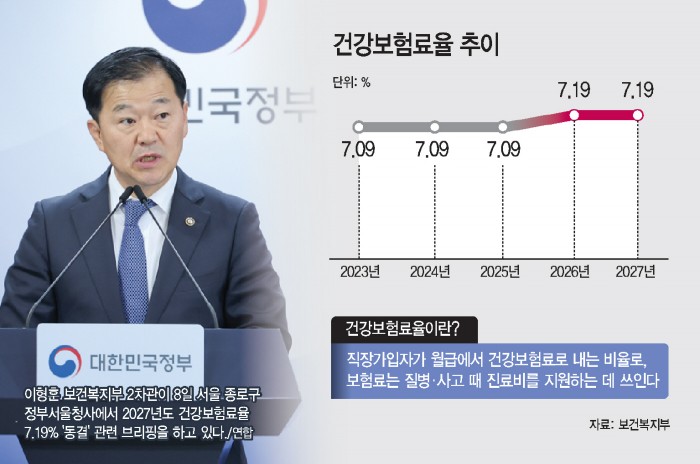 |
The South Korean government has frozen next year's health insurance premium rate at the current 7.19%. With fiscal reserves surpassing 30 trillion won and premium revenues projected to rise, authorities opted to expand coverage benefits without raising rates.
According to the Ministry of Health and Welfare on the 8th, the Health Insurance Policy Deliberation Committee voted to maintain the 2027 health insurance premium rate at the current 7.19% and froze the price per contribution point for self-employed insured individuals at 211.5 won. The decision passed without a vote, based on consensus among committee members representing policyholders, medical service providers, and public interest groups.
The ministry cited reserves of 30.2 trillion won held as of late last year, an amount sufficient to cover approximately 3.5 months of insurance benefit outlays. An increase of about 1.1 trillion won in state support for next year's health insurance compared to this year was also factored in. An economic recovery spurred by the semiconductor boom bolstered the projected rise in premium income. Lee Hyung-hoon, Second Vice Minister of Health and Welfare, stated, "We factored an estimated 3.8 trillion won in additional premium revenue into our fiscal outlook."
The government also estimated that spending rationalization could save roughly 3 trillion won annually. It plans to save 270 billion won per year by restructuring drug pricing systems announced in March, 2.6 trillion won by adjusting fee-for-service schedules for specimen and imaging tests decided in June, and 80 billion won by stepping up management of false and fraudulent claims, bringing the simple sum across the three categories to 2.95 trillion won annually.
State funding from the general account for next year was set at 13.7 trillion won, up roughly 1.01 trillion won from this year. The support ratio relative to expected premium revenues rose 0.4 percentage points from 11.9% to 12.3%, but remains 1.7 percentage points below the statutory 14%. Vice Minister Lee explained that discussions were held with fiscal authorities, noting, "It was difficult to ramp up the subsidy all at once to 14%."
Addressing concerns over fiscal deterioration, Lee emphasized that national health insurance operates as a short-term insurance scheme distinct from the National Pension Service. "National health insurance operates by matching premium revenues and expenditures over relatively short cycles," Lee said, adding that premium rates are adjusted annually based on prevailing fiscal conditions. In addition, the committee approved the Phase 1 Innovation Plan for Health Insurance Coverage, which provides 800 billion won annually to roughly 1.97 million beneficiaries. Copayment rates for 1.36 million patients with rare or severe intractable diseases will drop from 10% to 7% this December, and further to 5% in the first half of 2028.
The ministry said, "We will actively identify and pursue spending efficiency tasks so that the premiums paid by citizens are channeled effectively into essential healthcare services, while continuously moving to strengthen regional, essential, and public healthcare and ease the medical expense burden for citizens suffering from rare and severe intractable illnesses."
Meanwhile, healthcare labor unions and the medical sector voiced criticism over the government's rate freeze, expressing concern over the potential deterioration of health insurance finances.
The Korean Medical Association pointed out, "If a premium freeze is pushed through without the state fully meeting its financial responsibilities, fiscal stability for national health insurance cannot be guaranteed," adding, "Rather than freezing rates to evade short-term burdens, a responsible decision that simultaneously weighs the sustainability of health insurance and the public's right to health is required."
Lee Se-mi
Most Read
-
1
Celltrion nears additional contract with major U.S..

-
2
Putin proposes trilateral U.S.-China-Russia summit..

-
3
U.S. weighs dropping MOAB, world's most powerful n..

-
4
"Aren't those foreigners on welfare?": M..

-
5
Attention centers on APEC for possible Trump-Xi-Pu..

-
6
U.S., Israel plan to resume strikes on Iran after..

-
7
Saudi Arabia, Iran hold first diplomatic talks to..

PEOPLE






-
Address : In-Young Bldg., 34, Uisadang-daero 1-gil, Yeongdeungpo-gu, Seoul
Copyright by ASIATODAY CO., LTD. All rights resereved