



Behind China's world-leading EV sector lies cutthroat competition with no winners
Sep 08, 2026, 05:22 pm


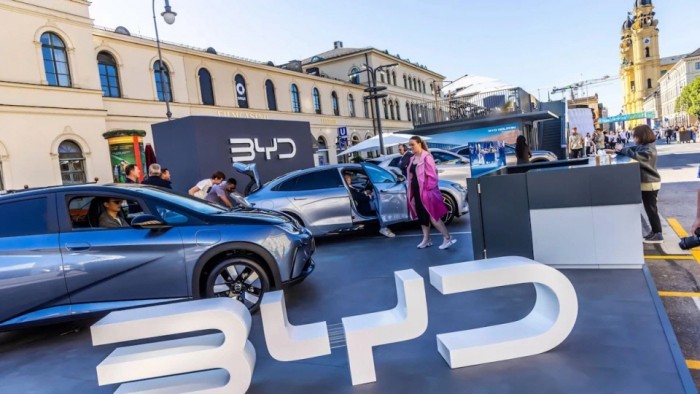 |
| A store and showroom of Chinese electric vehicle leader BYD in Munich, Germany. Companies including BYD are surging across Europe and other global markets through cutthroat sales practices. / Beijing Youth Daily |
China is surging across global electric vehicle markets, including Europe, fueled by cutthroat sales practices. At this rate, the trend is widely projected to risk mutual destruction across foreign and domestic industries, creating an extreme zero-sum environment with no winners.
According to recent reports by media outlets including The Beijing News, the apparent global competitiveness of China's electric vehicle industry is formidable. Production numbers alone tell the story: output is projected to reach up to roughly 16 million units this year, including new energy vehicles. Of that total, nearly one-third, or approximately 5 million units, is almost certain to be exported to overseas markets such as Europe.
Unmatched affordability coupled with product quality that stands toe-to-toe with global rivals makes the rapid expansion into international markets hardly surprising. Data both inside and outside China reinforces this reality, showing that Chinese players commanded an estimated 65% of the global market as of 2025. That market share is widely expected to climb even higher this year.
BYD, the bellwether of China's EV industry, alone exported 792,000 units in the first half of the year, marking a 67.8% surge compared to the same period last year. BYD is not the sole player leading the charge, as other automakers including Geely are displaying formidable momentum of their own.
Such overwhelming price and manufacturing strength from BYD and its peers has dealt a devastating blow to legacy global giants like Volkswagen. It is no coincidence that Volkswagen recently finalized a restructuring plan entailing 100,000 job cuts and the closure of four plants after struggling to match Chinese competition.
The core dilemma, however, is that manufacturers like BYD are hardly in a position to celebrate. To survive suffocating domestic overcompetition, a significant number of carmakers have slashed prices to extreme levels, turning to bleeding, loss-making exports. When factoring in the ancillary investments required for physical infrastructure abroad, such as after-sales service networks, only a minuscule handful of companies turn a genuine profit on their export volumes.
Furthermore, this race to the bottom is even more pronounced in China's domestic market, where saturation and price wars are routine on an entirely different scale. Even BYD saw its first-half net profit fall 20.54% in China to 12.325 billion yuan (approximately 2.465 trillion won). Viewed in this light, the wave of bankruptcies that has plagued the Chinese EV industry for years appears almost inevitable.
The limitless competition across China's EV sector, often likened to a game of chicken, is poised to intensify further, pointing to unprecedented pressure at home and abroad. It comes as little surprise that while Chinese automakers squeeze foreign legacy giants like Volkswagen, they simultaneously face severe internal pressures of their own, marked by ongoing restructuring and the looming threat of market exit.
Hong Soon-do
Most Read
-
1
Celltrion nears additional contract with major U.S..

-
2
Putin proposes trilateral U.S.-China-Russia summit..

-
3
U.S. weighs dropping MOAB, world's most powerful n..

-
4
"Aren't those foreigners on welfare?": M..

-
5
Attention centers on APEC for possible Trump-Xi-Pu..

-
6
Saudi Arabia, Iran hold first diplomatic talks to..

-
7
U.S., Israel plan to resume strikes on Iran after..

PEOPLE







-
Address : In-Young Bldg., 34, Uisadang-daero 1-gil, Yeongdeungpo-gu, Seoul
Copyright by ASIATODAY CO., LTD. All rights resereved