



Iran's oil revenue dries up under U.S. blockade, leaving economy on the brink
Sep 08, 2026, 04:22 pm


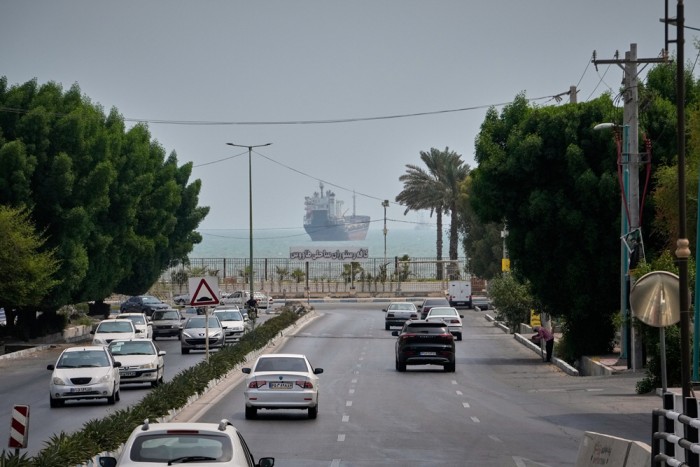 |
| Vehicles pass along a road as a commercial vessel lies anchored in the Strait of Hormuz near Bandar Abbas, Iran, on the 7th (local time). / AP, Yonhap |
A U.S. naval blockade against Iran is pushing the Iranian economy to the brink. With crude exports—its primary revenue source—blocked and floating reserves bound for China dwindling rapidly, pressure is mounting on Iran's already staggering economy.
According to The Wall Street Journal on the 7th (local time), vessel-tracking firm Kpler reported that no Iranian crude has breached the perimeter since the U.S. Navy reinstated its naval blockade on July 14 targeting vessels moving to and from Iranian ports and coastal waters.
Iran's daily crude shipments plummeted to around 255,000 barrels last month following the resumption of the blockade, down nearly ninefold in six months from roughly 2,202,000 barrels in February, just before the outbreak of hostilities.
Iran's floating crude reserves outside the blockade zone, which have served as a revenue lifeline, shrank from approximately 90 million barrels in mid-July to roughly 29 million barrels recently. Kpler projected that even these remaining stockpiles could run dry by next month.
Gulf oil industry officials, who set official selling prices each month after confirming customer purchase volumes, noted that trading volumes of Iranian crude have recently ground to a near-total halt.
Deprived of its principal source of foreign exchange, Iran faces a severe economic crisis marked by a collapsing rial and soaring inflation.
Roughly one-third of Iran's state budget is traditionally funded by crude sales revenue, which directly finances the regime's military expenditures.
The U.S. Department of the Treasury stated that the Iranian military, including the Islamic Revolutionary Guard Corps (IRGC), has utilized front companies and a network of so-called shadow fleets to sell crude and replenish military coffers.
While Iran generated revenue by exporting substantial volumes of crude moved outside the blockade perimeter during the temporary suspension following the June signing of a memorandum of understanding (MOU) on ending the war with the U.S., those reserves have now nearly depleted as well.
Kpler estimated that floating stockpiles could be exhausted by mid-October at the current discharge rate, with most of Iran's crude deliveries—averaging roughly 1 million barrels per day—heading to China. Payments for crude that has already been delivered are also likely to cease by mid-December.
Collecting outstanding payments could become increasingly difficult as the U.S., as part of a renewed economic pressure campaign, targets banks and financial channels facilitating transactions with Iran.
Iran's inflation rate between June and August surged past 80% year-on-year. The International Monetary Fund (IMF) projected that Iran's economy will contract by 5.4% this year, marking the steepest economic downturn since the 1980s.
Total trade, however, has not come to a complete standstill. Iran exported approximately $15 billion worth of non-oil products from mid-March to mid-August, though this represents a decline compared to the same period last year.
Gulf officials and analysts observe few signs that the Iranian government will capitulate despite mounting U.S. economic pressure.
Saudi Arabian authorities claimed that Iran is expanding weapons, personnel, and intelligence support to its Houthi allies in Yemen.
This escalation heightens threats to Saudi shipping and infrastructure while endangering another vital maritime transit chokepoint.
Ellie Geranmayeh, an Iran analyst at the European Council on Foreign Relations (ECFR), remarked that while U.S. pressure will heavily impact ordinary Iranian households, she does not expect Iran to capitulate at the negotiating table.
She projected that available evidence indicates the Iranian regime is far more likely to maintain its resistance.
Kim Hyun-min
Most Read
-
1
U.S. Treasury Secretary Bessent publicly warns ove..

-
2
China overhauls National Defense Mobilization Law..

-
3
Hyundai Motor Group breaks ground on integrated st..

-
4
U.S. strikes Iran after a month, hits IRGC rocket..

-
5
Russia faces warning signs over prolonged war econ..

-
6
CIA director visits Russia, warns Moscow not to at..

-
7
Anti-Western solidarity strengthens amid Trump's e..

PEOPLE







-
Address : In-Young Bldg., 34, Uisadang-daero 1-gil, Yeongdeungpo-gu, Seoul
Copyright by ASIATODAY CO., LTD. All rights resereved