



S. Korea's top five commercial banks see warning signs in loan asset quality
Sep 08, 2026, 09:48 am


 |
A sense of unease is clouding the financial soundness of South Korea's major commercial banks, which had continued to post solid earnings through the first half of this year. Non-performing assets are deepening across loan portfolios that have underpinned interest income—the core revenue driver for the nation's top five lenders—while the banks' capacity to absorb these losses is steadily deteriorating.
Moreover, following two consecutive benchmark interest rate hikes by the Bank of Korea alongside prospects of further increases, concerns are mounting over a potential surge in marginal firms whose interest coverage ratio falls below 1.
Analysts point out that loan assets, long the bedrock of bank profitability, could ultimately escalate financial soundness risks. Because vulnerabilities are likely to concentrate among financially fragile small and medium-sized enterprises (SMEs) and marginal companies, observers emphasize the need for lenders to write off or sell distressed debt while also providing non-financial support, such as management consulting, to help fundamentally vulnerable SMEs bolster self-reliance.
According to financial industry sources on the 7th, South Korea's top five commercial banks—KB Kookmin, Shinhan, Hana, Woori, and NH Nonghyup—posted a combined net profit exceeding 9.34 trillion won in the first half of this year alone. Among them, Shinhan, Kookmin, and Hana continued their earnings growth to set new all-time records. Woori and NH Nonghyup delivered relatively modest results due to increased loan-loss provisions.
Despite these robust headline numbers, deteriorating financial health is fueling doubts over whether banks can sustain earnings momentum into the second half. Furthermore, the Bank of Korea opened the era of a 3.00 percent base rate with back-to-back rate hikes in July and August, and experts lean toward the likelihood of one or two additional increases.
Higher benchmark rates drive up market interest rates. While climbing rates can elevate net interest margins (NIM), the foundation of bank interest income, they can conversely stall profitability by accelerating loan defaults.
As of late June, the non-performing loan (NPL) ratio of domestic banks stood at 0.63 percent, up 0.06 percentage points from the end of last year. Total substandard-or-below loans reached 18.9 trillion won, expanding by 2.3 trillion won over the same period, driven largely by corporate lending. The five major banks also saw their substandard-or-below loans jump by tens of billions to hundreds of billions of won compared to the end of last year.
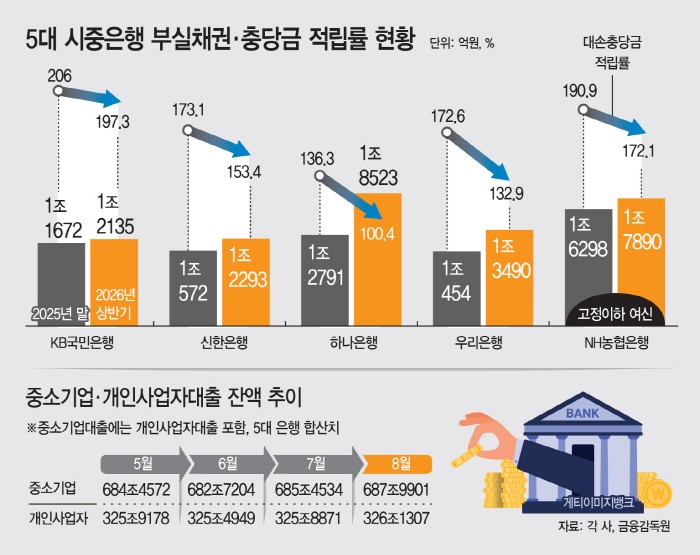
In contrast, the loan-loss coverage ratio—a core gauge of a bank's capacity to absorb credit losses by comparing loan-loss provisions against substandard-or-below loans—retreated substantially. KB Kookmin Bank's coverage ratio dropped about 10 percentage points from 206.0 percent at the end of last year to 197.3 percent in the first half of this year, while Shinhan Bank's figure fell by roughly 20 percentage points from 173.1 percent to 153.4 percent. Hana Bank dropped from 136.3 percent to 100.4 percent, Woori Bank retreated from 172.6 percent to 132.9 percent, and NH Nonghyup Bank declined from 190.9 percent to 172.1 percent.
The key concern is that financial soundness risks could widen further. Looking at the monetary policy board members' six-month rate forecasts, projections between 3.25 percent and 3.50 percent carry substantial weight, signaling one or two additional rate hikes ahead.
Because benchmark rate hikes sharply raise market rates, risks could intensify, particularly among liquidity-strained SMEs and sole proprietors.
According to Representative Lee Jong-wook of the ruling People Power Party, who serves on the National Assembly Strategy and Finance Committee, every 0.25 percentage-point increase in the benchmark rate adds roughly 3.2 trillion won to corporate annual financial costs. Factoring in the two recent rate hikes, corporate interest expenses could climb by 6.3 trillion won.
The interest coverage ratio, which measures a company's ability to service debt, remains negative for many SMEs. As rising interest rates inflate borrowing costs, corporate delinquency volumes inevitably swell. Concerns are rising that the emergence of new defaults and prolonged distress across vulnerable segments, including undercapitalized SMEs, could impair bank profitability alongside capital health.
Sohn Jae-sung, a professor at the Korea Institute of Finance, noted, "Even if expanding productive financing is necessary, reckless lending to high-risk companies ultimately returns to banks in the form of provisioning burdens and credit losses, making selective credit allocation inevitable."
Kang In-soo, an economics professor at Sookmyung Women's University, also stressed, "Lenders need a differentiated response, offering pinpoint support such as maturity extensions and liquidity assistance to borrowers with repayment capacity facing temporary shocks, while enforcing stricter credit management on borrowers facing structural default risks."
An official at a commercial bank stated, "For struggling companies deemed capable of normalization, banks can offer interest burden relief and restructuring advisory." The official added, "The most effective approach to managing health is tightening screening at the origination stage to prevent new bad loans while easing financial pressures on existing borrowers with turnaround potential to contain risk contagion."
Cho Eun-guk
Han Sang-wook
Most Read
-
1
U.S. Treasury Secretary Bessent publicly warns ove..

-
2
China overhauls National Defense Mobilization Law..

-
3
Hyundai Motor Group breaks ground on integrated st..

-
4
U.S. strikes Iran after a month, hits IRGC rocket..

-
5
Russia faces warning signs over prolonged war econ..

-
6
CIA director visits Russia, warns Moscow not to at..

-
7
Anti-Western solidarity strengthens amid Trump's e..

PEOPLE







-
Address : In-Young Bldg., 34, Uisadang-daero 1-gil, Yeongdeungpo-gu, Seoul
Copyright by ASIATODAY CO., LTD. All rights resereved