



S. Korea's national debt to reach 1,734 trillion won by 2030
Sep 08, 2026, 09:43 am


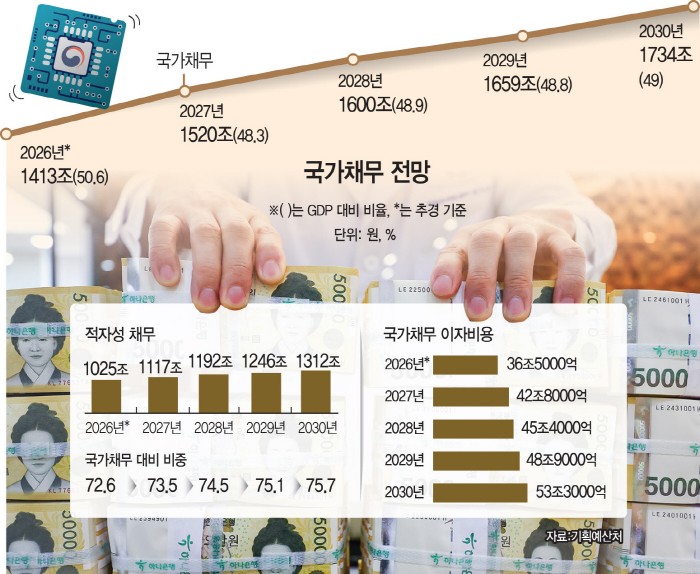 |
South Korea's national debt is projected to swell to 1,734 trillion won by 2030, but the debt-to-GDP ratio is expected to stay below 50 percent, buoyed by increased tax revenues and nominal GDP growth from the semiconductor boom. Concerns are mounting, however, that fiscal indicators could deteriorate again if the semiconductor cycle turns downward amid steadily growing deficit-financing debt and rising interest burdens.
National debt to rise by 321 trillion won while debt ratio declines on nominal GDP expansion
According to the 2026–2030 National Fiscal Management Plan released by the Ministry of Planning and Budget on the 7th, South Korea's national debt is projected to increase by 107 trillion won, rising from 1,412.8 trillion won under this year's supplementary budget to 1,519.8 trillion won next year. The figure is forecast to reach 1,600.3 trillion won in 2028 and 1,659.1 trillion won in 2029 before climbing to 1,734.1 trillion won by 2030—a 321.3 trillion won increase compared to this year.
In contrast, the debt-to-GDP ratio is projected to drop 2.3 percentage points from 50.6 percent this year to 48.3 percent next year. It is then expected to move within the government's targeted 50 percent ceiling, registering at 48.9 percent in 2028, 48.8 percent in 2029, and 49.0 percent in 2030.
The primary driver behind the falling debt ratio is not a reduction in national debt, but the expansion of nominal GDP, which serves as the denominator. Increased corporate earnings and corporate tax revenues driven by expanded artificial intelligence investments and the semiconductor supercycle, alongside rapid nominal GDP growth, have outpaced the growth rate of national debt.
Indeed, nominal GDP in the first quarter of this year grew 10.5 percent quarter-on-quarter, marking the fastest pace in 50 years since the first quarter of 1976. Year-on-year, it rose 17.1 percent. Bank of Korea Governor Shin Hyun-song also noted at a recent press conference that second-quarter nominal GDP growth is expected to come in quite strong, which should significantly improve debt ratios and fiscal soundness metrics.
Fiscal indicators vulnerable to semiconductor downturn as deficit-financing debt hits 1,312 trillion won
The issue lies in the fact that these indicators can hardly be viewed as a structural improvement in fiscal health. If the semiconductor industry enters a downturn, leading to reduced corporate tax receipts, or if nominal GDP fails to expand as projected, the debt-to-GDP ratio could climb higher than initially forecast.
Kim Woo-chul, a professor of taxation at the University of Seoul, pointed out that the current fiscal environment is structured to be affected not only by the performance of domestic chipmakers, but also by U.S. AI capital expenditure and changes in Chinese memory makers' market share. He noted that if operating profits at semiconductor firms decline, both tax revenues and nominal GDP would undergo corrections, which could push the national debt ratio higher than current forecasts.
Deteriorating debt quality and rising interest costs are also adding to the burden. According to the government's 2026–2030 National Debt Management Plan, deficit-financing debt—which lacks corresponding financial assets and must be serviced through general revenue such as taxes—is projected to rise by 287.1 trillion won, increasing from 1,025.2 trillion won under this year's supplementary budget to 1,312.3 trillion won in 2030. The share of deficit-financing debt within total national debt will also climb from 72.6 percent to 75.7 percent over the same period.
The National Assembly Budget Office noted that a steep increase in deficit-financing debt could compound the public's actual repayment burden and exacerbate fiscal rigidity due to rising interest expenditures, stressing that active management efforts are required not only for the total volume of national debt, but also for the level of deficit-financing debt.
National debt interest expenses are also projected to grow, rising from 36.5 trillion won this year to 42.8 trillion won next year, 45.4 trillion won in 2028, 48.9 trillion won in 2029, and 53.3 trillion won by 2030. Interest costs in 2030 alone are expected to exceed this year's figure by 16.8 trillion won.
Professor Kim advised that given the continuous, large-scale increase in absolute national debt, the declining debt ratio cannot easily be seen as structural improvement stemming from government fiscal management efforts, emphasizing that improving the fiscal balance and reining in the pace of debt growth when the economy is robust and tax revenue is plentiful is essential to secure fiscal room for economic downturns.
Lee Ji-hoon
Most Read
-
1
U.S. Treasury Secretary Bessent publicly warns ove..

-
2
China overhauls National Defense Mobilization Law..

-
3
Hyundai Motor Group breaks ground on integrated st..

-
4
U.S. strikes Iran after a month, hits IRGC rocket..

-
5
Russia faces warning signs over prolonged war econ..

-
6
CIA director visits Russia, warns Moscow not to at..

-
7
Anti-Western solidarity strengthens amid Trump's e..

PEOPLE







-
Address : In-Young Bldg., 34, Uisadang-daero 1-gil, Yeongdeungpo-gu, Seoul
Copyright by ASIATODAY CO., LTD. All rights resereved