



Seoul housing starts surge 44.4% this year driven by redevelopment projects
Sep 08, 2026, 09:32 am


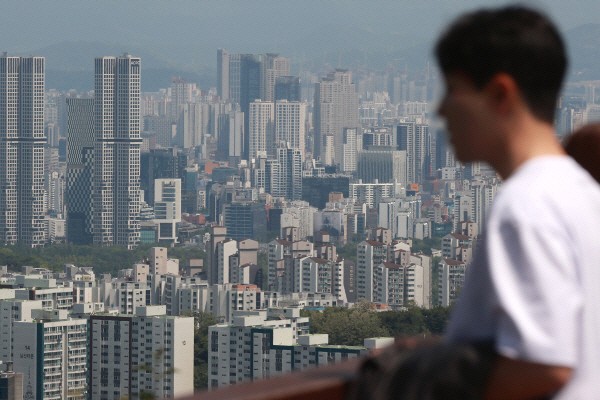 |
| A panoramic view of an apartment-dense area seen from Namsan Mountain in Seoul. / Yonhap News |
The volume of housing starting actual construction in Seoul this year has surged by more than 40 percent compared to last year. In particular, apartment starts increased around urban redevelopment and reconstruction projects, while the supply of non-apartment housing such as villas is also showing signs of recovery.
The Seoul Metropolitan Government announced on the 7th that housing starts in Seoul totaled 19,507 units from January to July this year. That represents a 44.4 percent increase compared to the same period last year, and is 34.6 percent higher than the average for the same period over the past three years.
Housing construction permits also climbed 6.1 percent from last year to 28,634 units, marking a 36.7 percent increase compared to the three-year average.
Given that permits represent project volumes expected to break ground in the future and housing starts reflect units that have actually begun construction, both metrics serve as leading indicators for gauging the future scale of housing supply.
By housing type, apartments accounted for the bulk of this year's starts at 14,995 units. This is a 36.1 percent increase from the same period last year, with redevelopment and reconstruction projects accounting for 12,211 units, or 81.4 percent.
Groundbreakings for large-scale complexes of more than 1,000 units also followed. Projects that broke ground this year include Heukseok Zone 11 (1,515 units), Sillim Zone 2 (1,430 units), and Junggye-bon-dong (3,178 units).
Permits similarly showed a clear trend centered on urban renewal projects. Apartment construction permits from January to July totaled 23,480 units, of which 19,447 units, or 82.8 percent, came from renewal projects.
Major sites completing the permitting process this year include Jamsil Jugong Complex 5 (6,411 units), Hannam Zone 5 (2,592 units), and Geoyeo Saemaeul (1,678 units).
Looking strictly at apartment permits, however, the figure slipped 1.6 percent compared to the same period last year, though it remained 27.6 percent higher than the three-year average.
Signs of recovery also emerged in the non-apartment housing market, where supply had previously been sluggish. Non-apartment construction permits from January to July rose 64.4 percent year-on-year to 5,154 units, a 101.9 percent jump compared to the three-year average. Starts also jumped 80.9 percent from last year to 4,512 units.
The Seoul city government analyzed that supply expansion policies, such as the Speedy Integrated Planning framework and streamlined renewal procedures, contributed in part to accelerating project momentum. The city noted, however, that the rise in permits and starts reflects a combination of multiple factors, including market conditions and project timelines across individual sites.
Attention is also focusing on whether the growth in starts and permits will translate into an increase in actual move-in volumes. In Seoul, a total of 48,000 units are slated for move-in over the next two years, including about 26,000 units this year and about 22,000 units next year.
To further accelerate housing supply, Seoul plans to target 310,000 housing starts by 2031. To this end, the city plans to elevate the management system for urban renewal project progress to the vice-mayoral level and operate special progress promotion meetings in coordination with autonomous district offices to inspect delayed sites.
Myung No-jun, director-general of Seoul's Housing Policy Bureau, stated, "We will closely manage major projects, including urban renewal initiatives, to ensure that the upward trend in permits and construction starts directly leads to actual move-ins."
Jeon Won-jun
Most Read
-
1
Celltrion’s Omlyclo gains ground in major European..

-
2
Trump demands rates fall below 1% as Fed hikes for..

-
3
Trump makes $1 trillion bet ahead of midterm elect..

-
4
Iran resumes ballistic missile production, assembl..

-
5
Samsung Electronics, Mistral AI to jointly develop..

-
6
Trump warns countries not helping U.S. must pay re..

-
7
Seoul faces triple squeeze over troop deployment t..

PEOPLE






-
Address : In-Young Bldg., 34, Uisadang-daero 1-gil, Yeongdeungpo-gu, Seoul
Copyright by ASIATODAY CO., LTD. All rights resereved