



Following New York billboard ad, Samsung DX union draws criticism over rally outside JY's residence
Sep 07, 2026, 09:44 am


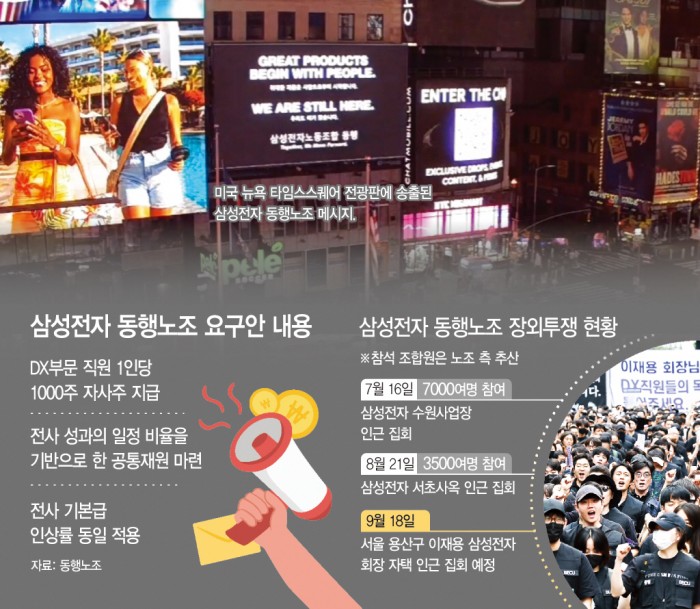 |
Labor Union Donghaeng (hereinafter referred to as the Donghaeng Union), centered within Samsung Electronics' Device eXperience (DX) division overseeing home appliances, TVs, and smartphones, is escalating its off-site protests. Following a large-scale rally held near the Seocho headquarters last month demanding overhauls to the wage and performance bonus structure, the union has announced an indefinite rally outside the private residence of Samsung Electronics Chairman Lee Jae-yong starting this month. Recently, it has intensified an external public relations push by running an ad critical of management on an electronic billboard in Times Square, New York, adding to internal fatigue across the company. Voices from both inside and outside the company point out that the union is losing both justification and practical gains through late, unreasonable pushback outside legitimate collective bargaining tables.
According to industry sources on the 6th, the Donghaeng Union will begin rallies and one-person picketing near Chairman Lee's private residence in Yongsan-gu, Seoul, starting on the 18th. The duration of the rally has not been set, and the union explained that it will switch to one-person pickets if rally registration is denied. Once the smallest among Samsung Electronics' multiple labor unions, the Donghaeng Union has expanded rapidly, growing from around 2,000 members in April of this year to more than 30,000 members at present. Citing a wide compensation gap regarding the wage agreement signed in May between management and the enterprise-wide Super Labor Union (focused on the Device Solutions semiconductor division), the union has maintained its off-site campaign. Under that agreement, the DS division was granted special management performance bonuses worth 10.5% of business performance, while the DX division received treasury shares valued at roughly 6 million won.
The union's core demands include granting 1,000 treasury shares per employee in the DX division, creating a shared bonus pool funded by a fixed percentage of company-wide performance, and applying a uniform base salary increase rate across the entire company. During a rally near Samsung Electronics' Seocho headquarters on the 21st of last month, approximately 3,500 union members (estimated by the union) voiced these demands while calling for the resignation of top management—including Park Hark-kyu, head of the Corporate Management Office, and Chung Hyeon-ho, assistant to the chairman—citing deteriorating profitability in the DX division. At the time, the Donghaeng Union stated, "Management is passing all responsibility for its failures onto employees," adding, "We will fight to the very end through every legitimate means permitted by law." The union has also partnered with the Korea Shareholders Alliance, a retail investor group, to ramp up pressure.
The previous day, the union took its criticism public by posting a message critical of management policies on a billboard in New York's Times Square. The 15-second video featured the text: "Great products start with people. We are still here." The message is likewise interpreted as an indirect expression of dissatisfaction over the wage and incentive structure, aimed at pressuring management through public opinion.
Regarding these actions, observers both inside and outside the company emphasize that the campaign bypasses procedural legitimacy. The prevailing view is that the union has lost its standing because the wage agreement was concluded through lawful collective bargaining procedures with over half of union members voting in favor, and above all, because the Donghaeng Union broke away from the joint bargaining group to pursue its own independent path. From a practical standpoint, industry observers evaluate that waging protests and public relations campaigns over an already finalized agreement is unlikely to yield tangible outcomes such as improved working conditions or increased compensation.
Adding to internal and external fatigue is also seen as a factor leading to the union's self-isolation. Criticisms suggest that blind pressure campaigns and denunciation protests against management alienate not only the general public but also the internal workforce. Industry observers explain that if internal support wavers, the union will struggle to exercise bargaining power in upcoming negotiations. A business community official remarked, "Attempting to overturn a labor-management agreement mediated by the government during a period of persistent business uncertainty is merely an exhausting move that forfeits both justification and practical gains," adding, "Protests straying beyond lawful boundaries will prove counterproductive, narrowing the union's bargaining leverage and standing."
Yeon Chan-mo
Most Read
-
1
Celltrion nears additional contract with major U.S..

-
2
Putin proposes trilateral U.S.-China-Russia summit..

-
3
U.S. weighs dropping MOAB, world's most powerful n..

-
4
"Aren't those foreigners on welfare?": M..

-
5
Attention centers on APEC for possible Trump-Xi-Pu..

-
6
Saudi Arabia, Iran hold first diplomatic talks to..

-
7
Saudi airport in Riyadh struck again, leaving at l..

PEOPLE






-
Address : In-Young Bldg., 34, Uisadang-daero 1-gil, Yeongdeungpo-gu, Seoul
Copyright by ASIATODAY CO., LTD. All rights resereved