



Glacial disaster hits Nepal, sounding alarm bells in the Andes
Sep 04, 2026, 10:14 am


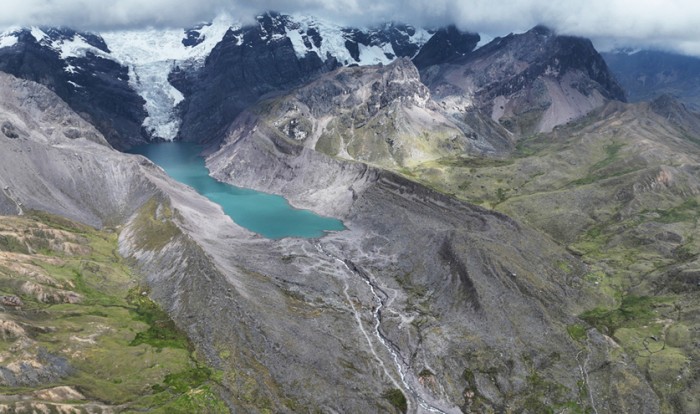 |
| Lake Upiscocha and traces of overflow. / National Institute of Research on Glaciers and Mountain Ecosystems (INAIGEM) of Peru |
Concerns are growing that catastrophic glacial disasters like the devastating floods in Nepal triggered by global warming could also occur in South America's Andes Mountains. As rising temperatures rapidly melt glaciers, expanding unstable glacial lakes and heightening the risk of collapsing ice walls and rock faces, tensions are mounting across Andean nations including Peru, Chile, and Argentina.
According to agencies including Peru's National Institute of Research on Glaciers and Mountain Ecosystems (INAIGEM) on the 2nd, the disaster looming over the Andes extends beyond rising water levels from melting glaciers. When unstable ice walls or rock faces collapse due to higher temperatures, sending massive slabs of ice and rock plunging into glacial lakes, towering waves can breach or rupture natural moraine dams, sending water, debris, and rock cascading down valleys all at once. This phenomenon is known as a Glacial Lake Outburst Flood (GLOF).
Peru in particular ranks as the world's third most vulnerable country to glacial lake outbursts. A nationwide survey by INAIGEM identified 528 glacial lakes at risk of outburst across eight regions, including Ancash, Cusco, Lima, and Puno, with 58 categorized as "very high risk."
Lake Upiscocha in Cusco's Vilcanota mountain range was assessed as facing the highest risk of outburst. The lake's water volume grew at an annual average rate of 14.9 percent between 2016 and 2023, exceeding 19 million cubic meters by 2024. That volume could fill roughly 7,600 Olympic-sized swimming pools. Fifteen hazardous points prone to potential landslides or avalanches were also identified around the lake.
Lake Palcacocha, located upstream from Huaraz in the Ancash region, ranks as the second most hazardous after Lake Upiscocha. Perched at an altitude of 4,546 meters above sea level, the lake formed from the melting of the Palcaraju and Pucaranra glaciers, with its water volume swelling 34-fold between 1972 and 2016. INAIGEM estimates that an outburst could affect more than 27,000 residents and currently operates a real-time early warning system.
The hazards posed by Palcacocha have already materialized in the past. In 1941, an outburst flood from the lake sent a torrent of water and mud sweeping through downstream Huaraz, destroying much of the city and claiming thousands of lives.
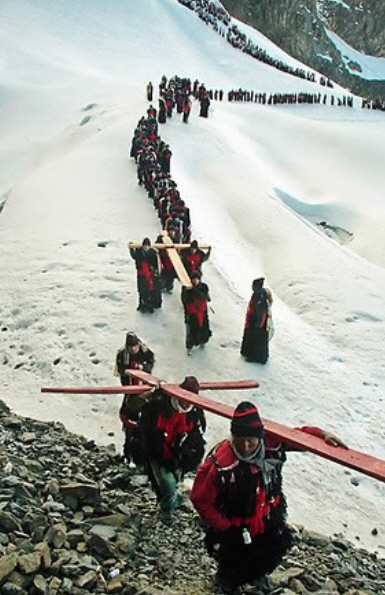 |
| The Peruvian Andes / EPA, Yonhap |
In Argentina, the rapid retreat of glaciers in Patagonia is emerging as a new hazard factor. According to research published in 2024 by researchers at the University of Buenos Aires, the retreat rate of the Torre Glacier near the tourist town of El Chaltén quadrupled from 2022 to April 2024 compared to the preceding three-year period. Over this timeframe, the glacier lost roughly 0.4 square kilometers in area, while its terminus retreated by about 645 meters.
The concern is that this glacial retreat is destabilizing surrounding mountain slopes. Researchers identified not only landslides, debris flows, and rockfalls around the Torre Glacier, but also fractures and deformation along the slopes. They analyzed these changes as progressing in tandem with the retreat of the glacier.
Warnings over collapsing ice and rock faces are also emerging in Chile, home to more than 26,000 glaciers. Darío Ormeño, a geology professor at Andrés Bello University, recently told Chilean media outlet BioBioChile that ice and rock from high-altitude glaciers could likewise collapse and plunge into valleys below. Indeed, massive slope collapses tied to glaciers were observed in Chile in 2009, 2018, and 2024, and research into related risks is currently underway in the Cajón del Maipo area near the capital Santiago as well as across Patagonia.
However, analyses suggest that disasters on the scale seen in Nepal are relatively less likely. While noting that Chilean glaciers are smaller and feature less vertical relief than those in the Himalayas, Professor Ormeño pointed out that landslide hazards stemming from ice and rock collapses remain a tangible reality.
As glacial disaster risks mount, monitoring and response efforts are intensifying. Peru operates real-time early warning systems for high-risk glacial lakes such as Palcacocha, while Chile is pushing to establish remote monitoring systems utilizing satellite radar. Given the inaccessibility of high-altitude mountain terrain, Professor Ormeño emphasized the importance of continuously monitoring changes in glaciers and surrounding mountain slopes through satellites and radar.
Nam Mi-kyung
Most Read
-
1
Celltrion nears additional contract with major U.S..

-
2
Putin proposes trilateral U.S.-China-Russia summit..

-
3
U.S. weighs dropping MOAB, world's most powerful n..

-
4
"Aren't those foreigners on welfare?": M..

-
5
Attention centers on APEC for possible Trump-Xi-Pu..

-
6
Saudi Arabia, Iran hold first diplomatic talks to..

-
7
Saudi airport in Riyadh struck again, leaving at l..

PEOPLE







-
Address : In-Young Bldg., 34, Uisadang-daero 1-gil, Yeongdeungpo-gu, Seoul
Copyright by ASIATODAY CO., LTD. All rights resereved