



As ISA reform falls through, tax-saving investments in U.S. ETFs regain spotlight
Sep 07, 2026, 09:35 am


 |
With the government's proposed reform to the Individual Savings Account (ISA)—which would have capped contract periods and restricted the rollover of unused contribution limits—scrapped amid strong investor pushback, sentiment toward ISA investing is set to regain momentum after stalling due to policy uncertainty. This comes as investors can continue to enjoy tax-free limits and low-rate separate taxation without mandatory maturity dates.
Within an ISA, investing in exchange-traded funds (ETFs) tracking foreign assets such as U.S. equities offers distinct advantages over domestic asset-based ETFs. While domestic-listed foreign ETFs held in standard taxable accounts incur relatively heavy taxes, an ISA significantly eases this burden. As a result, demand for ISAs is expanding in tandem across both long-term systematic investment and dividend-focused strategies.
According to the Ministry of Economy and Finance on the 6th, the government plan maintaining the current contract period and contribution limits for ISAs was officially finalized at a Cabinet meeting on the 1st of this month. In the tax reform proposal announced last month, the government had planned to limit the ISA contract period to an initial three years with a maximum duration of five years. While leaving the contribution ceiling unchanged at 20 million won annually up to an aggregate 100 million won, the initial proposal would have prohibited rolling over unused annual quotas into subsequent years. The proposal drew substantial criticism because it narrowed the existing system, which features no maturity limits and allows rollover of unused contribution headroom.
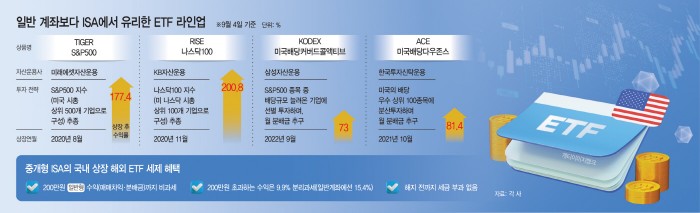
The core appeal of the retained ISA structure is particularly pronounced when investing in domestic-listed foreign ETFs. In a standard brokerage account, foreign ETFs are subject to a 15.4% tax on both capital gains and dividend distributions. Within an ISA, however, gains combining both capital appreciation and dividend distributions are entirely tax-free up to 2 million won.
Net earnings exceeding the 2 million won threshold are subject to separate taxation at a low rate of 9.9%. Because taxes are deferred until the account is closed, investment returns are continuously reinvested throughout the holding period, compounding over time.
For this reason, ETFs tracking flagship U.S. indices are widely viewed as the primary option for long-term systematic investing. Coupling an installment accumulation strategy with ISA tax advantages allows investors to target both compound capital growth and tax efficiency over the long run.
Mirae Asset Global Investments' TIGER U.S. S&P 500, which tracks the Standard & Poor's 500 Index comprising the 500 largest U.S. companies by market capitalization, has recorded a return of 177.4% since listing in August 2020. KB Asset Management's RISE U.S. Nasdaq 100, tracking the 100 largest firms on the Nasdaq exchange, has generated a return of 200.8% since its listing in November 2020.
Samsung Asset Management's KODEX U.S. Dividend Covered Call Active is another monthly dividend ETF offering substantial tax benefits within an ISA. This product selects U.S. dividend growth stocks from among S&P 500 constituents that have consistently raised payouts over extended periods, diversifying across sectors such as IT, financials, healthcare, industrials, and energy. Its structure supplements corporate dividend payouts by selling call options (covered call strategy) to generate additional distribution resources.
Korea Investment Management's ACE U.S. Dividend Dow Jones is likewise a monthly dividend ETF that pairs effectively with an ISA. The product screens the Dow Jones U.S. Broad Market Index, which covers the broader U.S. equity market, by first excluding real estate investment trusts (REITs) and selecting actively traded companies with extended histories of dividend distributions.
After filtering for firms in the top half by annual dividend yield, it conducts an integrated evaluation based on four fundamental metrics—debt-to-cash-flow ratio, return on equity (ROE), annual dividend yield, and five-year dividend growth rate—to select a final portfolio of 100 stocks.
Its portfolio constituents include blue-chip U.S. names such as multinational pharmaceutical company Merck & Co., Coca-Cola, and PepsiCo. By sector, consumer staples and healthcare—which are comparatively less sensitive to economic cycles—comprise the largest weightings, reflecting an investment strategy centered on dividend durability.
Park I-sak
#ISA #Stock #Investment #ETF
Copyright by Asiatoday
Most Read
-
1
Celltrion nears additional contract with major U.S..

-
2
Putin proposes trilateral U.S.-China-Russia summit..

-
3
U.S. weighs dropping MOAB, world's most powerful n..

-
4
"Aren't those foreigners on welfare?": M..

-
5
Attention centers on APEC for possible Trump-Xi-Pu..

-
6
Saudi Arabia, Iran hold first diplomatic talks to..

-
7
Saudi airport in Riyadh struck again, leaving at l..

PEOPLE







-
Address : In-Young Bldg., 34, Uisadang-daero 1-gil, Yeongdeungpo-gu, Seoul
Copyright by ASIATODAY CO., LTD. All rights resereved