



July current account surplus hits record 42.08 billion dollars on strong chip exports
Sep 04, 2026, 09:58 am


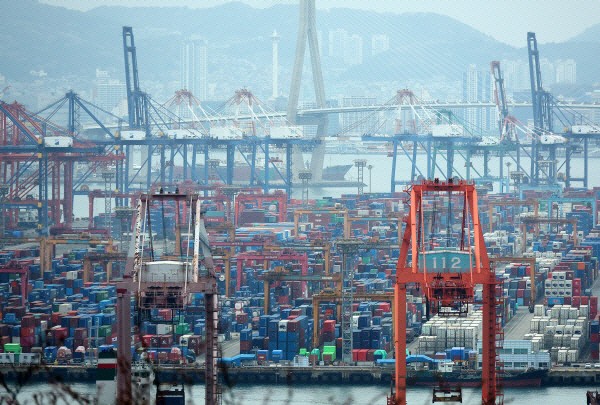 |
| Containers stacked at the Sinseondae Pier of Busan Port. / Yonhap |
Driven by sustained strength in semiconductor exports, South Korea's current account balance logged its largest-ever surplus for any July. In monthly terms, it marked the second-largest surplus in history, following the all-time high set in June.
According to preliminary balance of payments data for July 2026 released by the Bank of Korea (BOK) on the 4th, the July current account recorded a surplus of 42.08 billion dollars (approximately 57 trillion won). Although down from 49.73 billion dollars the previous month, the surplus surpassed 40 billion dollars for the second straight month. The cumulative surplus for January through July reached 233.09 billion dollars, roughly four times the 59.82 billion dollars logged during the same period last year.
On the 27th of last month, the BOK sharply revised up its annual current account surplus projection for this year from 250 billion dollars to 450 billion dollars. Yoo Seong-wook, head of the financial statistics division at the BOK, remarked, "While the surplus narrowed from the previous month, centered on the goods balance due to seasonal downward factors, it remained well above 40 billion dollars," adding, "For now, we expect trends to largely align with the forecast."
The current account surplus was propelled by robust exports led by chips. The goods balance posted a surplus of 40.43 billion dollars in July, recording the second-largest figure on record following June's 47.89 billion dollars.
Exports stood at 100.45 billion dollars, surging 65.3% year-on-year. Although exports fell from June due to the base effect of quarter-end export concentration in the prior month, they topped the 100 billion dollar mark for the second consecutive month.
On a customs clearance basis, semiconductor exports soared 176.3% from the same month last year, and solid-state drive (SSD) computer peripherals jumped 344.5%. Shipments of petroleum and chemical products also increased by 35.7% and 19.1%, respectively.
Imports rose 21.7% year-on-year to 60.02 billion dollars. On a customs clearance basis, raw material and capital goods imports expanded by 29.1% and 36.7%, respectively, whereas consumer goods imports fell 3.0%, slipping into contraction for the first time in 15 months.
The services account ran a deficit of 1.97 billion dollars, widening from a 1.29 billion dollar shortfall the prior month. In particular, the travel balance swung from a surplus of 440 million dollars in June to a deficit of 340 million dollars in July. The travel account flipped into the red for the first time in three months as the number of outbound travelers rose, spurred by the peak summer overseas vacation season and the designation of Constitution Day as a public holiday.
The primary income account registered a surplus of 4.35 billion dollars, widening from 3.27 billion dollars the previous month. The dividend income surplus widened from 2.56 billion dollars to 3.83 billion dollars as operating profits from overseas sales subsidiaries of semiconductor companies climbed.
Net assets in the financial account increased by 40.32 billion dollars, marking the second-largest gain on record. Domestic residents' overseas portfolio investments rose by 13.57 billion dollars, driven by equities, while foreign investors' portfolio investments in South Korea expanded by 8.17 billion dollars.
Foreign equity investment in domestic stocks rose by 5.98 billion dollars, turning into net purchases for the first time in six months. The BOK explained that along with an easing in domestic equity sell-offs, factors such as SK Hynix's issuance of American Depositary Receipts (ADRs) also contributed to the inflow.
Park Seo-a
Most Read
-
1
Celltrion nears additional contract with major U.S..

-
2
Putin proposes trilateral U.S.-China-Russia summit..

-
3
U.S. weighs dropping MOAB, world's most powerful n..

-
4
"Aren't those foreigners on welfare?": M..

-
5
Attention centers on APEC for possible Trump-Xi-Pu..

-
6
Saudi Arabia, Iran hold first diplomatic talks to..

-
7
Saudi airport in Riyadh struck again, leaving at l..

PEOPLE







-
Address : In-Young Bldg., 34, Uisadang-daero 1-gil, Yeongdeungpo-gu, Seoul
Copyright by ASIATODAY CO., LTD. All rights resereved