



Coupang shaken by regulatory issues, with FTC risks emerging as key variable for next year's profitability
Sep 04, 2026, 09:43 am


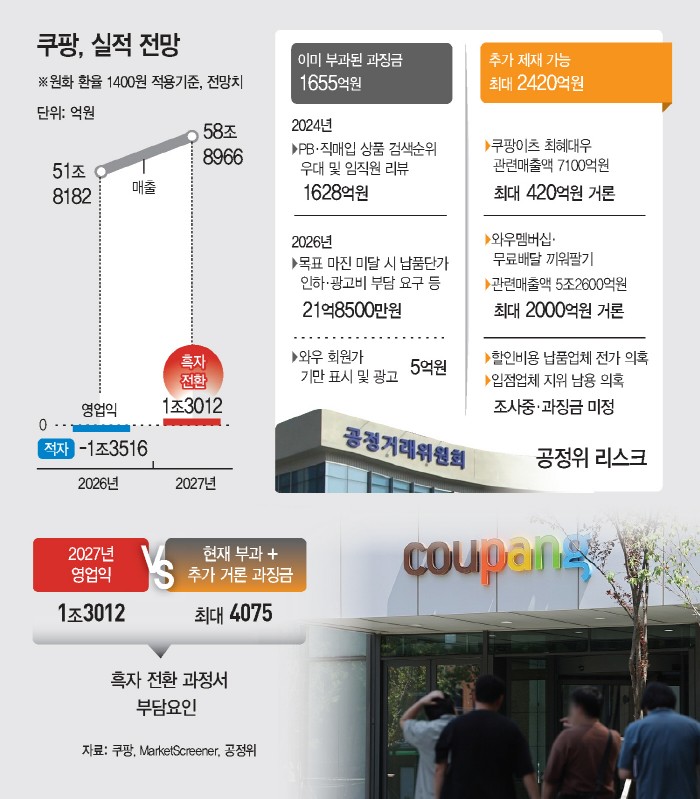 |
Regulatory risks from the Fair Trade Commission (FTC) have emerged as a key variable in Coupang's earnings recovery. With massive operating losses expected this year in the aftermath of a personal data breach, a series of FTC-driven regulatory issues have also erupted, raising concerns that they could weigh on the company's turnaround to profitability next year. In addition to ongoing controversies since last year over Coupang Eats' alleged most-favored-nation (MFN) clauses and the tying of Wow Membership benefits, fresh investigations involving suppliers and third-party sellers have recently begun. The regulatory front appears to be expanding beyond Coupang Eats into core retail operations. Analysts point out that even if Coupang files an administrative suit to challenge future fines and ultimately prevails, reaching a final verdict typically takes several years, meaning sanction costs and uncertainty could weigh on short-term earnings in the interim.
According to industry sources on the 3rd, the FTC is currently examining at least four distinct issues involving Coupang: alleged MFN demands by Coupang Eats, tying Wow Membership with Coupang Eats, allegations of shifting custom discount coupon costs onto suppliers, and suspected abuse of market dominance against platform sellers. Having already been hit with 2.6 billion won in fines this year alone, Coupang could face significantly higher penalty burdens if the cases currently under investigation and review lead to additional sanctions. Coupang was previously fined 162.8 billion won in 2024 over allegations of manipulating search rankings in favor of its private-label and direct-purchase products and mobilizing employee reviews.
The issue drawing the keenest attention recently involves allegations of shifting discount expenses onto suppliers. Tensions between the two sides surfaced publicly after Coupang rejected an on-site FTC inspection—an unusual move in the retail industry—and escalated the matter into a courtroom battle. The FTC recently launched an inquiry into allegations that Coupang passed the costs of personalized discount coupons offered to consumers onto its suppliers. When the FTC initiated an on-site inspection, Coupang refused, arguing that the commission failed to comply with advance notification procedures, and filed a lawsuit seeking to revoke the decision to conduct an ex officio investigation. While the court temporarily suspended the effect of the investigation decision through the 23rd, it held a hearing on the stay of execution request on the 2nd.
The scope of FTC investigations is widening to Coupang's core retail business. The commission recently launched a separate probe to examine whether Coupang abused its superior bargaining position over third-party marketplace sellers. With investigations into tying and MFN practices regarding delivery app Coupang Eats ongoing since last year still unresolved, a substantial portion of Coupang's major business models has now come under the FTC's investigative lens.
In particular, the cases related to Coupang Eats are heading into full commission deliberations to decide on potential sanctions. While Coupang applied for a consent decree regarding the alleged MFN case—where it reportedly pressured merchants to set food prices and minimum order amounts no less favorable than those on rival delivery apps—the FTC dismissed the application in June. Consequently, the commission will determine whether the practice violated competition laws and set penalty levels through upcoming formal hearings. The tying case involving the linkage between Wow Membership and Coupang Eats is also slated for review, and Coupang did not seek a consent decree for that case. Citing related revenue figures calculated by the case examiner, industry observers raise the possibility that combined fines for the two cases could reach up to the 200 billion won range. However, the final determination on sanctions and the scale of fines will be settled following commission deliberations.
Such regulatory burdens are expected to act as a variable in Coupang's earnings rebound. Coupang's operating profit (EBIT) forecast compiled by financial data provider MarketScreener points to an operating deficit of around 1.3516 trillion won this year. Reflecting cost burdens associated with the personal data breach, Coupang posted an operating loss of 1.1895 trillion won in the first half of the year alone. Additionally, expenses tied to a fire at the Incheon fulfillment center are expected to weigh on annual performance.
The critical phase begins next year. The market projects that Coupang will swing to the black next year with an operating profit (EBIT) of approximately 1.3012 trillion won. During its recent second-quarter earnings release, Coupang also projected that the profitability of its core retail operations, including Rocket Delivery, would recover close to pre-breach levels by around mid-next year. The expectation is that the drag from one-off expenses weighing on this year's results will diminish and core business profitability will normalize. Nevertheless, if the ongoing FTC cases lead to successive sanctions, they could incur additional costs and potentially necessitate revisions to business policies, which analysts warn could pose headwinds to earnings recovery next year.
Choi Jeong-a
Most Read
-
1
U.S. Treasury Secretary Bessent publicly warns ove..

-
2
China overhauls National Defense Mobilization Law..

-
3
U.S. strikes Iran after a month, hits IRGC rocket..

-
4
Hyundai Motor Group breaks ground on integrated st..

-
5
Russia faces warning signs over prolonged war econ..

-
6
CIA director visits Russia, warns Moscow not to at..

-
7
Anti-Western solidarity strengthens amid Trump's e..

PEOPLE






HEADLINE NEWS
- U.S. strikes Iranian tanker again, retaliating for attack on American warships
- Canada enacts retaliatory tariffs up to 50% on U.S., deepening trade confli..
- 'Super El Niño' looms over Latin America, threatening food security and put..
- S. Korea and France sign 16 agreements and MOUs on defense, advanced tech

-
Address : In-Young Bldg., 34, Uisadang-daero 1-gil, Yeongdeungpo-gu, Seoul
Copyright by ASIATODAY CO., LTD. All rights resereved