



This summer was the third hottest on record
Sep 04, 2026, 09:28 am


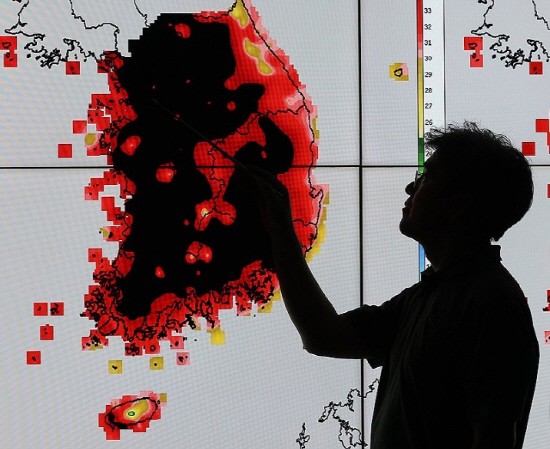 |
| A monitor at the Korea Meteorological Administration in Dongjak-gu, Seoul, displays nationwide peak temperatures on the 6th of last month. / Yonhap |
This summer went down as the third hottest on record since nationwide meteorological observation networks were established in 1973. While rain events were infrequent again this year, precipitation concentrated in narrow areas, causing simultaneous damage from torrential downpours and droughts depending on the region. Analyses indicate that compound disasters have become pronounced, with extreme climate events recurring in short spans.
The Korea Meteorological Administration announced on the 3rd the results of its analysis of the climate characteristics and causes of the summer season (June to August) in 2026. According to the KMA, the nationwide average temperature this summer stood at 25.4 degrees, 1.7 degrees higher than average. This ranks third highest on record, following 2025 (25.7 degrees) and 2024 (25.6 degrees).
The main driver behind this summer's heat was the "double heat dome" effect, in which the North Pacific High and the Tibetan High blanketed the skies together from mid-July to early August. Nationwide heat wave days this summer reached 21.5 days, more than double the average (10.6 days), while tropical nights totaled 18.2 days, nearly triple the average (6.5 days). In particular, from late July to early August, westerly winds grew stronger than usual, leading the South Gyeongsang region—heavily influenced by terrain—to break daily high temperature records for seven consecutive days. On the 2nd of last month, temperatures in Yangsan soared to 42.5 degrees. Subsequently, under the influence of Typhoon Dolphin, the 13th typhoon of the season, hot and humid air flowed in along easterly winds, expanding the heat wave nationwide, including the Seoul metropolitan area.
In contrast, precipitation continued a trend of remaining below average for the third consecutive year since 2024. Nationwide rainy days this year totaled 31.2 days, about a week fewer than the average (38.5 days), and precipitation reached 558.6 mm, remaining at just 76% of the average (727.3 mm).
As extreme heat waves coincided with scarce precipitation, severe drought struck parts of the southern region. As of mid-August, reservoir storage rates in some parts of South Gyeongsang stood at just 32%, lingering at half of typical levels. Rain fell once over the Liberation Day holiday, but it concentrated in short bursts only over select areas, including Geoje and Tongyeong. While Geoje suffered damage from disaster-level downpours, drought relief in other regions remained extremely limited.
The KMA assessed that climate polarization between regions has deepened over the past three years as the summer weather pattern in South Korea repeatedly brought heat waves, heavy downpours, and droughts all at once.
KMA Administrator Lee Mi-sun said, "This summer again saw heightened climate volatility and pronounced risks of compound disasters, with diverse extreme events occurring simultaneously within short periods. As the climate crisis threatens daily life and safety, we will cooperate closely with disaster prevention agencies to bolster our disaster readiness posture."
Kim Hong-chan
Most Read
-
1
Celltrion nears additional contract with major U.S..

-
2
Putin proposes trilateral U.S.-China-Russia summit..

-
3
"Aren't those foreigners on welfare?": M..

-
4
U.S. weighs dropping MOAB, world's most powerful n..

-
5
Houthis launch successive attacks on Saudi airport..

-
6
Saudi Arabia, Iran hold first diplomatic talks to..

-
7
Saudi airport in Riyadh struck again, leaving at l..

PEOPLE





HEADLINE NEWS
- [Exclusive] U.S. military steel frame work at Gwangju Airport casts cloud over planned semiconductor industrial complex
- Momentum grows for mid-next month U.S.-China-Russia summit with mounting is..
- Elon Musk formalizes review of SpaceX-Tesla merger
- [Exclusive] 10 SNUs pledged, but three regional universities take half the..

-
Address : In-Young Bldg., 34, Uisadang-daero 1-gil, Yeongdeungpo-gu, Seoul
Copyright by ASIATODAY CO., LTD. All rights resereved