



Basic pension reform effectively back to square one
Sep 03, 2026, 09:11 am


 |
Minister of Health and Welfare Jung Eun-kyeong faces her heaviest policy test since taking office. This comes as the structural overhaul of basic pension eligibility was dropped on the threshold of the 2027 budget proposal, while structural reform of the National Pension also stalled. Although final decision-making power over pension reform rests with the administration as a whole and the National Assembly, the ministry is unlikely to avoid responsibility for the outcome as the competent authority in charge.
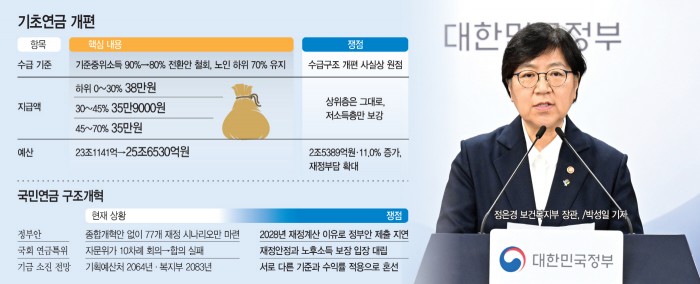
According to government sources on the 2nd, the Ministry of Health and Welfare's total expenditure for fiscal year 2027 stands at 148.7697 trillion won, up 8.2 percent from this year. Factoring in future response fund projects, the total reaches 152.4328 trillion won, reflecting a 10.9 percent growth rate. The basic pension budget rose from 23.1141 trillion won to 25.6530 trillion won, an increase of 2.5389 trillion won or 11.0 percent.
The problem is that, despite the increased budget, core structural reforms to eligibility criteria were omitted. The welfare ministry previously reviewed a plan to shift the eligibility baseline from the bottom 70 percent of senior income earners to a system pegged to the standard median income. The blueprint envisioned setting the threshold at 90 percent of standard median income in 2027, then progressively lowering it to 86.6 percent in 2028, 83.3 percent in 2029, and 80 percent by 2030.
However, the ministry postponed a press background briefing originally scheduled for the 26th of last month to the 27th, only to cancel it roughly 70 minutes prior to the announcement, citing that certain elements had not been finalized. Ultimately, the standard median income peg was dropped from the government budget, and the target coverage rate of the bottom 70 percent of seniors was maintained. Accordingly, basic pension payouts will be tiered into three brackets starting next year. The 3.48 million individuals in the bottom 0 to 30 percent income bracket will receive 380,000 won per month; the 1.74 million in the 30 to 45 percent bracket will receive 359,000 won adjusted for inflation; and the 2.9 million in the 45 to 70 percent bracket will see their benefits frozen at this year's level of 350,000 won.
For the 2.34 million low-income married couples falling in the bottom 45 percent, the couple benefit reduction rate will be lowered from 20 percent to 10 percent. Monthly payouts for couples in the bottom 30 percent will increase from 560,000 won to 684,000 won, and those in the 30 to 45 percent range will rise to 646,000 won. Additionally, 110,000 low-income recipients of occupational pensions and their spouses will be newly included in basic pension coverage, receiving up to 380,000 won per month depending on their income tier.
The government described this as an approach that keeps the upper tier intact while reinforcing the foundation. Civic groups, however, push back, arguing that the increase for the lowest income bracket is marginal and that failing to adjust the 45 to 70 percent bracket for inflation effectively reduces real benefits.
Meanwhile, the National Assembly's Special Committee on Pension Reform has also failed to find a breakthrough. Its civilian advisory panel convened ten meetings through May but was unable to reach a consensus on a unified proposal. Appearing before the special committee on the 21st of last month, Minister Jung stated that the ministry had formulated roughly 77 fiscal scenarios across various parameters and would release precise estimates through the sixth National Pension Actuarial Review in 2028. Through parametric reforms last year, the National Pension is set to gradually raise insurance contribution rates from 9 percent to 13 percent by 2033, while raising the income replacement rate to 43 percent starting this year. However, structural reforms—including automatic adjustment mechanisms, state subsidies, and role reallocation between retirement pensions and the basic pension—have been left on the back burner.
Minister Jung also defined the basic pension as part of a comprehensive overhaul of the entire pension system. Yet with no comprehensive government blueprint unveiled and the overhaul of basic pension eligibility effectively derailed, observers point out that the gap between the minister's stated vision and actual policy delivery has widened.
Oh Gun-ho, co-representative of My Welfare State, pointed out that the basic pension serves as a core pillar of structural pension reform, noting that the government's vacillation surrounding this budget proposal raises doubts about its commitment to and direction for overarching pension reform.
Lee Se-mi
Most Read
-
1
Celltrion nears additional contract with major U.S..

-
2
Putin proposes trilateral U.S.-China-Russia summit..

-
3
"Aren't those foreigners on welfare?": M..

-
4
U.S. weighs dropping MOAB, world's most powerful n..

-
5
Houthis launch successive attacks on Saudi airport..

-
6
Saudi Arabia, Iran hold first diplomatic talks to..

-
7
Saudi airport in Riyadh struck again, leaving at l..

PEOPLE





HEADLINE NEWS
- [Exclusive] U.S. military steel frame work at Gwangju Airport casts cloud over planned semiconductor industrial complex
- Momentum grows for mid-next month U.S.-China-Russia summit with mounting is..
- Elon Musk formalizes review of SpaceX-Tesla merger
- [Exclusive] 10 SNUs pledged, but three regional universities take half the..

-
Address : In-Young Bldg., 34, Uisadang-daero 1-gil, Yeongdeungpo-gu, Seoul
Copyright by ASIATODAY CO., LTD. All rights resereved