



G20 joint statement falls through due to China's opposition
Sep 02, 2026, 03:40 pm


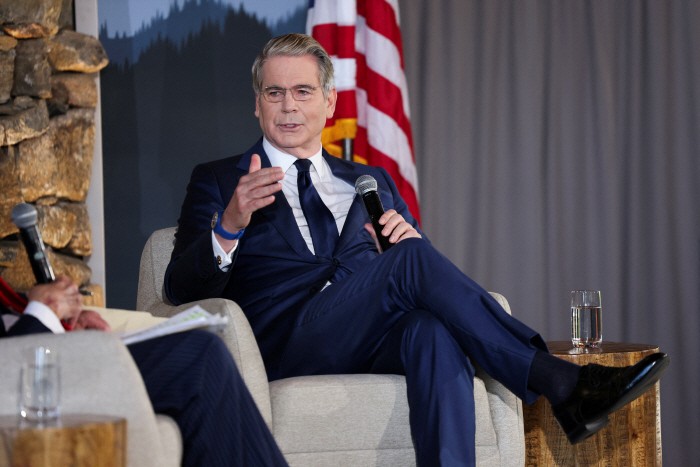 |
| U.S. Treasury Secretary Scott Bessent speaks at the G20 Finance Ministers and Central Bank Governors Meeting held in Asheville, North Carolina, on the 1st (local time). / Reuters, Yonhap |
The adoption of a joint statement fell through at the Group of 20 (G20) Finance Ministers Meeting held in Asheville, North Carolina, on the 1st (local time). This was because China was the sole country to oppose language calling for the dismantling of "non-market policies," thereby blocking a consensus. In response, U.S. Treasury Secretary Scott Bessent publicly criticized China, Bloomberg reported that day.
Normally, the G20 can only issue a joint statement if all member nations reach a consensus. However, the agreement collapsed after China objected to phrasing addressing trade surplus issues, and no joint statement was released.
Instead, a chair's statement released by the U.S. Department of the Treasury was issued. The chair's statement noted that "countries with excessive and persistent external surpluses should remove distortions that lead to excessive reliance on exports and avoid unnecessary export restrictions." It also included that nations agreed to take steps to eliminate non-market policies and practices that exacerbate imbalances. Nineteen of the 20 G20 members supported the statement, with China as the sole exception.
Secretary Bessent held a press conference that day and openly criticized Beijing, stating, "China is the country with the world's largest and most unsustainable current account surplus," and adding that "China blocked the adoption of the joint statement due to disputes surrounding its massive trade surplus."
China recorded an all-time high trade surplus of 1.2 trillion dollars in 2025, an increase of 20 percent from the previous year. In contrast, the U.S. recorded a trade deficit of approximately 200 billion dollars in its trade with China.
Addressing this, Bessent took issue with China's trade structure as an "unsustainable current account surplus," remarking that "it is unsustainable for a non-market-based economy to pour out an endless stream of cheap exports."
The "non-market policies" opposed by China refer to policies where prices, production, and investments are distorted by government intervention and subsidies rather than market principles. Typical examples include state subsidies and preferential support for state-owned enterprises.
The U.S. and the European Union (EU) have long criticized such Chinese policies for driving overcapacity and leading to massive exports of cheap goods that distort global markets.
Meanwhile, Bessent noted that he briefly exchanged views on artificial intelligence (AI) with the Chinese delegation at the G20 meeting, anticipating that AI will be a major agenda item when Chinese President Xi Jinping meets U.S. President Donald Trump in the U.S.
Park Jin-sook
Most Read
-
1
Celltrion nears additional contract with major U.S..

-
2
Putin proposes trilateral U.S.-China-Russia summit..

-
3
U.S. weighs dropping MOAB, world's most powerful n..

-
4
"Aren't those foreigners on welfare?": M..

-
5
Attention centers on APEC for possible Trump-Xi-Pu..

-
6
Saudi Arabia, Iran hold first diplomatic talks to..

-
7
Saudi airport in Riyadh struck again, leaving at l..

PEOPLE







-
Address : In-Young Bldg., 34, Uisadang-daero 1-gil, Yeongdeungpo-gu, Seoul
Copyright by ASIATODAY CO., LTD. All rights resereved