



Japan's opposition Centrist Reform Alliance effectively splits after just seven months
Sep 02, 2026, 10:12 am


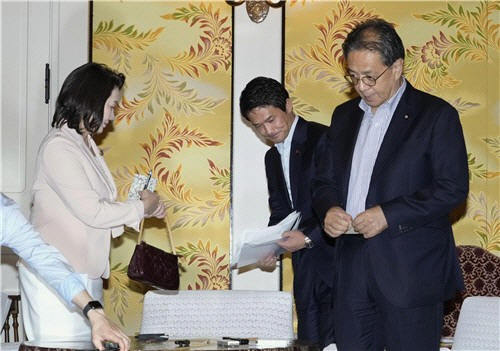 |
| Leaders of the three Japanese opposition parties whose merger fell through—Junya Ogawa, leader of the Centrist Reform Alliance (center); Shunichi Mizuoka, leader of the Constitutional Democratic Party of Japan (right); and Toshiko Takeya, leader of Komeito—held talks in parliament on the 31st and decided not to pursue the three-party merger they had been discussing. / Yonhap News |
The Centrist Reform Alliance, launched as an opposition "centrist counterweight" to confront the administration of Japanese Prime Minister Sanae Takaichi, has effectively entered the process of disbandment just seven months after its founding. As the choices of the voters who cast 10.43 million proportional representation votes for the alliance in the February House of Representatives election fracture once again, the realignment of Japan's opposition enters a new phase.
The Centrist Reform Alliance, the Constitutional Democratic Party of Japan (CDP), and Komeito held a summit of party leaders in parliament on the 31st of last month, officially confirming their decision to abandon a full merger of the three parties. Consequently, the Centrist Reform Alliance is even considering splitting the party into lawmakers formerly affiliated with the CDP and those formerly with Komeito. The new party, founded in January with the goal of rallying forces against the Takaichi administration, has found its very survival in jeopardy in a mere seven months.
The Centrist Reform Alliance was initially formed with members of the House of Representatives joining first. The blueprint envisioned leaving the House of Councillors and local chapters within the CDP and Komeito, respectively, and then integrating them in phases once the lower house election concluded.
However, in the February general election, the Centrist Reform Alliance suffered a crushing defeat, with its seats plummeting from 172 to 49. Although it secured 10.43 million votes in the proportional representation tier, this represented a drop of more than 7 million votes compared to the combined 17.52 million proportional votes won by the CDP and Komeito in the 2024 general election.
The election outcome drained momentum from the three-party merger. Opposition voices mounted within the CDP and its regional chapters, arguing that "there is no practical gain in merging." On the 28th of last month, CDP leader Shunichi Mizuoka communicated to the Centrist Reform Alliance and Komeito that the party would not pursue an organizational merger. During the talks on the 31st, he acknowledged the collapse of the integration effort, stating in effect that "everyone recognizes substantial differences among the three parties."
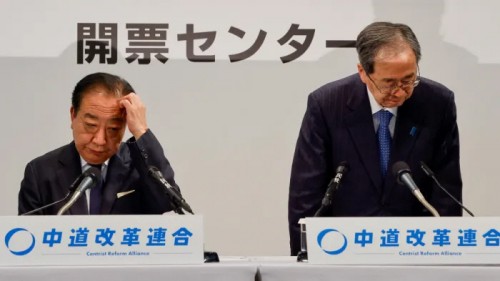 |
| Yoshihiko Noda (left) and Tetsuo Saito, co-leaders of Japan's Centrist Reform Alliance, sigh over their bitter defeat during a press conference in Tokyo following the release of exit polls projecting a crushing loss in the House of Representatives general election in February. / Reuters, Yonhap News |
On the other hand, Komeito pushed back strongly. Party leader Toshiko Takeya maintains that integrating the House of Councillors and regional chapters after the lower house election was a founding promise. As recently as June, Komeito argued that the three parties should consolidate into a single broad centrist force, emphasizing that the Centrist Reform Alliance won 10.43 million votes in the general election.
The fundamental problem was that sufficient policy integration had not taken place prior to forming the electoral alliance. Stances diverged on whether to consider the security legislation permitting limited collective self-defense constitutional, the relocation of U.S. Marine Corps Air Station Futenma to Henoko in Okinawa, a "zero nuclear power" policy, and constitutional revision. During the special Diet session, the Centrist Reform Alliance and Komeito favored an imperial succession reform plan that would grant imperial status to male descendants of former collateral branches through adoption, but the CDP voiced strong opposition.
The ruling bloc capitalized on the opposition's internal rift. Nippon Ishin no Kai leader Hirofumi Yoshimura criticized the parties, remarking that they banded together based on electoral calculations without policy or ideological alignment, only to split once the election ended. Voices within the Liberal Democratic Party (LDP) also argued that the Centrist Reform Alliance proved itself to be nothing more than a mutual-aid machine for the election.
The issue lies less with the Centrist Reform Alliance itself and more with the 10.43 million votes left in its wake. Despite the crushing defeat, the alliance secured nearly half as many proportional representation votes as the LDP in the last general election. Reviewing its election performance, the party itself acknowledged that it "must answer the trust placed in us by 12.2 million single-member district votes and 10.43 million proportional representation votes".
This indicates that the future landscape of Japan's opposition could shift depending on where these voters—who sought an alternative distinct from traditional progressive opposition parties while keeping their distance from the conservative tone of the Takaichi administration—migrate next. With the virtual fracture of the Centrist Reform Alliance, prospects for a unified opposition counterweight to challenge the Takaichi administration are likely to weaken further for the time being.
Choi Young-jae
Most Read
-
1
Celltrion nears additional contract with major U.S..

-
2
Putin proposes trilateral U.S.-China-Russia summit..

-
3
U.S. weighs dropping MOAB, world's most powerful n..

-
4
"Aren't those foreigners on welfare?": M..

-
5
Attention centers on APEC for possible Trump-Xi-Pu..

-
6
Saudi Arabia, Iran hold first diplomatic talks to..

-
7
Saudi airport in Riyadh struck again, leaving at l..

PEOPLE







-
Address : In-Young Bldg., 34, Uisadang-daero 1-gil, Yeongdeungpo-gu, Seoul
Copyright by ASIATODAY CO., LTD. All rights resereved