



Kazakhstan reinstates vice presidency after 30 years
Sep 02, 2026, 10:07 am


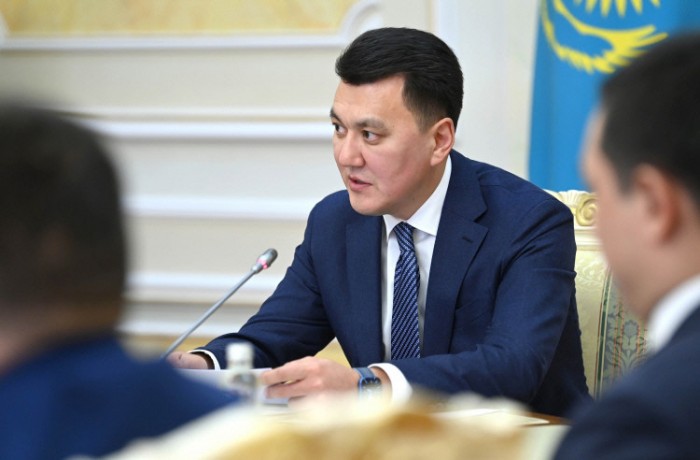 |
| Erlan Karin, the newly appointed Vice President of Kazakhstan, speaks during a cabinet meeting in June while serving as First Deputy Head of the Presidential Administration. / Courtesy of the Presidential Administration of Kazakhstan |
Erlan Karin, 50, regarded as a key aide to President Kassym-Jomart Tokayev, has been appointed to the vice presidency reinstated in Kazakhstan after 30 years.
President Tokayev nominated Karin as the candidate for vice president during a session of the Kurultai on the 31st, and the appointment was confirmed with 141 lawmakers voting in favor, Kazakh media outlet Kazinform reported.
Following elections held on the 23rd of the same month for the Kurultai—the first unicameral parliament inaugurated under the new constitution—the appointment of the vice president signals a full-scale reorganization of Kazakhstan's political and administrative framework in alignment with the new constitutional order.
Born in 1976, the new vice president majored in history and geography teacher education at Aktobe State University in northern Kazakhstan and built his career across political and social arenas as a university lecturer, journalist, and political commentator.
He has played a central role in the presidential administration since President Tokayev took office in 2019. Serving in posts such as adviser to the president and first deputy head of the presidential administration, he coordinated and articulated the Tokayev administration's principal political reforms and state governance.
In June of this year, he transferred to the post of first deputy head of the presidential administration before assuming office as the inaugural vice president under the new constitutional system roughly two months later.
The reinstatement of the vice presidency carries significance beyond merely establishing a senior post. With the adoption of a new constitution via referendum in March of this year, which took effect on July 1, Kazakhstan overhauled its overall system of state governance, replacing the previous bicameral parliament with the unicameral Kurultai.
The vice presidency is likewise a core element of this political restructuring. The post was first established in Kazakhstan in the early 1990s shortly after independence. It was subsequently abolished during constitutional reorganizations and remained defunct for roughly 30 years.
Appointed by the president with the consent of the Kurultai under the new constitution, the vice president represents the president in relations with the Kurultai, the government, and other state agencies, while performing specific duties delegated by the head of state.
Of particular note is that the constitution designates the vice president as first in the presidential line of succession in the event of a vacancy.
If the president resigns, becomes incapacitated due to health reasons, or passes away, presidential powers transfer to the vice president. Should the vice president also be unable to perform these duties, the powers pass to the chairman of the Kurultai, followed by the prime minister.
Rather than acting as an independently elected official with autonomous political authority, the primary role of the vice president is to assist the president in state administration and oversee inter-agency coordination.
Local media anticipated that Vice President Karin, who commands deep trust from President Tokayev thanks to his extensive administrative experience and coordination capacity across state organs, will play a vital role in the newly restructured state governance system.
Kim Min-gyu
Most Read
-
1
Celltrion nears additional contract with major U.S..

-
2
Putin proposes trilateral U.S.-China-Russia summit..

-
3
U.S. weighs dropping MOAB, world's most powerful n..

-
4
"Aren't those foreigners on welfare?": M..

-
5
Attention centers on APEC for possible Trump-Xi-Pu..

-
6
Saudi Arabia, Iran hold first diplomatic talks to..

-
7
China tightens grip on boosting domestic demand an..

PEOPLE






-
Address : In-Young Bldg., 34, Uisadang-daero 1-gil, Yeongdeungpo-gu, Seoul
Copyright by ASIATODAY CO., LTD. All rights resereved